线性代数的本质 · 精研复习站

第 01 集:向量究竟是什么?

Vectors, what even are they?
一句话直觉:向量既可以视为空间中锚定于原点的箭头,也可以视为有序的数字列表;线性代数的真正威力,就源于借助坐标在这两种视角之间自由往返翻译。

本集作为 Stage 1 几何根基的首讲,从物理、计算机与数学家三种截然不同却彼此相通的视角切入,确立了线性代数最底层的构建积木——向量。随后通过坐标系将“空间中的箭头”与“列向量数字列表”精确绑定,并详细剖析了贯穿全书的两大基本运算——首尾相连的向量加法与伸缩反向的标量乘法,为下一集理解线性组合、张成空间与基铺平道路。

▶ YouTube 原片 📺 B站官方双语 P2 🎙 B站中文配音 P2

前置依赖

← 第 00 集 · 序言:线性代数的本质:建立以几何直觉为核心、将繁琐计算交付数值表示的线性代数全局观。

后续延伸

→ 第 02 集 · 线性组合、张成的空间与基:掌握了向量加法与标量乘法这两大基本运算后,下一步自然要追问:仅用这两种运算反复组合几个向量,究竟能铺满怎样的几何空间?
二维与三维列向量坐标表示
$$\vec{v} = \begin{bmatrix} x \\ y \end{bmatrix}, \qquad \vec{w} = \begin{bmatrix} x \\ y \\ z \end{bmatrix}$$
向量加法(对应分量逐项相加)
$$\begin{bmatrix} x_1 \\ y_1 \end{bmatrix} + \begin{bmatrix} x_2 \\ y_2 \end{bmatrix} = \begin{bmatrix} x_1 + x_2 \\ y_1 + y_2 \end{bmatrix}$$
向量加法具体算例(四步位移重组)
$$\begin{bmatrix} 1 \\ 2 \end{bmatrix} + \begin{bmatrix} 3 \\ -1 \end{bmatrix} = \begin{bmatrix} 1 + 3 \\ 2 + (-1) \end{bmatrix} = \begin{bmatrix} 4 \\ 1 \end{bmatrix}$$
标量乘法(对每个分量等比例缩放)
$$c \begin{bmatrix} x \\ y \end{bmatrix} = \begin{bmatrix} cx \\ cy \end{bmatrix}$$

三种视角下的“向量”:物理、计算机与数学家

⏱ 00:11 – 01:57

线性代数最根本、最底层的构建积木就是向量(vector)。在真正展开运算前,必须先统一对“向量究竟是什么”的认知。广义来看,存在着三种看似不同却紧密相连的向量视角:物理专业视角、计算机专业视角以及数学家视角。

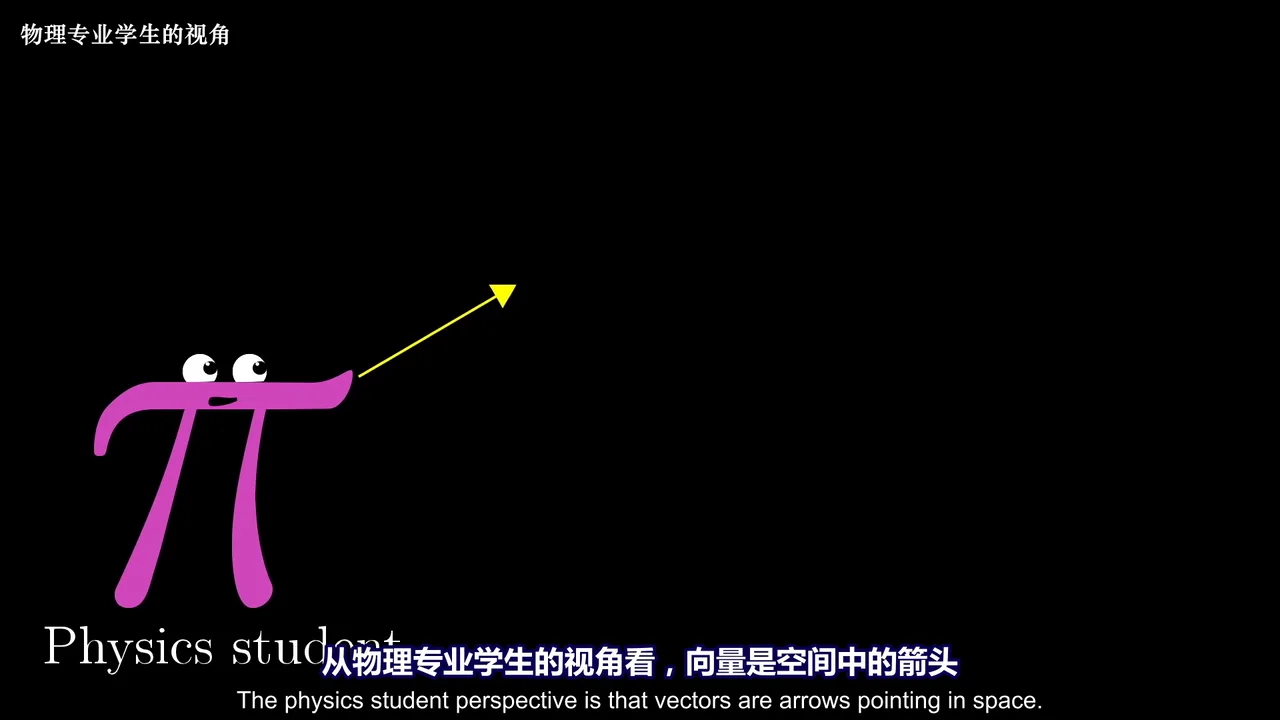
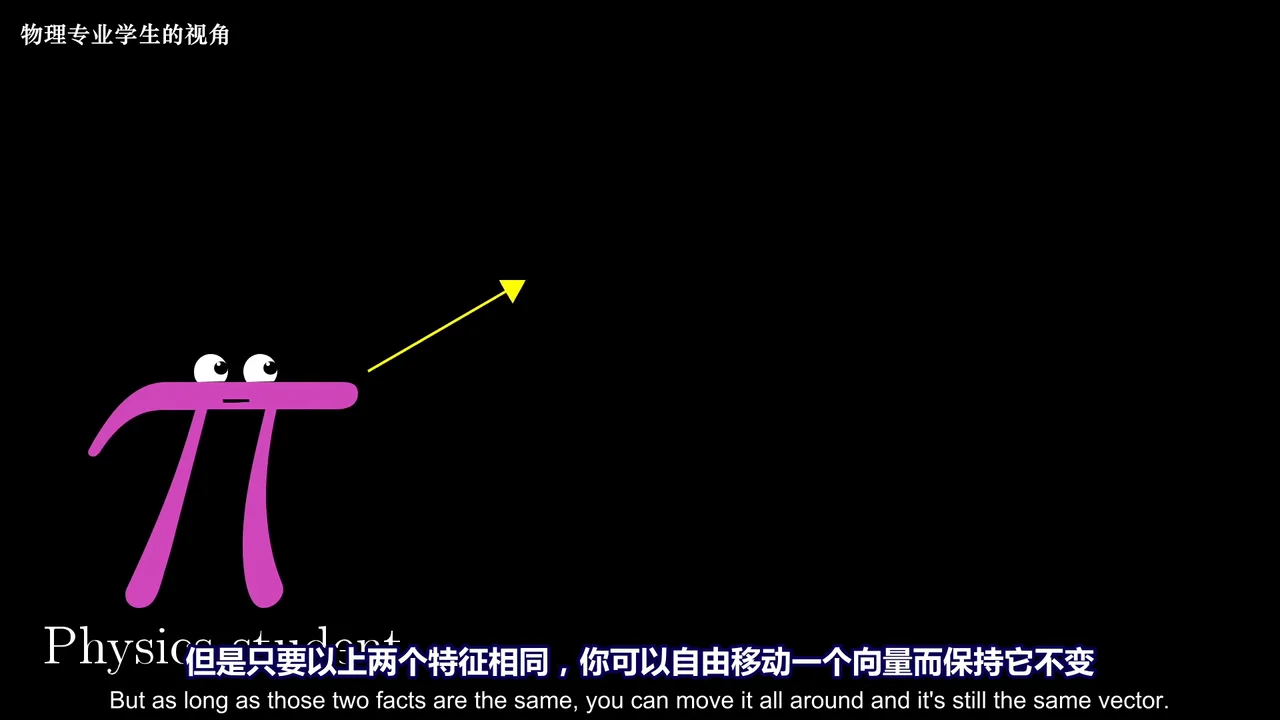
从物理系学生的视角看,向量是空间中指向特定方向的箭头。唯一决定一个给定向量的是它的长度和方向——只要这两个特征保持不变,你可以把它在空间中任意平移,它依然是同一个向量。落在平坦平面里的箭头是二维向量,而处于我们所生活的三维空间中的箭头则是三维向量。

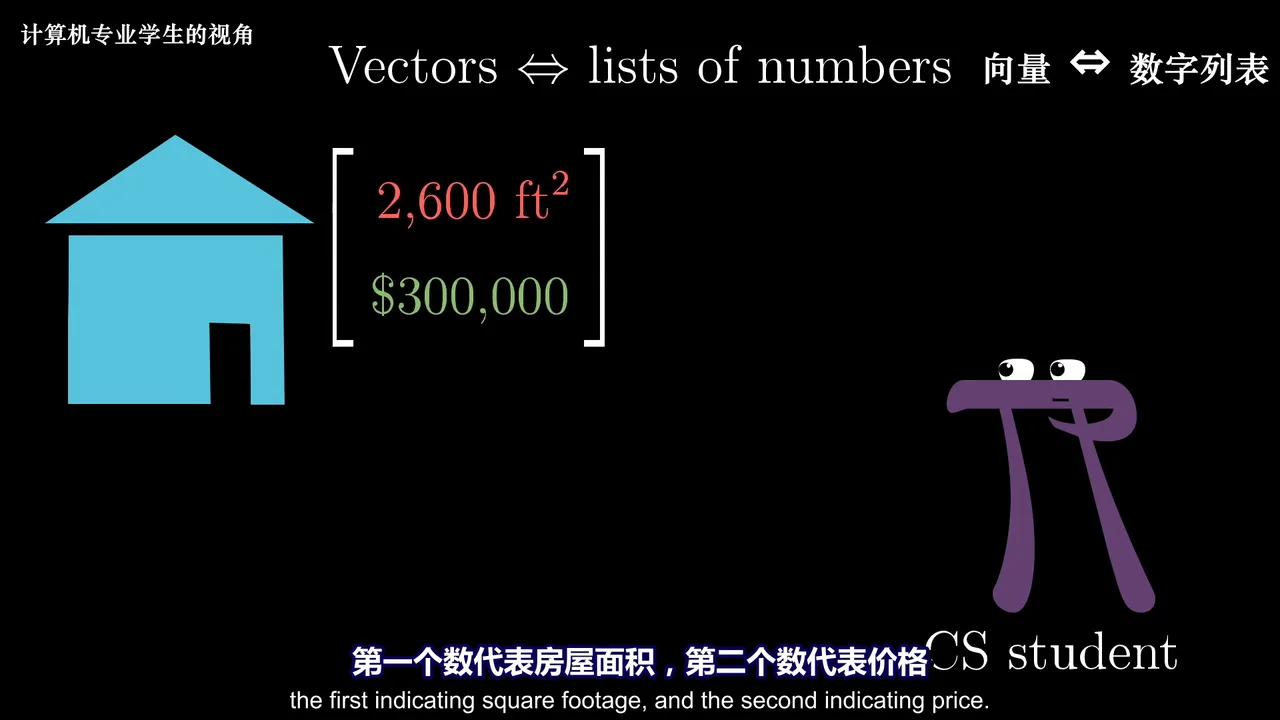
从计算机专业学生的视角看,向量本质上是“有序的数字列表”。例如在分析房价数据时,如果你只关心房屋面积(平方英尺)和价格两个特征,就可以用一对数字为每套房屋建模(如视频展示的 2,600 平方英尺与 300,000 美元),第一个数表示面积、第二个数表示价格。注意这里的顺序不可颠倒:把面积和价格写反,数据含义就彻底错乱。在这个语境下,“向量”几乎就是“列表(list)”的雅称,列表长度为 $2$ 就称作二维向量。

而数学家的视角则试图同时概括上述两种观点:只要某个集合里的对象能够合乎情理地定义“两向量相加”和“向量乘以一个数字”这两种运算,任何事物都可以被称为向量。这一高度抽象的公理体系在入门阶段大可先暂搁至系列终章再去深究,但它在此处点破了一个至关重要的伏笔:向量加法与数乘运算将在整个线性代数中扮演核心支柱角色。

  • 物理视角(几何箭头):关注“长度 + 方向”,允许在空间中自由平移而不改变向量本身。
  • 计算机视角(有序列表):关注“数据长度 + 位置语义”,维度等于列表元素的个数。
  • 数学家视角(抽象结构):抽离具体形态,只要求存在合理的加法与数乘运算。
物理视角:粉色 $\pi$ 生物手举一根黄色箭头,代表由长度与方向唯一定义的空间向量。 00:33
物理视角:粉色 $\pi$ 生物手举一根黄色箭头,代表由长度与方向唯一定义的空间向量。画面重点:物理视角:空间中的有向箭头
只要长度和指向保持不变,把箭头在屏幕中自由平移到另一处,它依然代表同一个物理向量。 00:41
只要长度和指向保持不变,把箭头在屏幕中自由平移到另一处,它依然代表同一个物理向量。画面重点:平移不变性:只取决于模长与方向
计算机视角:一座房子被抽象为包含“面积(2,600 ft²)”与“价格(300,000 美元)”的二维有序数字列表。 01:06
计算机视角:一座房子被抽象为包含“面积(2,600 ft²)”与“价格(300,000 美元)”的二维有序数字列表。画面重点:CS 视角:向量即有序特征列表
[00:11] ↗
线性代数中最基础、最根源的组成部分就是向量
The fundamental, root-of-it-all building block for linear algebra is the vector.
[00:16] ↗
所以我得确信我们在“向量究竟是什么”这一问题上达成共识
So it's worth making sure that we're all on the same page about what exactly a vector is.
[00:20] ↗
一般来说,有三种看待向量的观点,看似不同却有所关联 我分别将它们称为物理专业学生的视角 计算机专业学生的视角 以及数学家的视角
You see, broadly speaking, there are three distinct but related ideas about vectors, which I'll call the physics student perspective, the computer science student perspective, and the mathematician's perspective.
[00:31] ↗
从物理专业学生的视角看,向量是空间中的箭头
The physics student perspective is that vectors are arrows pointing in space.
[00:35] ↗
决定一个向量的是它的长度和它所指的方向 但是只要以上两个特征相同,你可以自由移动一个向量而保持它不变
What defines a given vector is its length and the direction it's pointing, but as long as those two facts are the same, you can move it all around, and it's still the same vector.
[00:44] ↗
处在平面中的向量是二维的 而处在我们所生活的空间中的向量是三维的
Vectors that live in the flat plane are two-dimensional, and those sitting in broader space that you and I live in are three-dimensional.
[00:52] ↗
从计算机专业学生的视角看,向量是有序的数字列表
The computer science perspective is that vectors are ordered lists of numbers.
[00:56] ↗
比如说你正在做一些有关房价的分析 而你只关心两个特征:房屋面积和价格
For example, let's say you were doing some analytics about house prices, and the only features you cared about were square footage and price.
[01:03] ↗
你可能会用一对数字对每个房屋进行建模 第一个数代表房屋面积,第二个数代表价格
You might model each house with a pair of numbers, the first indicating square footage and the second indicating price.
[01:09] ↗
注意,这里的数字顺序不可颠倒
Notice the order matters here.
[01:12] ↗
用行话来讲,你会用二维向量对房屋进行建模 在这里,“向量”只不过“列表”的一个花哨的说法 之所以这个向量是二维的,是因为这个列表的长度是2
In the lingo, you'd be modeling houses as two-dimensional vectors, where in this context, vector is pretty much just a fancy word for list, and what makes it two-dimensional is the fact that the length of that list is two.
[01:26] ↗
另一方面,数学家试图概括这两种观点,大致意思是:只要存在合理的“两向量相加”和“向量乘以一个数字”的概念,向量就可以是任何东西;我会在本视频后半段讲解这两种运算。
The mathematician, on the other hand, seeks to generalize both these views, basically saying that a vector can be anything where there's a sensible notion of adding two vectors and multiplying a vector by a number, operations that I'll talk about later on in this video.
[01:40] ↗
这种视角的细节相当抽象,事实上我认为在系列最后一个视频之前暂且忽略它反而是明智的,在此期间我们先立足于更具体的场景。
The details of this view are rather abstract, and I actually think it's healthy to ignore it until the last video of this series, favoring a more concrete setting in the interim.
[01:48] ↗
但是我在这里提到了这个观点,是因为它暗示了一个事实 即向量加法和向量数乘贯穿线性代数始终,二者起着很重要的作用
But the reason I bring it up here is that it hints at the fact that the ideas of vector addition and multiplication by numbers will play an important role throughout linear algebra.

锚定原点:坐标系与列向量坐标的精确读法

⏱ 01:58 – 04:36

在展开加法和数乘之前,我们先约定全系列的几何心智模型:每当引入一个新概念,请先把它想成落在坐标系中、且尾端(起点)固定在原点的箭头。这与物理中允许自由移动的向量略有不同——在线性代数里,向量几乎总是以原点为根。先在箭头语境下理解概念,再借助“向量坐标”翻译成有序数字列表,正是这套坐标系将线性代数的两大视角紧密连接起来。

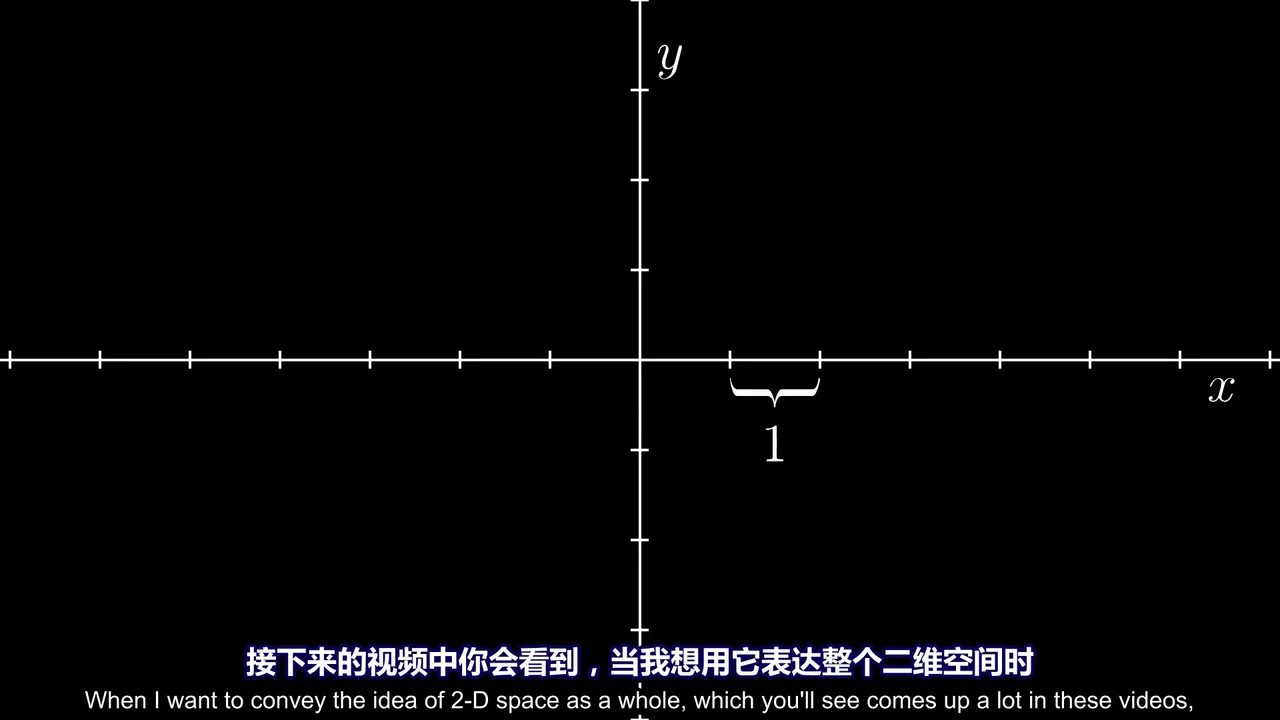
聚焦到二维平面:我们有一条水平的 $x$ 轴 和一条竖直的 $y$ 轴,它们的交点称为原点——请把它视为整个空间的中心与所有向量的起点。选定一段任意长度作为单位 $1$ 后,就可以在坐标轴上标出刻度;后续视频中为了表现整个二维空间整体,我们常会把刻度延展为网格线(此刻为了画面简洁暂不画出)。

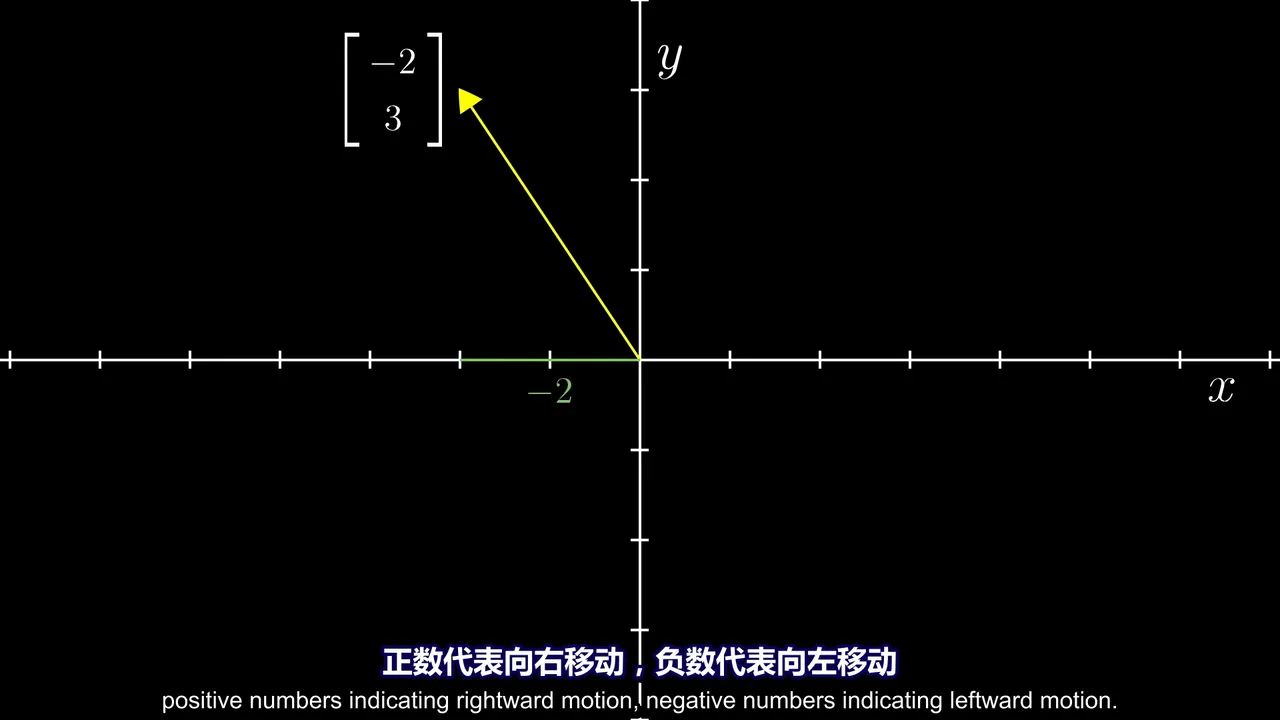
一个向量的坐标就是一对数字,相当于一套“从原点(向量尾端)走到箭头尖端”的行走指令:第一个数字指示沿 $x$ 轴走多远(正数向右、负数向左),第二个数字指示接着平行于 $y$ 轴走多远(正数向上、负数向下)。为了在符号上把“向量”与“平面上的点”明确区分开,惯例是将这对数字竖排书写并用方括号括起来。于是,每一对数字唯一对应一个向量,每一个向量也恰好对应唯一一对数字。

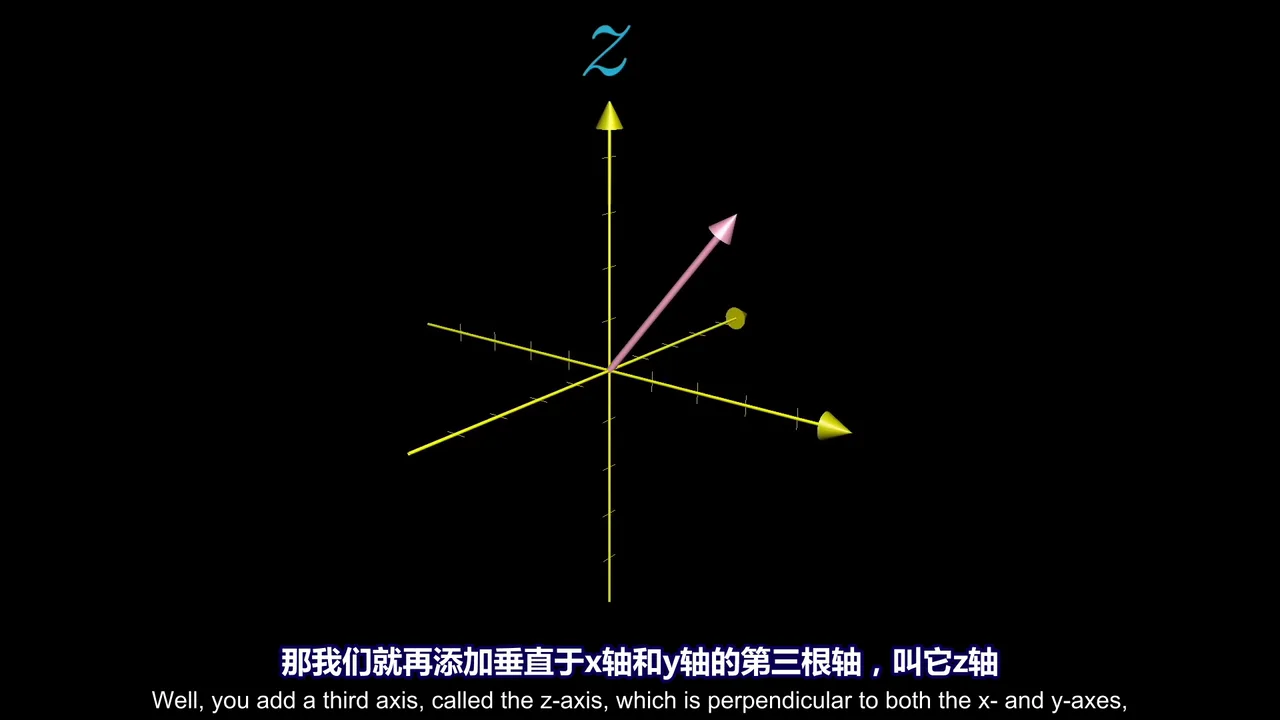
推广到三维空间也非常自然:只需再添加一条同时垂直于 $x$ 轴和 $y$ 轴的第三根坐标轴——$z$ 轴。此时每个三维向量对应一个有序三元数组:第一个数说明沿 $x$ 轴走多远,第二个数说明接着平行 $y$ 轴走多远,第三个数说明最后平行 $z$ 轴走多远。三维空间中的向量与三元数字数组之间同样构成严格的一一对应。
📐 二维与三维列向量(Column Vector)的标准记号
$$\vec{v} = \begin{bmatrix} -2 \\ 3 \end{bmatrix}, \qquad \vec{w} = \begin{bmatrix} x \\ y \\ z \end{bmatrix}$$
视频图例 $\vec{v} = [-2, 3]^T$ 对应指令:从原点向左走 2 格,再向上走 3 格。
⚠️ 易错提醒:竖排方括号 vs 圆括号,以及“根植原点”
日常坐标常写成横排圆括号 $(x, y)$ 来表示空间中的“点”,而线性代数中为了突出向量身份,统一写成竖排方括号 $\begin{bmatrix} x \\ y \end{bmatrix}$。此外,在本系列讨论矩阵变换与线性空间时,请务必默念“向量的尾巴锁定在原点”,不要随意在平面上乱挪起点。
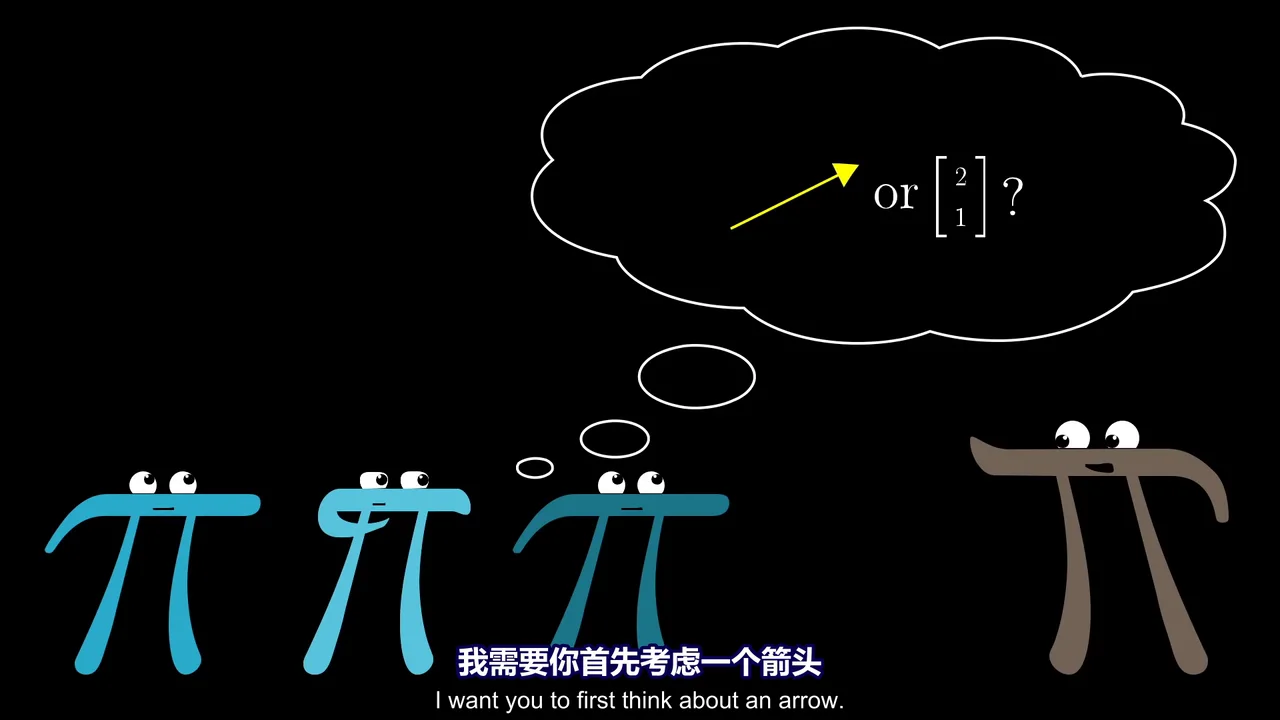
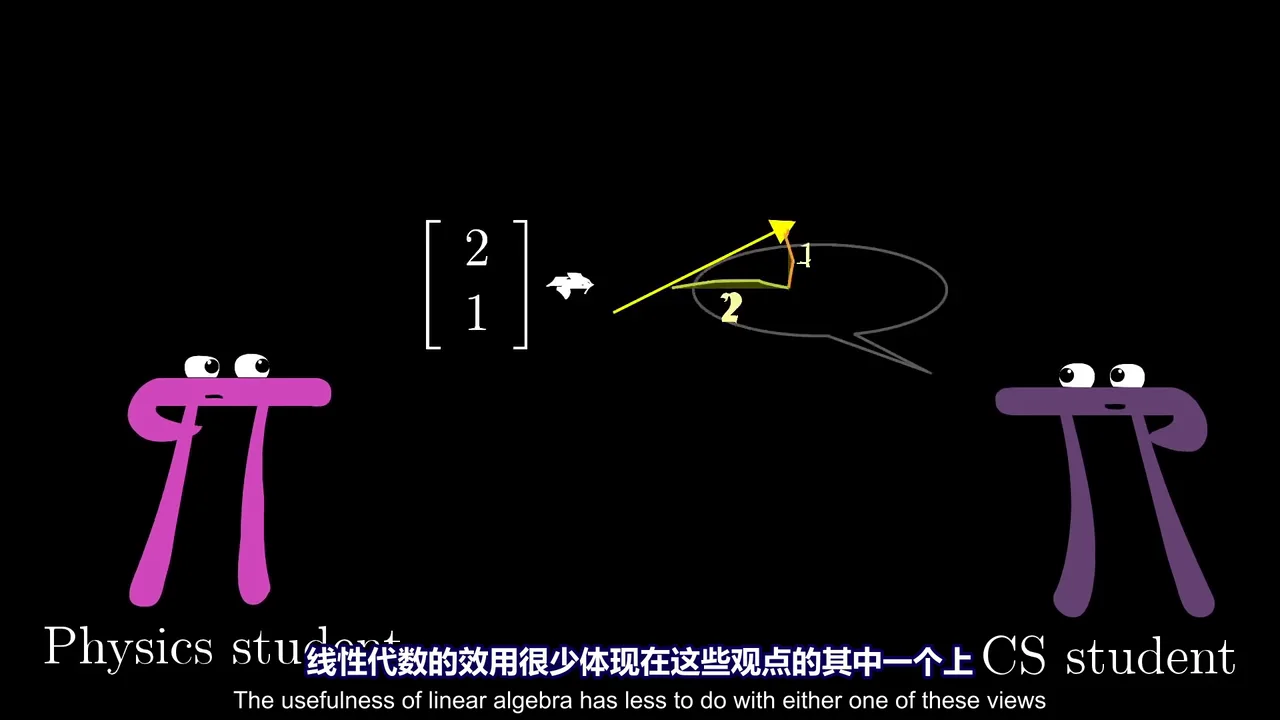
三个 $\pi$ 生物仰望思考气泡:“向量究竟是空间中的箭头,还是竖排的列表 $\begin{bmatrix} 2 \\ 1 \end{bmatrix}$?”——引入几何为主的心智契约。 02:10
三个 $\pi$ 生物仰望思考气泡:“向量究竟是空间中的箭头,还是竖排的列表 $\begin{bmatrix} 2 \\ 1 \end{bmatrix}$?”——引入几何为主的心智契约。画面重点:双视角融合:以原点箭头为第一直觉
二维直角坐标系建构:正交的 $x$ 轴与 $y$ 轴交于原点,并标定出代表距离 $1$ 的单位刻度。 03:14
二维直角坐标系建构:正交的 $x$ 轴与 $y$ 轴交于原点,并标定出代表距离 $1$ 的单位刻度。画面重点:坐标基石:轴线、原点与单位刻度
向量 $\begin{bmatrix} -2 \\ 3 \end{bmatrix}$ 的行进演示:先沿 $x$ 轴向左移动 $2$ 单位,再平行 $y$ 轴向上移动 $3$ 单位到达尖端。 03:35
向量 $\begin{bmatrix} -2 \\ 3 \end{bmatrix}$ 的行进演示:先沿 $x$ 轴向左移动 $2$ 单位,再平行 $y$ 轴向上移动 $3$ 单位到达尖端。画面重点:坐标指令:先水平行走,再竖直行走
三维空间引入正交于 $x$、$y$ 轴的蓝色 $z$ 轴,展示三维空间向量与有序三元组的一一对应。 04:12
三维空间引入正交于 $x$、$y$ 轴的蓝色 $z$ 轴,展示三维空间向量与有序三元组的一一对应。画面重点:三维拓展:三轴正交与三元组定位
[01:58] ↗
在我谈论这两个运算之前 我们先来确定一种思考“向量”的特定方式
But before I talk about those operations, let's just settle in on a specific thought to have in mind when I say the word vector.
[02:05] ↗
因为我现在关注的是它的几何方面 所以每当我引入一个关于向量的新主题时 我需要你首先考虑一个箭头 更具体地说,考虑这个箭头落在某个坐标系中,比如x-y平面 并且箭头起点位于原点
Given the geometric focus that I'm shooting for here, whenever I introduce a new topic involving vectors, I want you to first think about an arrow, and specifically, think about that arrow inside a coordinate system, like the xy-plane, with its tail sitting at the origin.
[02:20] ↗
这与物理专业学生的看法略有不同 因为在他们眼中,向量可以在空间中自由落脚
This is a little bit different from the physics student perspective, where vectors can freely sit anywhere they want in space.
[02:25] ↗
但是在线性代数中,向量经常以原点作为起点
In linear algebra, it's almost always the case that your vector will be rooted at the origin.
[02:31] ↗
一旦你理解了“向量是空间中的箭头”这种观点 我们就来看看“向量是有序的数字列表”这种观点 我们可以通过向量坐标来理解它
Then, once you understand a new concept in the context of arrows in space, we'll translate it over to the list of numbers point of view, which we can do by considering the coordinates of the vector.
[02:41] ↗
虽然我相信你们中的许多人早已熟悉坐标系,但仍有必要明确梳理一遍——因为线性代数两大视角之间所有重要的往复转换,正是在这里发生的。
Now, while I'm sure that many of you are already familiar with this coordinate system, it's worth walking through explicitly, since this is where all of the important back and forth happens between the two perspectives of linear algebra.
[02:53] ↗
现在我们先把眼光局限在二维空间中 画一条水平的线,我们叫它x轴 再画一条竖直的线,叫它y轴
Focusing our attention on two dimensions for the moment, you have a horizontal line, called the x-axis, and a vertical line, called the y-axis.
[03:00] ↗
两个轴的交点我们称之为原点 你应该把它看作整个空间的中心和所有向量的根源
The place where they intersect is called the origin, which you should think of as the center of space and the root of all vectors.
[03:06] ↗
选取一个任意的长度代表1,你就可以在坐标轴上标记刻度线来代表这一距离
After choosing an arbitrary length to represent one, you make tick marks on each axis to represent this distance.
[03:12] ↗
如你在后续视频中所见,当我想表达二维空间整体这一概念时,会把这些刻度线延伸成网格线;不过现在画网格反而有些碍事,所以先略去。
When I want to convey the idea of 2D space as a whole, which you'll see comes up a lot in these videos, I'll extend these tick marks to make grid lines, but right now, they'll actually get a little bit in the way.
[03:22] ↗
一个向量的坐标由一对数构成 这对数指导你如何从原点(向量起点)出发到达它的尖端(向量终点)
The coordinates of a vector is a pair of numbers that basically gives instructions for how to get from the tail of that vector at the origin to its tip.
[03:31] ↗
第一个数告诉你沿着x轴走多远 正数代表向右移动,负数代表向左移动 第二个数告诉你在此之后沿着平行y轴的方向走多远 正数代表向上移动,负数代表向下移动
The first number tells you how far to walk along the x-axis, positive numbers indicating rightward motion, negative numbers indicating leftward motion, and the second number tells you how far to walk parallel to the y-axis after that, positive numbers indicating upward motion, and negative numbers indicating downward motion.
[03:48] ↗
为了把向量和点区别开 惯用的方法是把这对数竖着写,然后用方括号括起来
To distinguish vectors from points, the convention is to write this pair of numbers vertically with square brackets around them.
[03:56] ↗
每一对数给出唯一一个向量 而每一个向量恰好对应唯一一对数
Every pair of numbers gives you one and only one vector, and every vector is associated with one and only one pair of numbers.
[04:05] ↗
三维空间的向量又如何呢?
What about in three dimensions?
[04:06] ↗
那我们就再添加垂直于x轴和y轴的第三根轴,叫它z轴 这种情况下,每个向量就与一个有序三元数组对应
Well, you add a third axis, called the z-axis, which is perpendicular to both the x and y-axes, and in this case, each vector is associated with ordered triplet of numbers.
[04:17] ↗
第一个数告诉你沿着x轴走多远 第二个数告诉你沿着平行y轴的方向走多远 第三个数告诉你沿着平行z轴的方向走多远
The first tells you how far to move along the x-axis, the second tells you how far to move parallel to the y-axis, and the third one tells you how far to then move parallel to this new z-axis.
[04:28] ↗
每一个三元数组给出唯一一个向量 而每一个向量恰好对应唯一一个三元数组
Every triplet of numbers gives you one unique vector in space, and every vector in space gives you exactly one triplet of numbers.

向量加法:首尾相连与分步位移直觉

⏱ 04:37 – 06:53

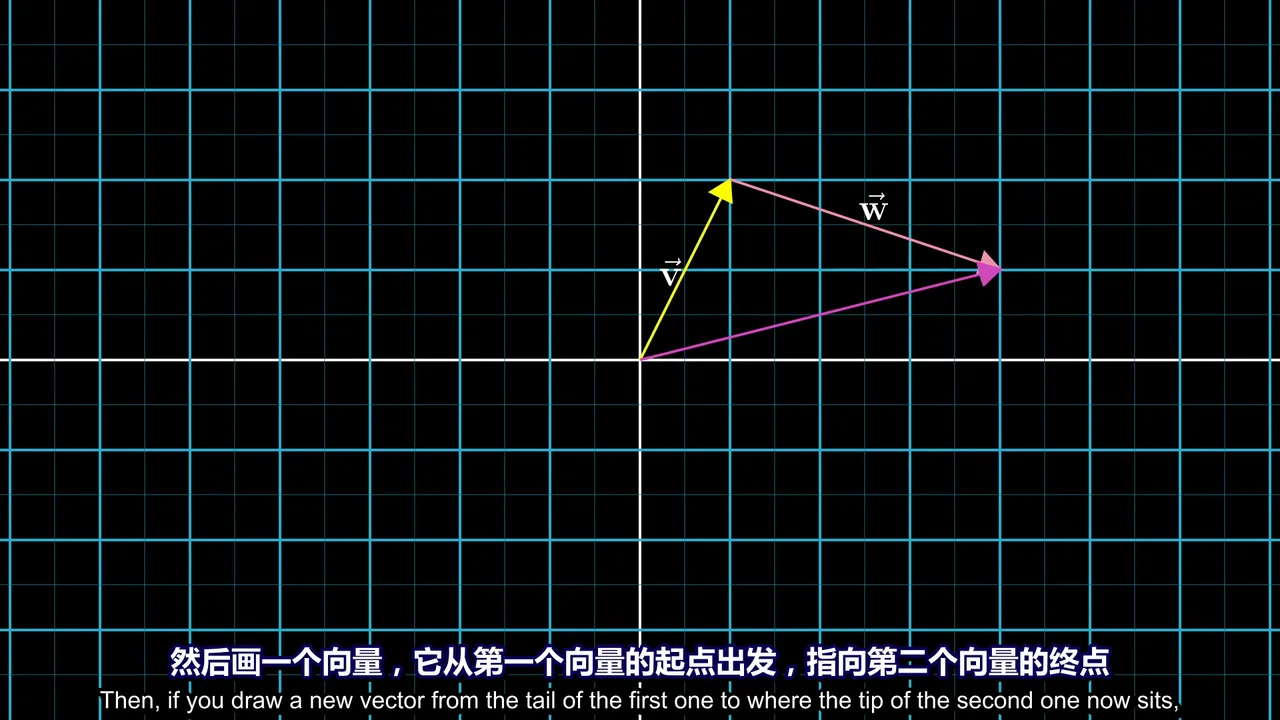
现在正式进入围绕线性代数全貌的两大基础运算之一:向量加法。假设我们有两个向量,一个指向右上方,另一个指向右下方。在几何上将它们相加的方法是:平移第二个向量,使它的起点(tail)刚好接在第一个向量的终点(tip)上;接着从第一个向量的起点出发,画一条指向第二个向量新终点的新向量,这个新箭头就是两者的和向量。顺带一提,这几乎是整个线性代数中唯一一次允许我们让向量暂时离开原点的情形。

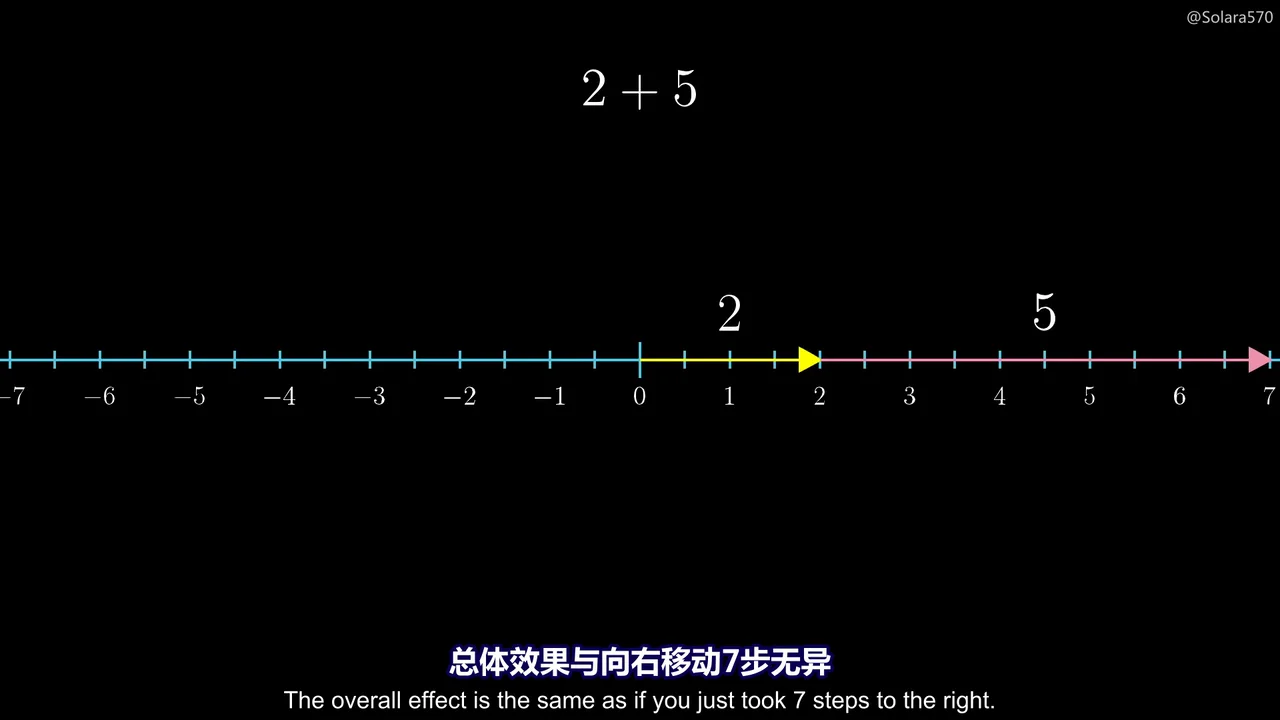
为什么偏偏这样定义加法,而不是别的规则?最直观的理解是把每个向量看作空间中的一次特定运动(位移)——朝指定方向迈出指定距离的一步。如果你先沿着第一个向量迈出一步,紧接着按照第二个向量描述的方向和距离再迈一步,最终抵达的位置与从一开始就直接沿着和向量走过去完全一样!这其实也是小学数轴加法的自然二维推广:计算 $2 + 5$ 时,先向右走 $2$ 步再向右走 $5$ 步,总效果就等同于一步向右走 $7$ 步。

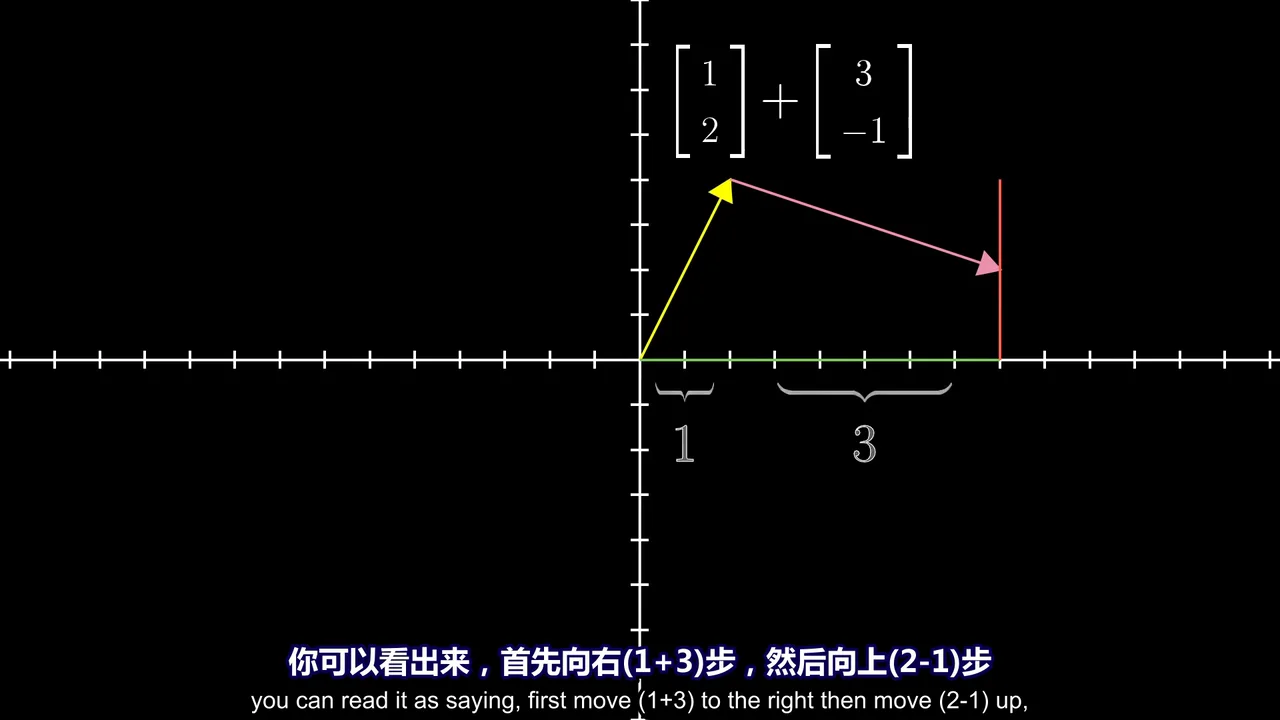
来看这一几何定义如何完美翻译为数字列表运算。设视频中的两个向量坐标分别为 $\begin{bmatrix} 1 \\ 2 \end{bmatrix}$ 与 $\begin{bmatrix} 3 \\ -1 \end{bmatrix}$。用“首尾相连(tip-to-tail)”法相加时,可以把它看成一条从原点出发、经历四步到达和向量终点的折线路径:先向右 $1$ 步,向上 $2$ 步;再向右 $3$ 步,向下 $1$ 步。现在我们重新编排这四步的顺序,先把所有水平运动合并,再把所有竖直运动合并——总共向右移动 $1 + 3$ 步,总共向上移动 $2 - 1$ 步。因此新向量的坐标恰好就是 $\begin{bmatrix} 1 + 3 \\ 2 + (-1) \end{bmatrix} = \begin{bmatrix} 4 \\ 1 \end{bmatrix}$。推而广之,在数字列表视角下,向量加法就是将对应位置的各分量逐项相加。
📐 向量加法的位移拆解与分量相加
$$\begin{bmatrix} 1 \\ 2 \end{bmatrix} + \begin{bmatrix} 3 \\ -1 \end{bmatrix} = \begin{bmatrix} 1 + 3 \\ 2 + (-1) \end{bmatrix} = \begin{bmatrix} 4 \\ 1 \end{bmatrix}$$
先做横向合并 $(1+3)$,再做纵向合并 $(2-1)$,几何路径重排恰好对应代数逐项求和。
💡 几何直觉:为什么向量加法天然满足交换律?
先走 $\vec{v}$ 再走 $\vec{w}$,或者先走 $\vec{w}$ 再走 $\vec{v}$,相当于同一个平行四边形从原点出发的相邻两边——无论沿哪两条邻边走,最终都会汇合在同一个对角线顶点 $\vec{v} + \vec{w}$ 处。
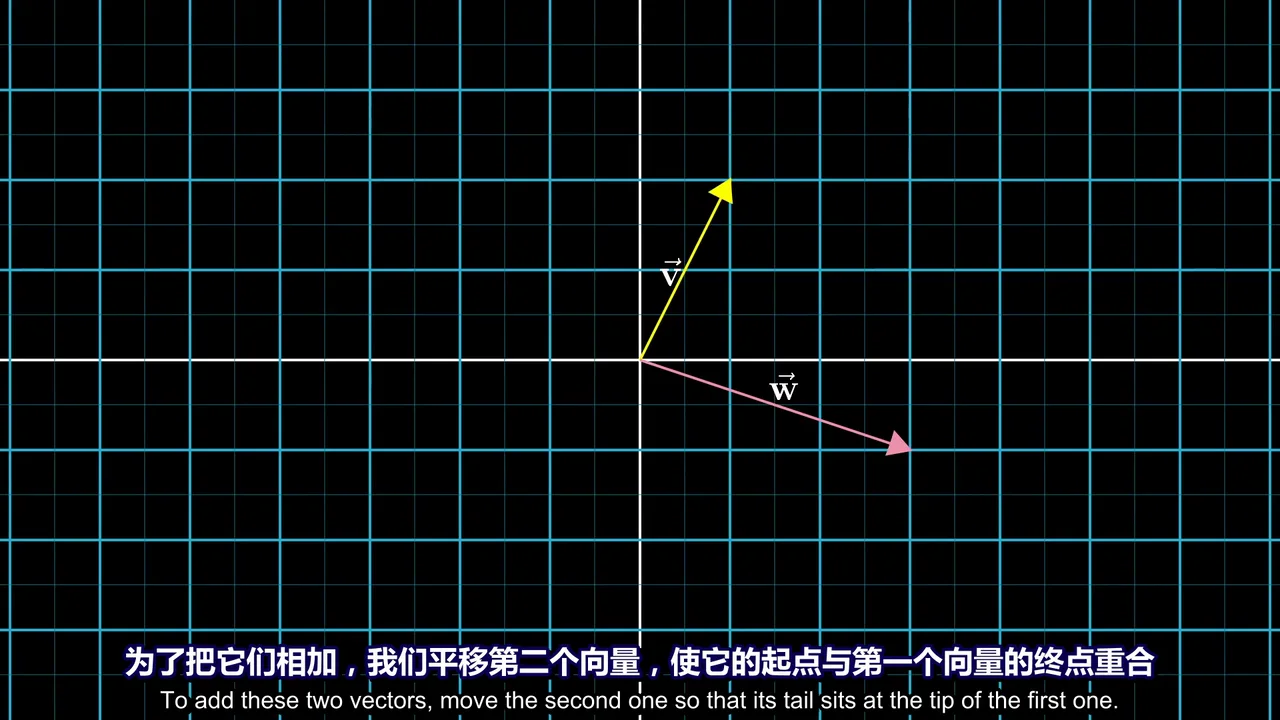
首尾相连(Tip-to-Tail)第一幕:把第二个向量 $\vec{w}$ 平移,使其尾端落到第一个向量 $\vec{v}$ 的尖端。 04:57
首尾相连(Tip-to-Tail)第一幕:把第二个向量 $\vec{w}$ 平移,使其尾端落到第一个向量 $\vec{v}$ 的尖端。画面重点:几何定义:平移以接续位移
从原点($\vec{v}$ 的起点)出发,直接指向平移后 $\vec{w}$ 尖端的紫红色箭头,就是合向量 $\vec{v}+\vec{w}$。 05:06
从原点($\vec{v}$ 的起点)出发,直接指向平移后 $\vec{w}$ 尖端的紫红色箭头,就是合向量 $\vec{v}+\vec{w}$。画面重点:合成结果:两段位移的总效应
一维数轴类比 $2 + 5$:先向右走 $2$ 步再向右走 $5$ 步,总位移等价于向右走 $7$ 步。 06:00
一维数轴类比 $2 + 5$:先向右走 $2$ 步再向右走 $5$ 步,总位移等价于向右走 $7$ 步。画面重点:数轴类比:从一维加法推广到二维
数值算例:在网格中标出第一个向量 $\begin{bmatrix} 1 \\ 2 \end{bmatrix}$ 与待平移的第二个向量 $\begin{bmatrix} 3 \\ -1 \end{bmatrix}$。 06:10
数值算例:在网格中标出第一个向量 $\begin{bmatrix} 1 \\ 2 \end{bmatrix}$ 与待平移的第二个向量 $\begin{bmatrix} 3 \\ -1 \end{bmatrix}$。画面重点:具体算例:准备进行坐标相加
底部花括号清晰重组出先横向走 $(1+3)$ 步、再纵向走 $(2-1)$ 步,直观证明为何加法只需“对应分量相加”。 06:34
底部花括号清晰重组出先横向走 $(1+3)$ 步、再纵向走 $(2-1)$ 步,直观证明为何加法只需“对应分量相加”。画面重点:数形桥梁:路径重排解释分量求和
[04:37] ↗
现在我们回到向量加法和向量数乘
All right, so back to vector addition and multiplication by numbers.
[04:40] ↗
毕竟线性代数中每一个主题都围绕着这两种运算
After all, every topic in linear algebra is going to center around these two operations.
[04:45] ↗
很幸运,两个运算的定义都很直接
Luckily, each one's pretty straightforward to define.
[04:48] ↗
假设这里有两个向量,一个指向上方,略微偏右 另一个指向右方,略微偏下
Let's say we have two vectors, one pointing up and a little to the right, and the other one pointing right and down a bit.
[04:54] ↗
为了把它们相加,我们平移第二个向量,使它的起点与第一个向量的终点重合
To add these two vectors, move the second one so that its tail sits at the tip of the first one.
[05:00] ↗
然后画一个向量,它从第一个向量的起点出发,指向第二个向量的终点 这个向量就是它们的和
Then, if you draw a new vector from the tail of the first one to where the tip of the second one sits, that new vector is their sum.
[05:12] ↗
顺便一提,这个向量加法的定义几乎是线性代数中唯一一次让向量离开原点的情形。
This definition of addition, by the way, is pretty much the only time in linear algebra where we let vectors stray away from the origin.
[05:20] ↗
那为什么这样定义是合理的?
Now, why is this a reasonable thing to do?
[05:22] ↗
为什么不用其他的方法去定义呢?
Why this definition of addition and not some other one?
[05:26] ↗
我喜欢的思考方式是把每个向量看作一种特定的运动——在空间中朝着某方向迈出一定距离的一步。
Well, the way I like to think about it is that each vector represents a certain movement, a step with a certain distance and direction in space.
[05:34] ↗
如果你先沿着第一个向量运动 然后再按照第二个向量所描述的运动方式运动 总体效果与你沿着这两个向量的和运动无异
If you take a step along the first vector, then take a step in the direction and distance described by the second vector, the overall effect is just the same as if you moved along the sum of those two vectors to start with.
[05:45] ↗
你也可以把它看做数轴上加法的一种扩展
You could think about this as an extension of how we think about adding numbers on a number line.
[05:50] ↗
我们可以用这种方法教小孩做加法,比如2+5 考虑向右移动2步,再向右移动5步
One way that we teach kids to think about this, say with 2 plus 5, is to think of moving two steps to the right followed by another five steps to the right.
[05:58] ↗
总体效果与向右移动7步无异
The overall effect is the same as if you just took seven steps to the right.
[06:03] ↗
现在我们从数字的角度看看向量加法
In fact, let's see how vector addition looks numerically.
[06:06] ↗
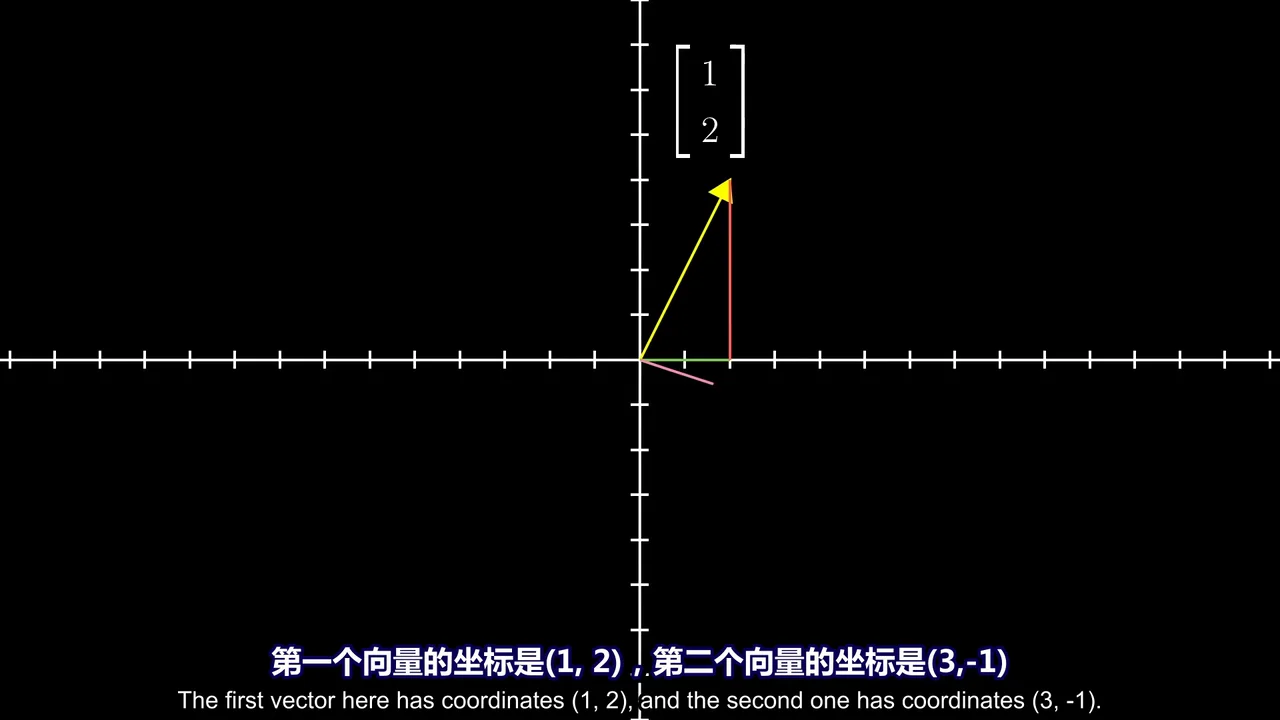
第一个向量的坐标是(1, 2),第二个向量的坐标是(3,-1)
The first vector here has coordinates 1, 2, and the second one has coordinates 3, negative 1.
[06:14] ↗
当你用这种首尾相连的方法求向量和时,可以把它想象成从原点到第二个向量终点的一条四步路径。
When you take the vector sum using this tip-to-tail method, you can think of a four-step path from the origin to the tip of the second vector.
[06:22] ↗
向右1步,向上2步,向右3步,最后向下1步
Walk 1 to the right, then 2 up, then 3 to the right, then 1 down.
[06:27] ↗
我们重新编排它们的顺序,使得我们先完成所有水平运动,再完成所有竖直运动 你可以看出来,首先向右(1+3)步,然后向上(2-1)步
Reorganizing these steps so that you first do all of the rightward motion, then do all the vertical motion, you can read it as saying first move 1 plus 3 to the right, then move 2 minus 1 up.
[06:40] ↗
所以新向量的坐标就是(1+3, 2+(-1))
So the new vector has coordinates 1 plus 3 and 2 plus negative 1.
[06:46] ↗
总的来说,在“向量是有序数字列表”的观点里,向量加法就是把两者的对应项对齐并逐一相加。
In general, vector addition in this list of numbers conception looks like matching up their terms and adding each one together.

向量数乘:几何缩放与“标量”一词的由来

⏱ 06:55 – 08:08

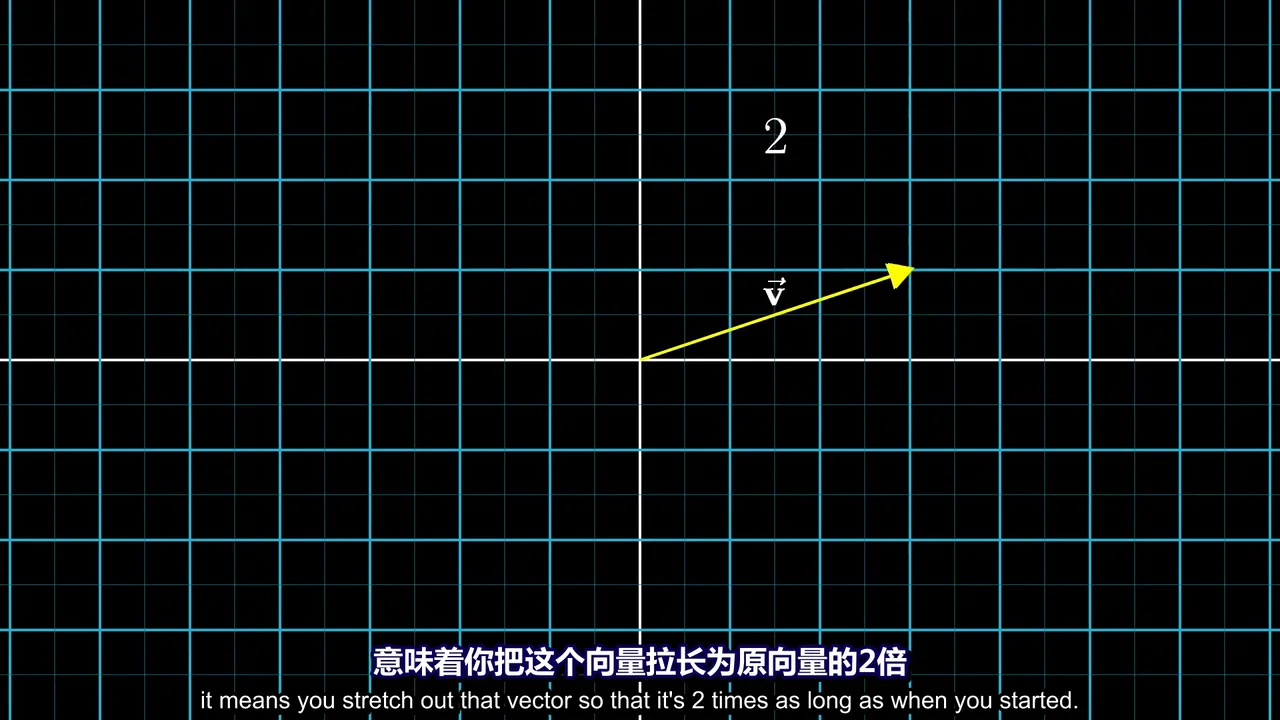
线性代数的第二大基本运算是“数字与向量相乘”。用几个具体数值例子最能说明它的几何含义:拿数字 $2$ 乘以一个给定向量,意味着把这个向量拉伸为原来长度的 $2$ 倍;乘以 $\frac{1}{3}$,则意味着把它压缩为原长的 $\frac{1}{3}$;而当乘以一个负数(例如 $-1.8$)时,向量会先反向翻转 $180^\circ$,再沿着新方向拉伸为原长的 $1.8$ 倍。

这种对向量进行拉伸、压缩乃至反向的操作统称为缩放(scaling);而每当你看到 $2$、$\frac{1}{3}$、$-1.8$ 这样的实数在执行这种缩放动作时,就称它为标量(scalar)。事实上,纵观整个线性代数,实数扮演的最主要角色就是缩放向量,因此“标量”和“数字”这两个词在语境中几乎可以互换使用。

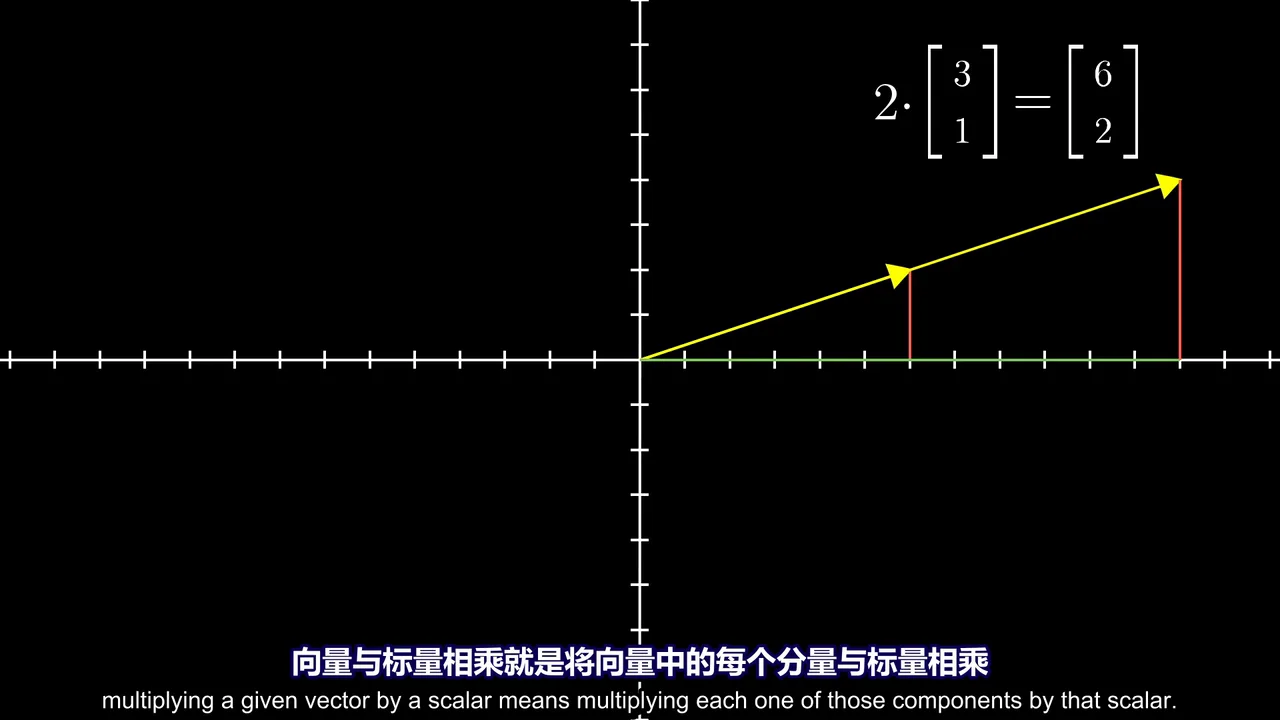
在数字列表的观点下,数乘同样直截了当:几何上把一个向量拉伸为原长的 $2$ 倍,代数上就对应着把它的每一个坐标分量都分别乘以 $2$(例如 $2 \cdot \begin{bmatrix} 3 \\ 1 \end{bmatrix} = \begin{bmatrix} 6 \\ 2 \end{bmatrix}$)。因此,向量与标量相乘在数值上就是将向量的每一个分量都乘以该标量。
📐 标量乘法的具体算例与通式
$$2 \cdot \begin{bmatrix} 3 \\ 1 \end{bmatrix} = \begin{bmatrix} 2 \times 3 \\ 2 \times 1 \end{bmatrix} = \begin{bmatrix} 6 \\ 2 \end{bmatrix}$$
正标量只改变长度,负标量同时反转方向;零标量将向量压缩至原点 $\vec{0}$。
标量 $2$ 作用于向量 $\vec{v}$:方向不变,箭头长度被拉长为原来的 $2$ 倍。 07:06
标量 $2$ 作用于向量 $\vec{v}$:方向不变,箭头长度被拉长为原来的 $2$ 倍。画面重点:正向放大:标量 $c > 1$ 拉伸向量
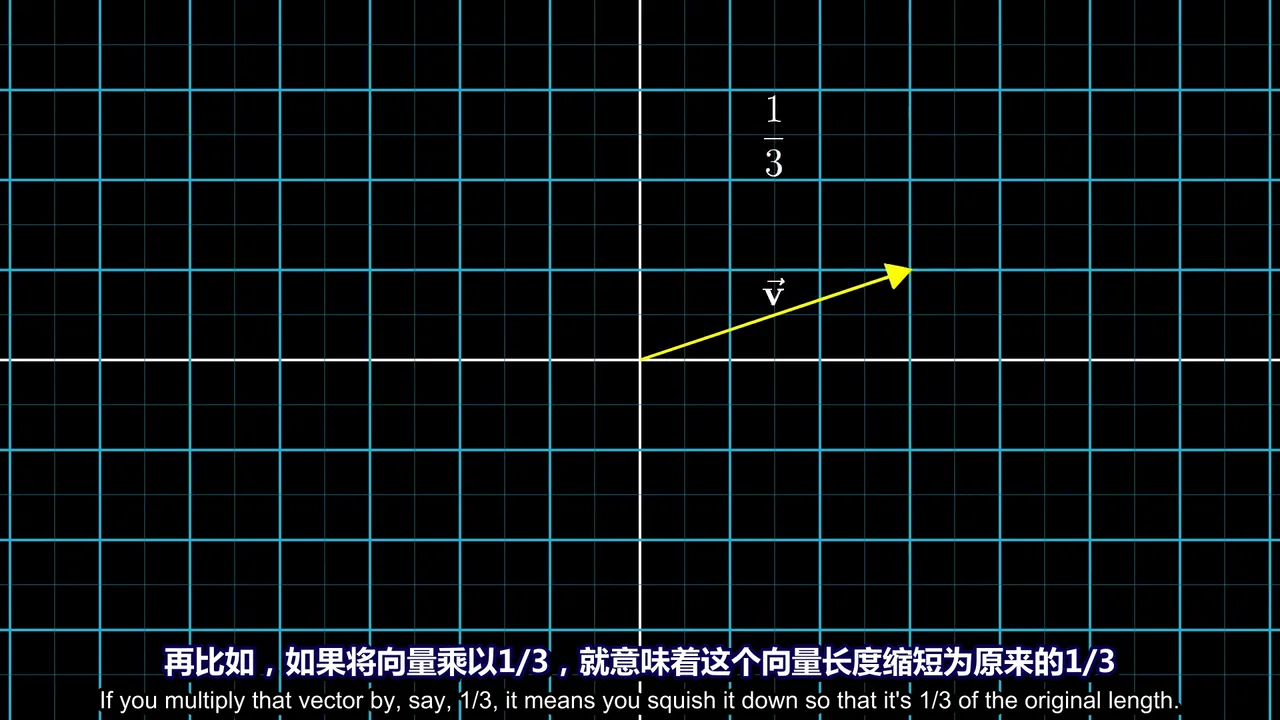
标量 $\frac{1}{3}$ 作用于向量 $\vec{v}$:方向不变,向量长度被压缩为原长的三分之一。 07:14
标量 $\frac{1}{3}$ 作用于向量 $\vec{v}$:方向不变,向量长度被压缩为原长的三分之一。画面重点:正向缩小:标量 $0 < c < 1$ 压缩向量
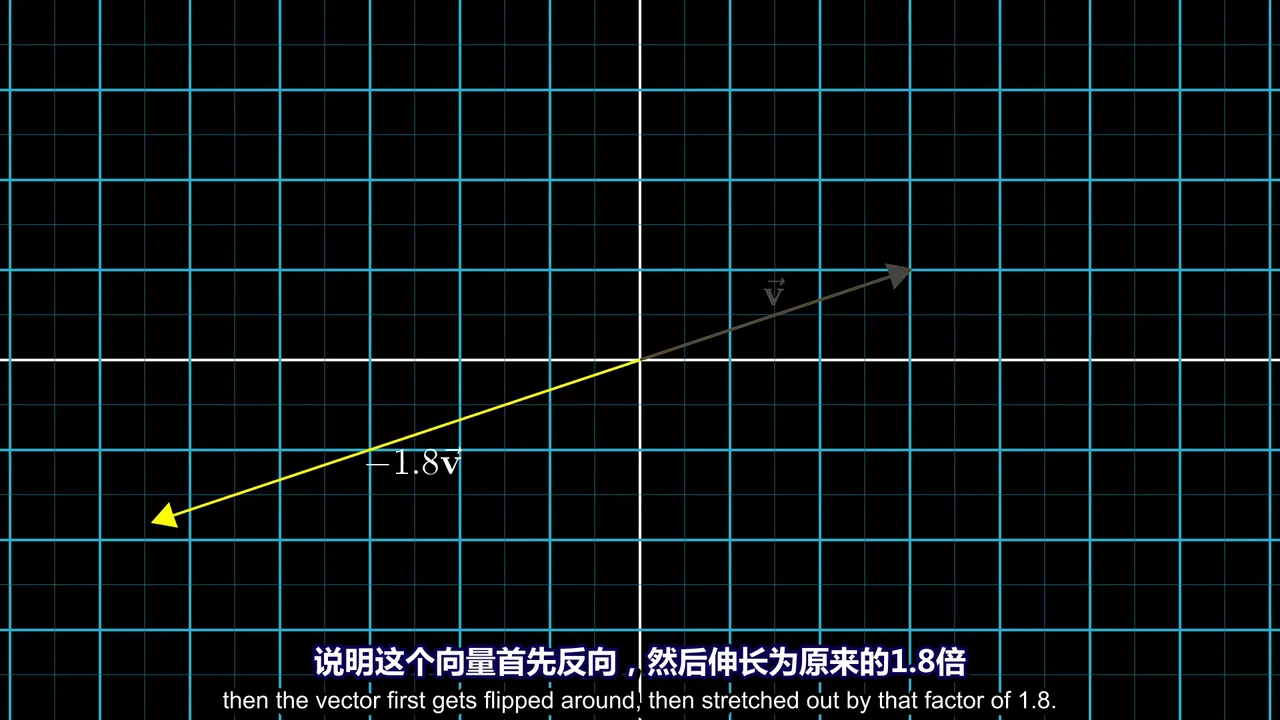
负标量 $-1.8$ 作用于向量 $\vec{v}$:先绕原点调转相反方向,再拉伸至原长的 $1.8$ 倍($-1.8\vec{v}$)。 07:23
负标量 $-1.8$ 作用于向量 $\vec{v}$:先绕原点调转相反方向,再拉伸至原长的 $1.8$ 倍($-1.8\vec{v}$)。画面重点:负号反转:标量 $c < 0$ 翻转并缩放
代数对应图解:$2 \cdot \begin{bmatrix} 3 \\ 1 \end{bmatrix} = \begin{bmatrix} 6 \\ 2 \end{bmatrix}$,横纵两个直角边分量恰好同时翻倍。 08:03
代数对应图解:$2 \cdot \begin{bmatrix} 3 \\ 1 \end{bmatrix} = \begin{bmatrix} 6 \\ 2 \end{bmatrix}$,横纵两个直角边分量恰好同时翻倍。画面重点:数形对应:几何缩放 $\iff$ 逐分量乘 $c$
[06:55] ↗
另一个向量基础运算就是向量数乘
The other fundamental vector operation is multiplication by a number.
[06:59] ↗
我们先看几个例子来更好理解这个概念
Now this is best understood just by looking at a few examples.
[07:02] ↗
比如说你选择数字2,把它与一个给定向量相乘 意味着你把这个向量拉长为原向量的2倍
If you take the number 2 and multiply it by a given vector, it means you stretch out that vector so that it's two times as long as when you started.
[07:10] ↗
再比如,如果将向量乘以1/3,就意味着这个向量长度缩短为原来的1/3
If you multiply that vector by, say, one-third, it means you squish it down so that it's one-third the original length.
[07:18] ↗
当向量与一个负数相乘时,比如-1.8 说明这个向量首先反向,然后伸长为原来的1.8倍
When you multiply it by a negative number, like negative 1.8, then the vector first gets flipped around, then stretched out by that factor of 1.8.
[07:27] ↗
这种拉伸或压缩,有时又使向量反向的过程被称为“缩放” 而我们选择的2、1/3、-1.8或者其他任何数 它们用于缩放向量,被称为“标量”
This process of stretching or squishing or sometimes reversing the direction of a vector is called scaling, and whenever you catch a number like two or one-third or negative 1.8 acting like this, scaling some vector, you call it a scalar.
[07:42] ↗
实际上自始至终,数字在线性代数中起到的主要作用就是缩放向量 所以“标量”和“数字”两个词通常在这里可以相互替换
In fact, throughout linear algebra, one of the main things that numbers do is scale vectors, so it's common to use the word scalar pretty much interchangeably with the word number.
[07:52] ↗
从数字的角度来看,将一个向量伸长为原来的2倍 对应于将每一个分量分别乘以2
Numerically, stretching out a vector by a factor of, say, 2, corresponds with multiplying each of its components by that factor, 2.
[08:00] ↗
所以将向量看作一个数字列表时 向量与标量相乘就是将向量中的每个分量与标量相乘
So in the conception of vectors as lists of numbers, multiplying a given vector by a scalar means multiplying each one of those components by that scalar.

双重视角互译:箭头的直观与列表的威力

⏱ 08:10 – 09:52

后续章节将充分印证“线性代数的一切主题都紧紧围绕向量加法与标量乘法展开”这句话;到系列最后一集时,我们还会进一步探讨数学家如何把这两种运算彻底抽离,让它们独立于“箭头”或“列表”等具体表示形式之外。

不过在实质上,无论你更习惯把向量看作“刚好能写成漂亮坐标的箭头”,还是看作“刚好带有漂亮几何解释的数字列表”,这本身并不重要——线性代数真正的实用威力,不在于固守某一种单一视角,而在于能够在“几何箭头”与“数字列表”这两种视角之间自由来回翻译。

这种双向互译赋予了不同领域工作者截然不同却同样强大的能力:对数据分析师而言,它提供了将海量高维数字列表概念化、可视化的途径,让隐含的数据模式与运算整体效果一眼看穿;反之,对物理学家和计算机图形学程序员而言,它提供了把空间几何构想写成计算机可执行数字运算的语言。正如作者自己制作本系列数学动画(Manim)时那样——先在脑海中构思空间里发生的变化,再通过线性代数算式让计算机精准算出屏幕像素该如何排布。
💡 黄金总结:双向互译(Back and Forth)
数据分析是“从列表走向几何”(借助直观图形看清数据模式);图形学与物理仿真是“从几何走向列表”(把直观空间操作编码成计算机可算的数组)。
物理视角与 CS 视角的两个 $\pi$ 生物在列向量 $\begin{bmatrix} 2 \\ 1 \end{bmatrix}$ 与旋转/指向的几何箭头之间双向传译对话。 08:45
物理视角与 CS 视角的两个 $\pi$ 生物在列向量 $\begin{bmatrix} 2 \\ 1 \end{bmatrix}$ 与旋转/指向的几何箭头之间双向传译对话。画面重点:核心能力:在箭头与数字间自如翻译
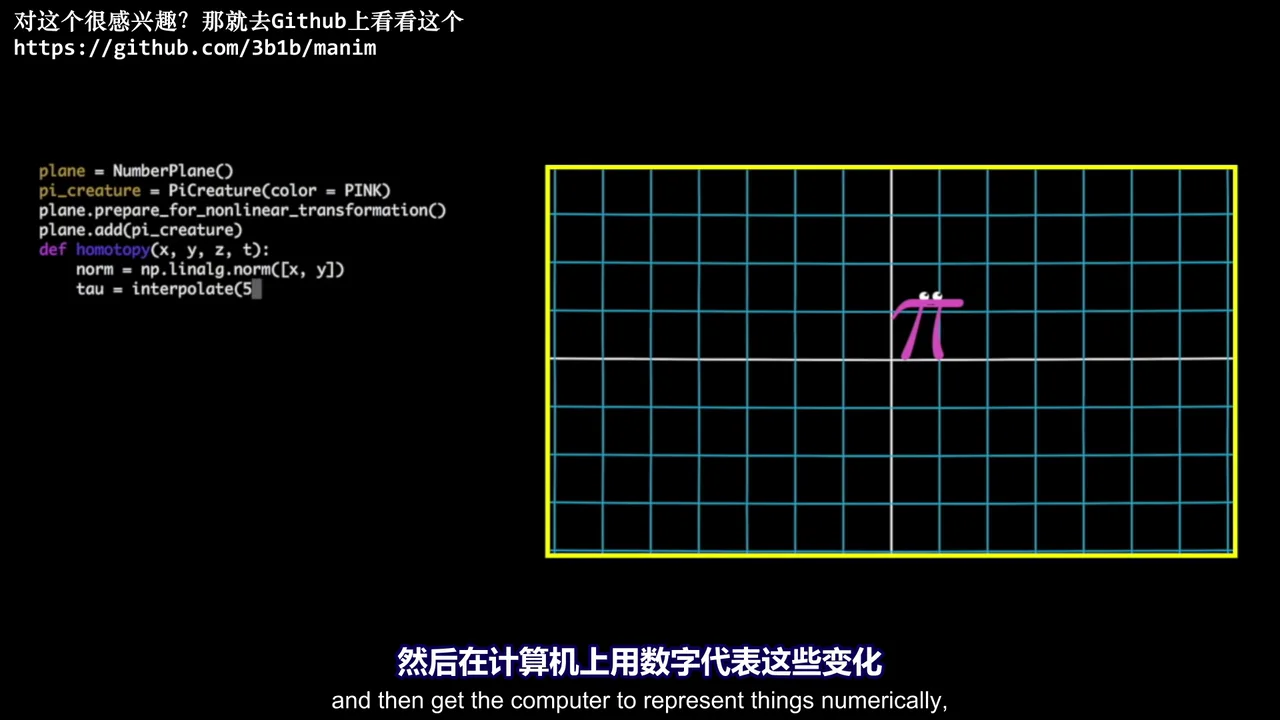
左侧为 Manim 动画 Python 源代码,右侧为计算机根据向量坐标演算渲染出的平面变形动画——“空间构想 $\rightarrow$ 数值像素”的生动实战。 09:18
左侧为 Manim 动画 Python 源代码,右侧为计算机根据向量坐标演算渲染出的平面变形动画——“空间构想 $\rightarrow$ 数值像素”的生动实战。画面重点:应用闭环:用数值计算驱动几何动画
[08:10] ↗
在接下来的视频中,你就会明白我之前所说的 “线性代数围绕两种基本运算:向量加法与向量数乘”究竟是什么意思了
You'll see in the following videos what I mean when I say linear algebra topics tend to revolve around these two fundamental operations, vector addition and scalar multiplication.
[08:20] ↗
到最后一个视频时,我还会更详细地探讨数学家为何以及如何只聚焦于这两种运算,并将它们彻底抽象出来,使其独立于你所选择的任何具体向量表示形式。
And I'll talk more in the last video about how and why the mathematician thinks only about these operations, independent and abstracted away from however you choose to represent vectors.
[08:30] ↗
事实上,无论你认为向量本质上是“恰好有漂亮数值表示的空间箭头”(如我所建议的那样),还是本质上“恰好有漂亮几何解释的数字列表”,其实都无关紧要。
In truth, it doesn't matter whether you think about vectors as fundamentally being arrows in space, like I'm suggesting you do, that happen to have a nice numerical representation, or fundamentally as lists of numbers that happen to have a nice geometric interpretation.
[08:43] ↗
线性代数的威力与其说在于这两种视角中的某一种,不如说在于能够在它们之间自如往返转换的能力。
The usefulness of linear algebra has less to do with either one of these views than it does with the ability to translate back and forth between them.
[08:50] ↗
线性代数为数据分析提供了一条将大量数据列表概念化、可视化的渠道 它让数据样式变得非常明晰,并让你大致了解特定运算的意义
It gives the data analyst a nice way to conceptualize many lists of numbers in a visual way, which can seriously clarify patterns in data and give a global view of what certain operations do.
[09:01] ↗
另一方面,线性代数给物理学家和计算机图形程序员提供了一种语言 让他们通过计算机能处理的数字来描述并操纵空间
And on the flip side, it gives people like physicists and computer graphics programmers a language to describe space and the manipulation of space using numbers that can be crunched and run through a computer.
[09:12] ↗
举例来说,当我制作数学动画时,我先思考空间中实际上正在发生什么,然后让计算机用数值去表示这一切,从而算出该把像素绘制在屏幕的哪些位置。
When I do math-y animations, for example, I start by thinking about what's actually going on in space, and then get the computer to represent things numerically, thereby figuring out where to place the pixels on the screen.
[09:23] ↗
完成这些工作通常需要依靠对线性代数的深厚理解才能完成
And doing that usually relies on a lot of linear algebra understanding.
[09:28] ↗
以上便是向量基础知识;在下一个视频中,我将开始探讨围绕向量的几个极其精妙的概念,例如张成的空间、基与线性相关。到时候见!(下期:线性组合、张成的空间与基)
So there are your vector basics, and in the next video I'll start getting into some pretty neat concepts surrounding vectors like span, bases, and linear dependence. See you then! you

📝 几何直觉自测(点击题目展开解答)

Q1. “物理学视角的箭头”和“线性代数惯常视角的箭头”有一个关键使用区别,是什么?▼
物理学中的向量可以**在空间中自由平移**(只要长度和方向不变就是同一个向量);而线性代数中的向量**几乎总是把尾端(起点)固定在原点**,从而使每个箭头唯一对应一个坐标列向量 $\begin{bmatrix} x \\ y \end{bmatrix}$。唯一的常见例外是在作几何向量加法“首尾相连”时,暂时把第二个向量的起点平移到第一个向量的尖端。
Q2. 从路径拆解的角度来看,为什么二维向量加法 $\begin{bmatrix} 1 \\ 2 \end{bmatrix} + \begin{bmatrix} 3 \\ -1 \end{bmatrix}$ 在数值上刚好等于对应分量相加?▼
首尾相连等效于从原点依次走完四步:先向右 $1$、向上 $2$,再向右 $3$、向下 $1$。因为水平位移与竖直位移互相正交独立,把同方向的步伐重新分组(先算总水平位移 $1+3=4$,再算总竖直位移 $2-1=1$)不改变最终终点,因此代数上自然表现为各分量分别相加:$\begin{bmatrix} 4 \\ 1 \end{bmatrix}$。
Q3. 给向量 $\vec{v} = \begin{bmatrix} 3 \\ 1 \end{bmatrix}$ 乘以标量 $-2$,在几何与数值上分别发生了什么?▼
几何上,向量先绕原点反向翻转 $180^\circ$,随后拉伸至原长的 $2$ 倍;数值上,两个分量各自乘以 $-2$,得到新向量 $\begin{bmatrix} -6 \\ -2 \end{bmatrix}$。