线性代数的本质 · 精研复习站

第 05 集:行列式

The determinant
一句话直觉:行列式不是一堆乘加规则的死记公式,而是线性变换对二维面积(或三维体积)的有向缩放因子:数值大小代表缩放倍数,正负号记录空间定向是否被翻转,而零意味着整个空间被压扁到了更低的维度。

本章揭示线性变换如何拉伸或挤压空间,并将“面积或体积的缩放比例”抽象为行列式(determinant)这一核心几何量。我们将从单位正方形与单位立方体出发,理解零行列式与降维坍缩、负行列式与空间定向(右手定则),最终给出二阶公式 $ad-bc$ 的面积剖分直觉与矩阵乘积行列式的几何本质。

▶ YouTube 原片 📺 B站官方双语 P7 🎙 B站中文配音 P7

前置依赖

← 第 03 集 · 矩阵与线性变换:理解矩阵的各列就是变换后基向量 $\hat{\imath},\hat{\jmath}$ 的落点,以及网格线保持平行且等距的线性性质。
← 第 04 集 · 矩阵乘法与线性变换复合:理解矩阵乘积对应线性变换的相继复合,用于推导并解释 $\det(M_1 M_2)=\det(M_1)\det(M_2)$。
← 第 04·附注 集 · 三维空间的线性变换:将二维基向量与空间变形的几何图景自然推广至三维空间及基向量 $\hat{k}$。

后续延伸

→ 第 06 集 · 逆矩阵、列空间、秩与零空间:以 $\det(A)=0$ 与 $\det(A)\neq 0$ 作为分水岭,判断线性方程组 $A\vec{x}=\vec{v}$ 是否存在逆矩阵与唯一解。
→ 第 08-2 集 · 以线性变换的眼光看叉积:三维叉积的坐标计算公式与三维有向体积(行列式)及对偶性直接等价。
→ 第 08·拓展 集 · 克莱姆法则的几何解释:利用坐标变换前后面积/体积的缩放比例不变性,直接几何导出求解线性方程组的克莱姆法则。
→ 第 10 集 · 特征向量与特征值:通过令 $\det(A-\lambda I)=0$ 寻找把特征空间压扁的缩放因子,从而求解特征值。
行列式的几何定义(二维/三维)
$$\det(A) = \text{单位正方形面积(或单位立方体体积)的有向缩放因子}$$
2×2 行列式面积公式
$$\det\begin{bmatrix} a & b \\ c & d \end{bmatrix} = ad - bc$$
矩阵乘积的行列式法则
$$\det(M_1 M_2) = \det(M_1)\det(M_2)$$
线性相关与降维判据
$$\det(A) = 0 \iff \text{矩阵列向量线性相关(空间被压入低维)}$$

面积缩放的直观引入:拉伸矩阵与剪切矩阵

⏱ 00:12 – 01:46

承接矩阵与线性变换的视觉图像,一些变换把空间向外拉伸,另一些把空间向内挤压。要定量刻画这种形变强度,最自然的度量便是:变换将给定区域的面积放大或缩小了多少倍。

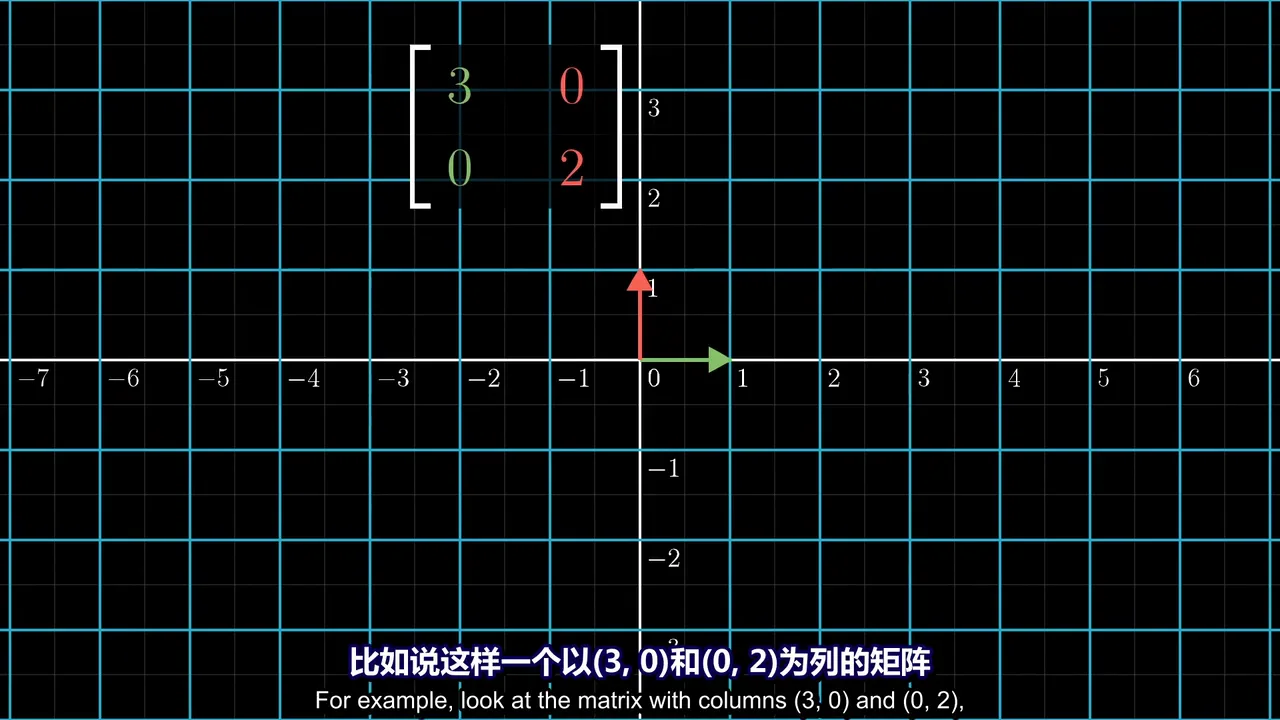
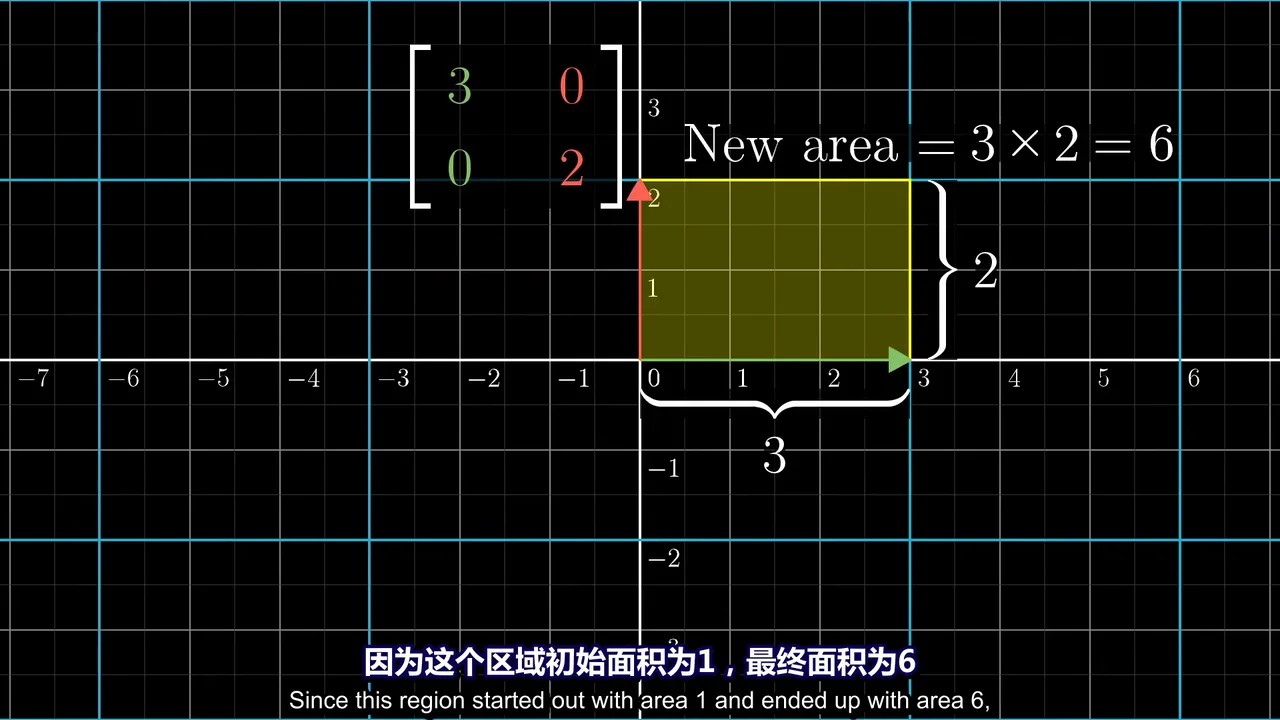
考察对角拉伸矩阵 $\begin{bmatrix} 3 & 0 \\ 0 & 2 \end{bmatrix}$:它把 $\hat{\imath}$ 伸长为原来的 $3$ 倍,把 $\hat{\jmath}$ 伸长为原来的 $2$ 倍。聚焦由 $\hat{\imath}$ 为底边、$\hat{\jmath}$ 为左边围成的 $1\times 1$ 单位正方形(初始面积为 $1$),变换后它拉成一个 $3\times 2$ 矩形,面积变为 $6$,因此该变换将面积缩放了 $6$ 倍。

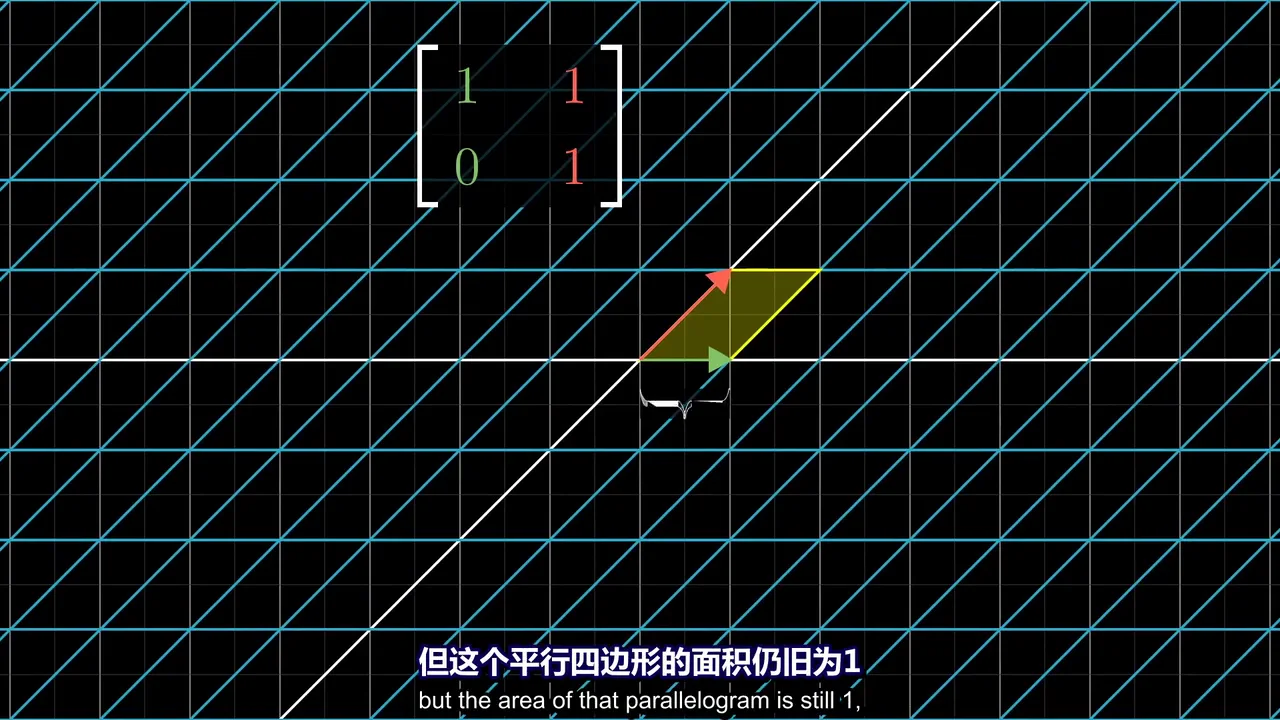
再对比剪切矩阵 $\begin{bmatrix} 1 & 1 \\ 0 & 1 \end{bmatrix}$:$\hat{\imath}$ 停在 $(1,0)$ 不动,$\hat{\jmath}$ 倾斜移至 $(1,1)$。同一个单位正方形被拉斜成平行四边形,但底边长仍为 $1$、高仍为 $1$,面积保持为 $1$。尽管空间整体明显向右错动挤压,它对面积的缩放比例依然是 $1$。
💡 核心观察
不要孤立地看矩阵里的数字,而要盯着 $\hat{\imath}$ 与 $\hat{\jmath}$ 围出的那个 $1\times 1$ 黄色小方块:拉伸它就改变面积,沿平行方向剪切它只改变形状却不改变面积。
引入问题:线性变换对空间的拉伸与挤压 00:25
引入问题:线性变换对空间的拉伸与挤压画面重点:不同线性变换对平面网格的膨胀与压缩对比
拉伸示例矩阵 [[3, 0], [0, 2]] 00:49
拉伸示例矩阵 [[3, 0], [0, 2]]画面重点:第一列绿色 (3,0) 与第二列红色 (0,2) 决定基向量落点
单位正方形拉成 3×2 矩形,面积变为 6 倍 01:12
单位正方形拉成 3×2 矩形,面积变为 6 倍画面重点:黄色高亮区域由 1×1 正方形变为宽 3 高 2 的矩形
剪切变换 [[1, 1], [0, 1]] 保持单位面积为 1 01:34
剪切变换 [[1, 1], [0, 1]] 保持单位面积为 1画面重点:平行四边形底为 1、高为 1,面积并未因倾斜而改变
[00:12] ↗
嘿 又见面了!
Hello, hello again.
[00:14] ↗
继续上次的内容 通过前几期视频的学习,我假定你已经对线性变换有一个形象的理解 并且你也知道如何用矩阵表示它们
So moving forward, I'll be assuming that you have a visual understanding of linear transformations and how they're represented with matrices, the way that I've been talking about in the last few videos.
[00:23] ↗
现在想象一些线性变换 你可能注意到其中有的将空间向外拉伸,有的则将空间向内挤压
If you think about a couple of these linear transformations, you might notice how some of them seem to stretch space out, while others squish it on in.
[00:31] ↗
有件事对理解这些线性变换很有用 那就是测量变换究竟对空间有多少拉伸或挤压
One thing that turns out to be pretty useful for understanding one of these transformations is to measure exactly how much it stretches or squishes things.
[00:40] ↗
更具体一点,就是测量一个给定区域面积增大或减小的比例
More specifically, to measure the factor by which the area of a given region increases or decreases.
[00:47] ↗
比如说这样一个以(3, 0)和(0, 2)为列的矩阵
For example, look at the matrix with columns 3, 0 and 0, 2.
[00:51] ↗
它将i帽伸长为原来的3倍,将j帽伸长为原来的2倍
It scales i-hat by a factor of 3 and scales j-hat by a factor of 2.
[00:57] ↗
现在如果我们关注以i帽为底边,以j帽为左边的1×1方形 在变换之后,它会变成一个2×3的矩形
Now, if we focus our attention on the 1 by 1 square whose bottom sits on i-hat and whose left side sits on j-hat, after the transformation, this turns into a 2 by 3 rectangle.
[01:08] ↗
因为这个区域初始面积为1,最终面积为6 所以我们说这个线性变换将它的面积变为6倍
Since this region started out with area 1 and ended up with area 6, we can say the linear transformation has scaled its area by a factor of 6.
[01:18] ↗
剪切矩阵的列为(1, 0)和(1, 1) 也就是说i帽保持不变,而j帽移动至(1, 1)
Compare that to a shear, whose matrix has columns 1, 0 and 1, 1, meaning i-hat stays in place and j-hat moves over to 1, 1.
[01:27] ↗
由i帽和j帽决定的单位正方形在变换后倾斜为一个平行四边形 但这个平行四边形的面积仍旧为1 因为它的底和高的长度还是1
That same unit square determined by i-hat and j-hat gets slanted and turned into a parallelogram, but the area of that parallelogram is still 1, since its base and height each continue to have length 1.
[01:39] ↗
所以说,即便这个变换将空间向右挤压 至少对于这个单位正方形来说,它似乎并不改变面积
So even though this transformation smushes things about, it seems to leave areas unchanged, at least in the case of that 1 unit square.

为何单位正方形决定一切与行列式的定义

⏱ 01:47 – 03:40

令人惊奇的是,只要知道那一个 $1\times 1$ 单位正方形的面积变化比例,就能立刻知道平面上任意形状区域的面积变化比例。其逻辑链条完全建立在“线性”二字之上:

  • 因为线性变换保证网格线保持平行且等距分布,所以单位正方形经历的缩放倍率,对网格中任意位置、任意尺寸的小方格都完全一致。
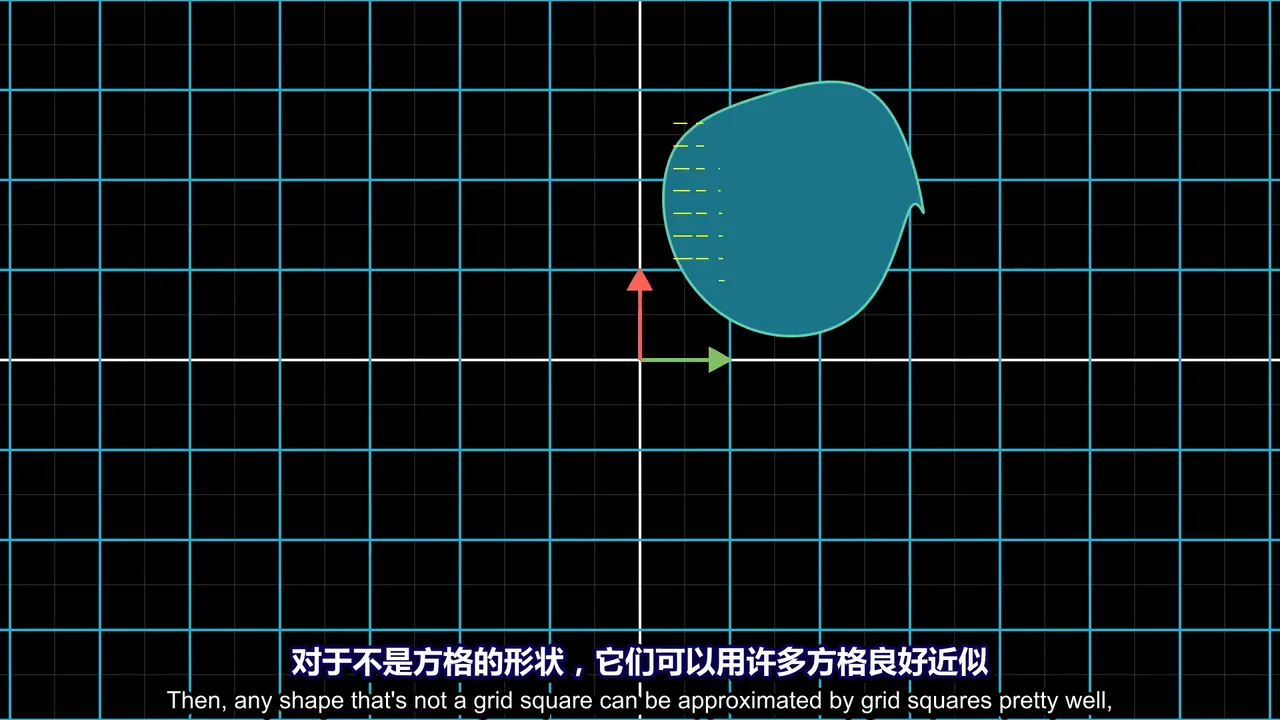
  • 平面上任何不规则的弯曲区域,都可以用足够细小的网格正方形进行任意精度的逼近(类似积分思想)。
  • 既然每个微元方格的面积都乘以同一个常数因子,将所有微元相加,整个不规则区域的总面积也必然乘以同一个缩放因子。
📐 行列式(Determinant)的定义
$$\det(A) = \frac{\text{变换后区域 } T(\Omega) \text{ 的有向面积}}{\text{变换前区域 } \Omega \text{ 的面积}}$$
这个由线性变换唯一决定的特殊面积缩放因子,就称为该变换(或其矩阵)的行列式。

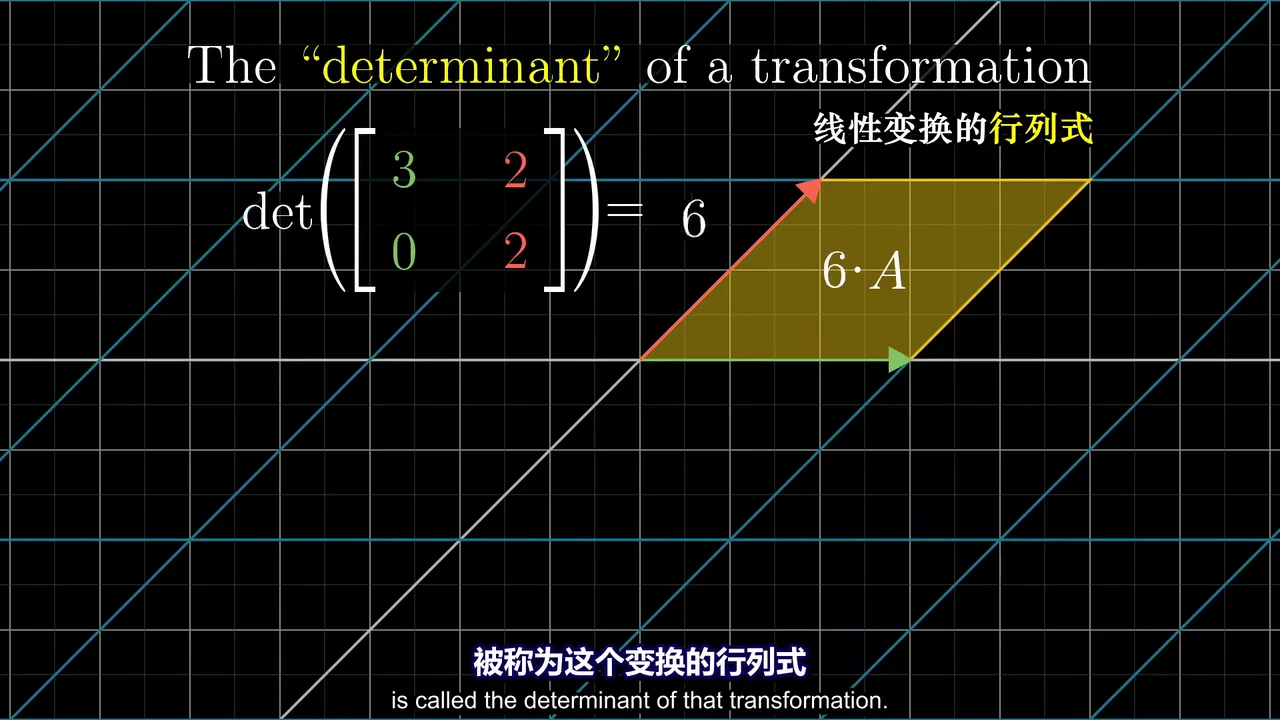
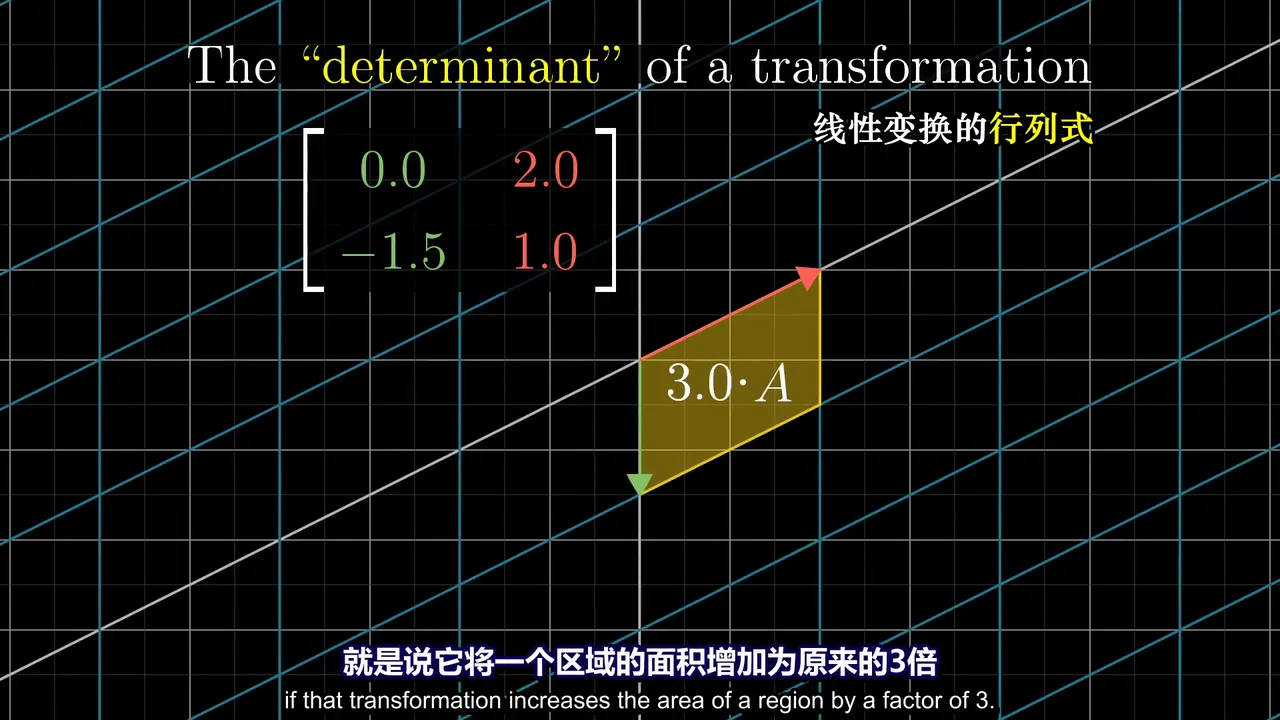
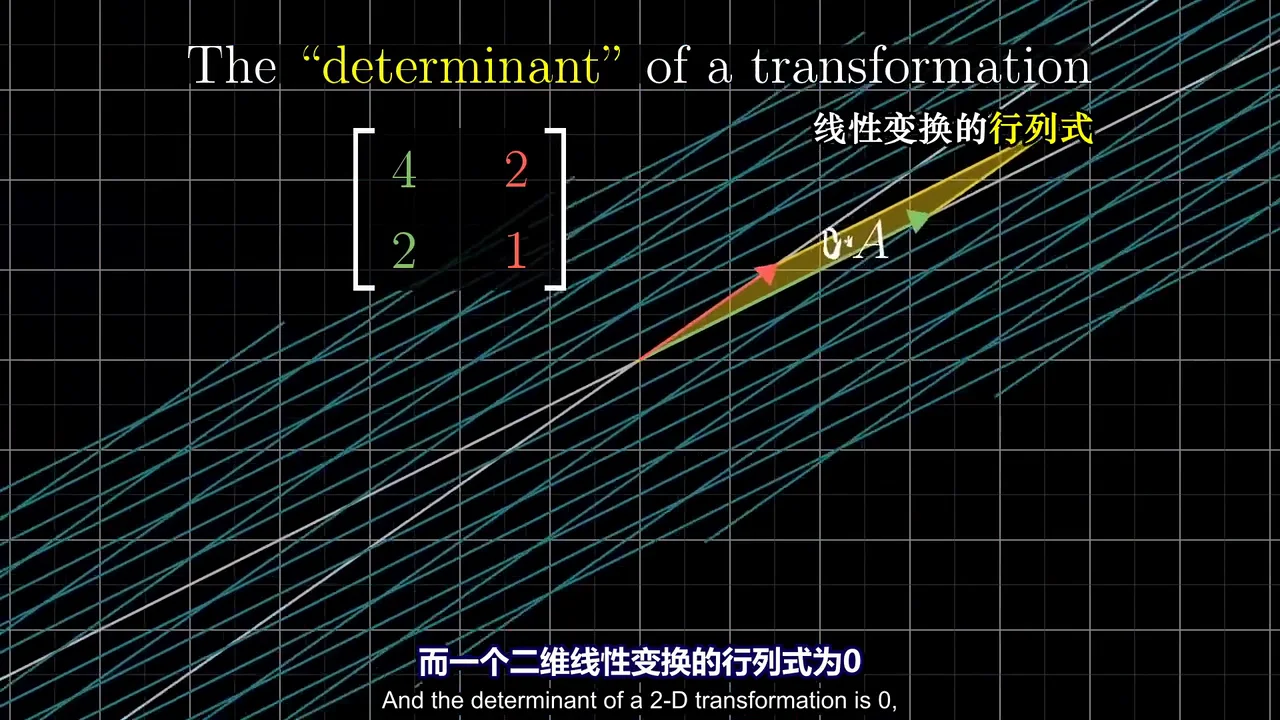
视频给出了三类关键数值实例:当矩阵为 $\begin{bmatrix} 3 & 2 \\ 0 & 2 \end{bmatrix}$ 时面积扩大为 $6$ 倍($\det=6$);当矩阵为 $\begin{bmatrix} 0 & 2 \\ -1.5 & 1 \end{bmatrix}$ 时面积扩大为 $3$ 倍($\det=3$);若变换将所有区域面积压缩为原来的 $\frac{1}{2}$,则 $\det=\frac{1}{2}$;而当二维变换如 $\begin{bmatrix} 4 & 2 \\ 2 & 1 \end{bmatrix}$ 将整个平面压扁到一条直线甚至一个原点时,任何区域的面积都坍缩为 $0$,此时 $\det=0$。
💡 零行列式的战略意义
检验 $\det(A)=0$ 与否,等价于检验这个矩阵对应的线性变换是否把空间“压扁”进了更低的维度——这一判据将在下一章求解线性方程组时发挥核心作用。
任意形状用微小网格方格逼近 02:12
任意形状用微小网格方格逼近画面重点:青色不规则区域被细密网格填充,整体随微元等比例缩放
行列式定义与 [[3, 2], [0, 2]] 的 6 倍缩放 02:36
行列式定义与 [[3, 2], [0, 2]] 的 6 倍缩放画面重点:公式 det([[3,2],[0,2]])=6 与 6·A 黄色平行四边形
行列式为 3 的斜向变换示例 02:54
行列式为 3 的斜向变换示例画面重点:矩阵 [[0.0, 2.0], [-1.5, 1.0]] 将面积变为 3.0·A
零行列式将二维平面压成一条直线 03:09
零行列式将二维平面压成一条直线画面重点:矩阵 [[4, 2], [2, 1]] 使所有网格重合于一条直线,面积 0·A
[01:47] ↗
实际上,你只要知道这个单位正方形面积变化的比例 它就能告诉你其他任意区域的面积变化比例
Actually though, if you know how much the area of that one single unit square changes, it can tell you how the area of any possible region in space changes.
[01:56] ↗
首先需要注意一点,无论一个方格如何变化 对其他大小的方格来说,都会有相同变化
For starters, notice that whatever happens to one square in the grid has to happen to any other square in the grid, no matter the size.
[02:04] ↗
这是由“网格线保持平行且等距分布”这一事实推断得出的
This follows from the fact that grid lines remain parallel and evenly spaced.
[02:09] ↗
对于不是方格的形状,它们可以用许多方格良好近似 只要使用的方格足够小,近似就能足够好
Then, any shape that's not a grid square can be approximated by grid squares pretty well, with arbitrarily good approximations if you use small enough grid squares.
[02:18] ↗
由于所有小方格都进行了一个比例的缩放 所以整个形状也进行了同样比例的缩放
So, since the areas of all those tiny grid squares are being scaled by some single amount, the area of the blob as a whole will also be scaled by that same single amount.
[02:29] ↗
这个特殊的缩放比例,即线性变换改变面积的比例 被称为这个变换的行列式
This very special scaling factor, the factor by which a linear transformation changes any area, is called the determinant of that transformation.
[02:39] ↗
在这个视频后半段,我会展示如何用矩阵计算一个线性变换的行列式 但是理解它的意义比计算本身重要得多
I'll show how to compute the determinant of a transformation using its matrix later on in this video, but understanding what it represents is, trust me, much more important than the computation.
[02:50] ↗
比如说,一个线性变换的行列式是3 就是说它将一个区域的面积增加为原来的3倍
For example, the determinant of a transformation would be 3 if that transformation increases the area of a region by a factor of 3.
[02:58] ↗
一个线性变换的行列式是1/2,意味着它将所有区域的面积都压缩为原来的1/2。
The determinant of a transformation would be ½ if it squishes down all areas by a factor of ½.
[02:58] ↗
一个线性变换的行列式是1/2 就是说它将一个区域的面积缩小一半 而一个二维线性变换的行列式为0 说明它将整个平面压缩到一条线,甚至是一个点上
The determinant of a transformation would be 1 half if it squishes down all areas by a factor of 1 half. And the determinant of a 2D transformation is 0 if it squishes all of space onto a line, or even onto a single point.
[03:14] ↗
因为此时任何区域的面积都变成了0
Since then, the area of any region would become zero.
[03:18] ↗
最后这个例子相当重要
That last example will prove to be pretty important.
[03:20] ↗
这是说,只需要检验一个矩阵的行列式是否为0 我们就能了解这个矩阵所代表的变换是否将空间压缩到更小的维度上
It means that checking if the determinant of a given matrix is zero will give a way of computing whether or not the transformation associated with that matrix squishes everything into a smaller dimension.
[03:31] ↗
接下来的几期视频中,你会明白它为什么有用 但是就现在而言,我只想让你留下直观的印象 这种直觉本身也是非常美妙的
You'll see in the next few videos why this is even a useful thing to think about, but for now, I just want to lay down all of the visual intuition, which, in and of itself, is a beautiful thing to think about.

负行列式与二维空间的定向反转

⏱ 03:42 – 05:29

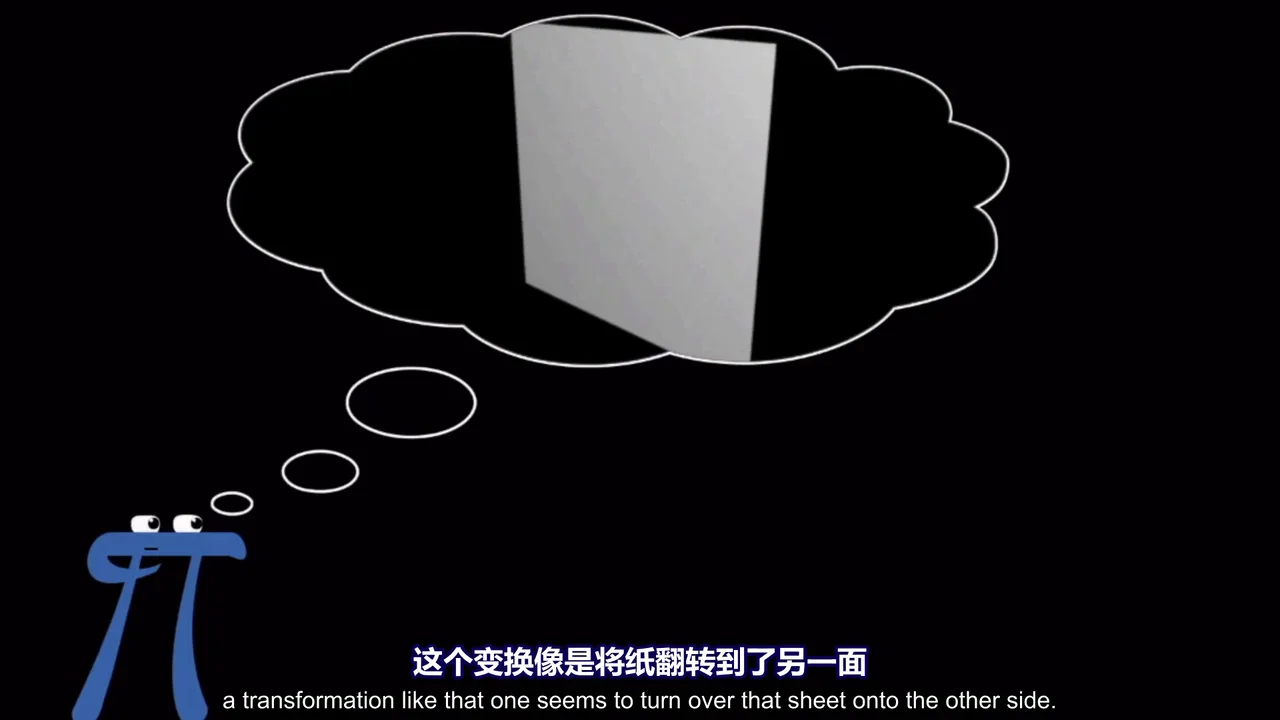
完整概念下的行列式允许出现负值。“把面积缩放负数倍”听起来反直觉,它其实描述的是空间定向(orientation)的翻转:如果把二维平面想成一张纸,某些线性变换就像把这张纸整张翻到了背面。

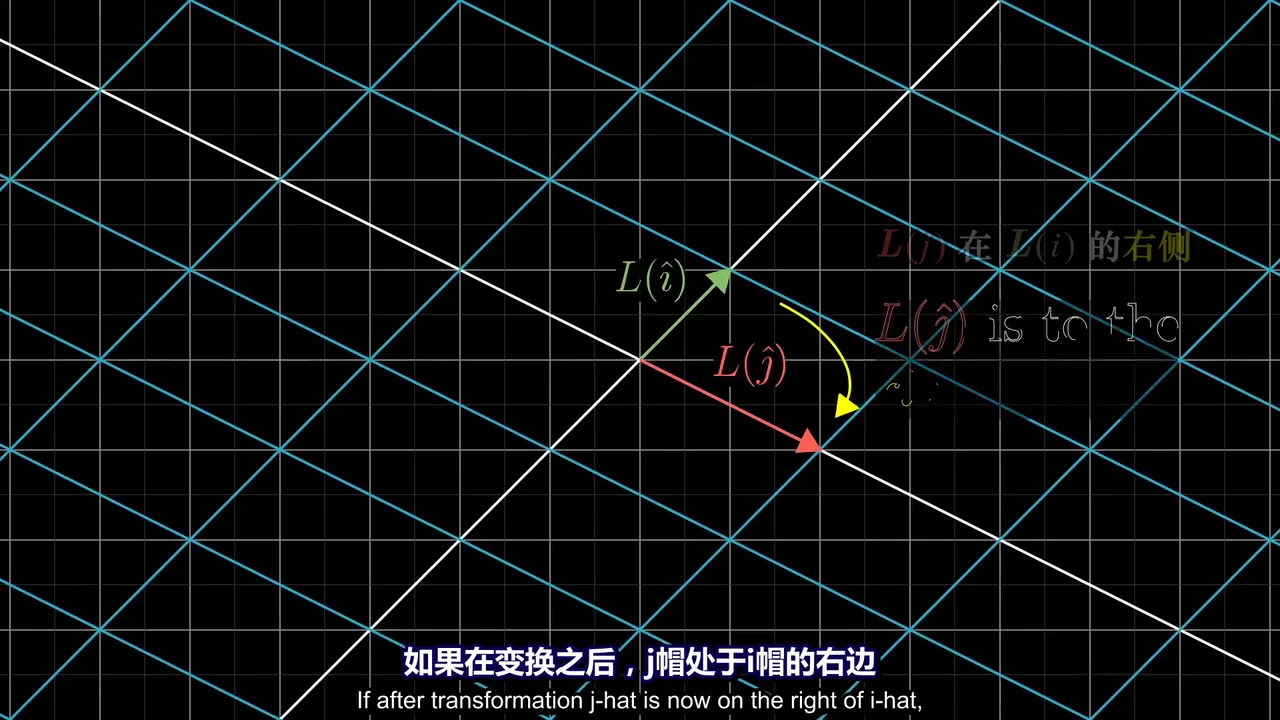
用基向量可以精确判别是否翻面:初始状态下,$\hat{\jmath}$ 位于 $\hat{\imath}$ 的左侧(逆时针转 $90^\circ$);如果在变换之后,$L(\hat{\jmath})$ 落在了 $L(\hat{\imath})$ 的右侧,就说明空间的定向发生了反转,此时行列式必然为负,而行列式的绝对值 $|\det(A)|$ 依然表示面积缩放比例。

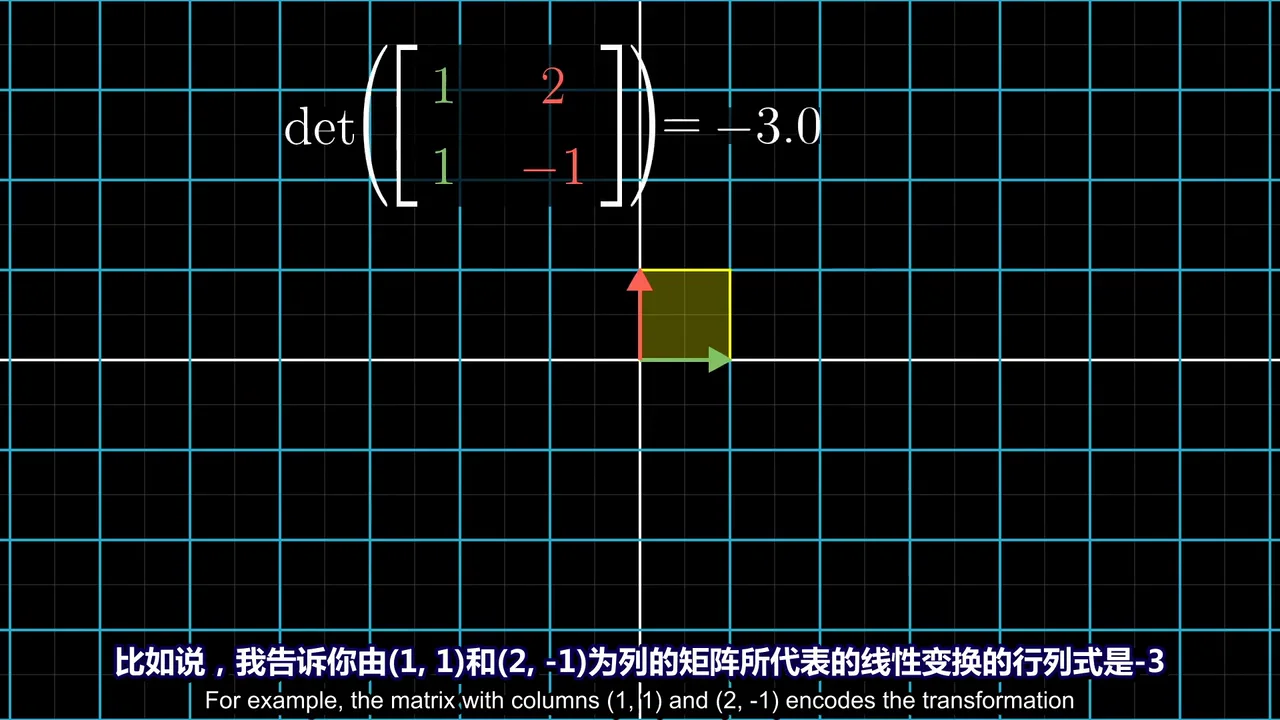
例如矩阵 $\begin{bmatrix} 1 & 2 \\ 1 & -1 \end{bmatrix}$ 的行列式为 $-3$:它既把平面翻转了过来($L(\hat{\jmath})=(2,-1)$ 跑到 $L(\hat{\imath})=(1,1)$ 的顺时针右侧),同时把所有图形的面积放大为原来的 $3$ 倍。
💡 连续形变下的平滑过渡直觉
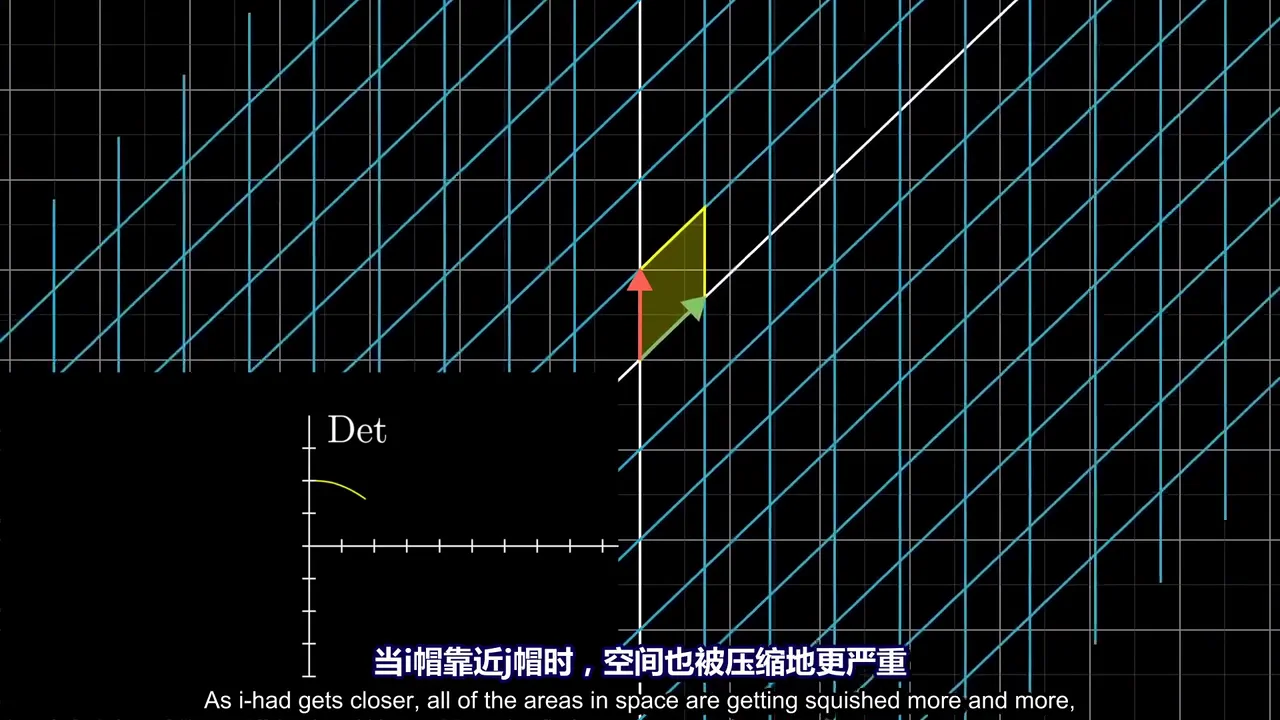
想象固定 $\hat{\jmath}$ 不动,让 $\hat{\imath}$ 逆时针慢慢向 $\hat{\jmath}$ 靠拢:平行四边形越压越扁,行列式持续减小趋近 $0$;当 $\hat{\imath}$ 与 $\hat{\jmath}$ 完全重合时面积归零,$\det=0$;若 $\hat{\imath}$ 沿着同一方向继续越过 $\hat{\jmath}$,行列式顺理成章地穿过 $0$ 跌入负数区间。这解释了为何用符号统一编码面积与定向如此自然。
空间翻面直观:把二维平面视作整张翻转的纸 04:06
空间翻面直观:把二维平面视作整张翻转的纸画面重点:三维视角下白色纸片被整体翻到背面
基向量左右位置互换标志定向反转 04:26
基向量左右位置互换标志定向反转画面重点:变换后 L(j-hat) 位于 L(i-hat) 右侧,触发负定向
负行列式数值示例:det = -3.0 04:47
负行列式数值示例:det = -3.0画面重点:矩阵 [[1, 2], [1, -1]] 翻转空间且面积放大 3 倍
连续逼近直觉:i-hat 靠近并越过 j-hat 05:14
连续逼近直觉:i-hat 靠近并越过 j-hat画面重点:随着夹角压扁至重合再越过,Det 曲线平滑穿过 0 进入负值
[03:42] ↗
我得承认一点,到目前为止我所说的并不完全正确
Okay, I need to confess that what I've said so far is not quite right.
[03:46] ↗
完整概念下的行列式是允许出现负值的
The full concept of the determinant allows for negative values.
[03:50] ↗
那将一个区域缩放负数倍到底是什么意思?
But what would the idea of scaling an area by a negative amount even mean?
[03:55] ↗
这和定向的概念有关
This has to do with the idea of orientation.
[03:58] ↗
举个例子,注意这个变换在感觉上将整个平面翻转了
For example, notice how this transformation gives the sensation of flipping space over.
[04:03] ↗
如果你将二维空间想象为一张纸 这个变换像是将纸翻转到了另一面
If you were thinking of 2D space as a sheet of paper, a transformation like that one seems to turn over that sheet onto the other side.
[04:11] ↗
我们称类似这样的变换改变了空间的定向
Any transformations that do this are said to invert the orientation of space.
[04:16] ↗
另一种方式是根据i帽和j帽来考虑
Another way to think about it is in terms of i-hat and j-hat.
[04:19] ↗
注意在初始状态时,j帽在i帽的左边
Notice that in their starting positions, j-hat is to the left of i-hat.
[04:24] ↗
如果在变换之后,j帽处于i帽的右边 那么空间定向就发生了改变
If, after a transformation, j-hat is now on the right of i-hat, the orientation of space has been inverted.
[04:32] ↗
当空间定向改变的情况发生时,行列式为负
Whenever this happens, whenever the orientation of space is inverted, the determinant will be negative.
[04:37] ↗
但是行列式的绝对值依然表示区域面积的缩放比例
The absolute value of the determinant, though, still tells you the factor by which areas have been scaled.
[04:43] ↗
比如说,我告诉你由(1, 1)和(2, -1)为列的矩阵所代表的线性变换的行列式是-3
For example, the matrix with columns 1, 1 and 2, negative 1 encodes a transformation that has determinant, I'll just tell you, negative 3.
[04:51] ↗
这就是说变换后空间被翻转,并且面积放大为原来的3倍
And what this means is that space gets flipped over and areas are scaled by a factor of 3.
[04:58] ↗
那么,负的面积缩放比例为什么会自然地用来描述定向改变呢?
So why would this idea of a negative area scaling factor be a natural way to describe orientation flipping?
[05:04] ↗
考虑i帽逐渐接近j帽所形成的一系列变换
Think about the series of transformations you get by slowly letting i-hat get closer and closer to j-hat.
[05:11] ↗
当i帽靠近j帽时,空间也被压缩地更严重 这意味着行列式趋近于0
As i-hat gets closer, all of the areas in space are getting squished more and more, meaning the determinant approaches 0.
[05:18] ↗
当i帽与j帽完全重合时,行列式为0
Once i-hat lines up perfectly with j-hat, the determinant is 0.
[05:22] ↗
如果i帽继续沿着这个方向运动 行列式继续减小为负值难道不是一件很自然的事吗?
Then, if i-hat continues the way that it was going, doesn't it kind of feel natural for the determinant to keep decreasing into the negative numbers?

三维行列式、平行六面体与右手定则

⏱ 05:31 – 07:29

推广到三维空间时,行列式的几何意义依然是缩放比例,只不过衡量对象从面积变成了体积。我们聚焦由基向量 $\hat{\imath}$、$\hat{\jmath}$、$\hat{k}$ 作为三条棱张成的 $1\times 1\times 1$ 单位立方体(初始体积为 $1$)。

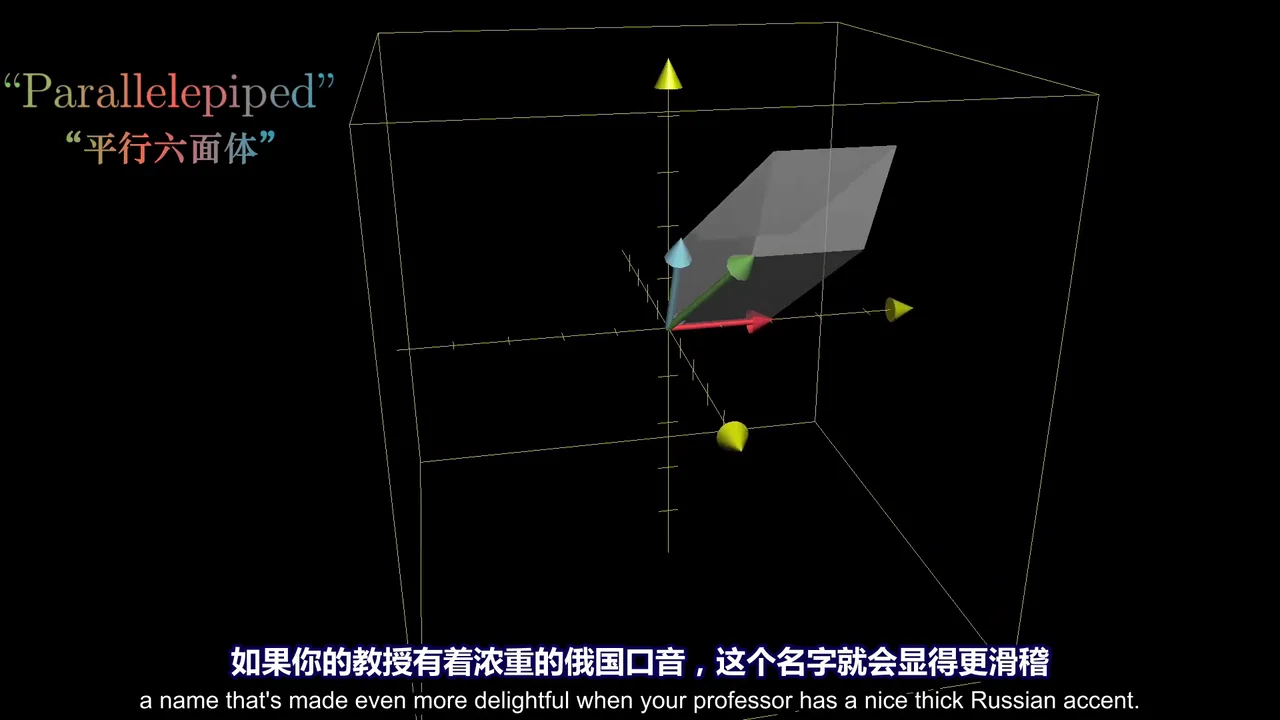
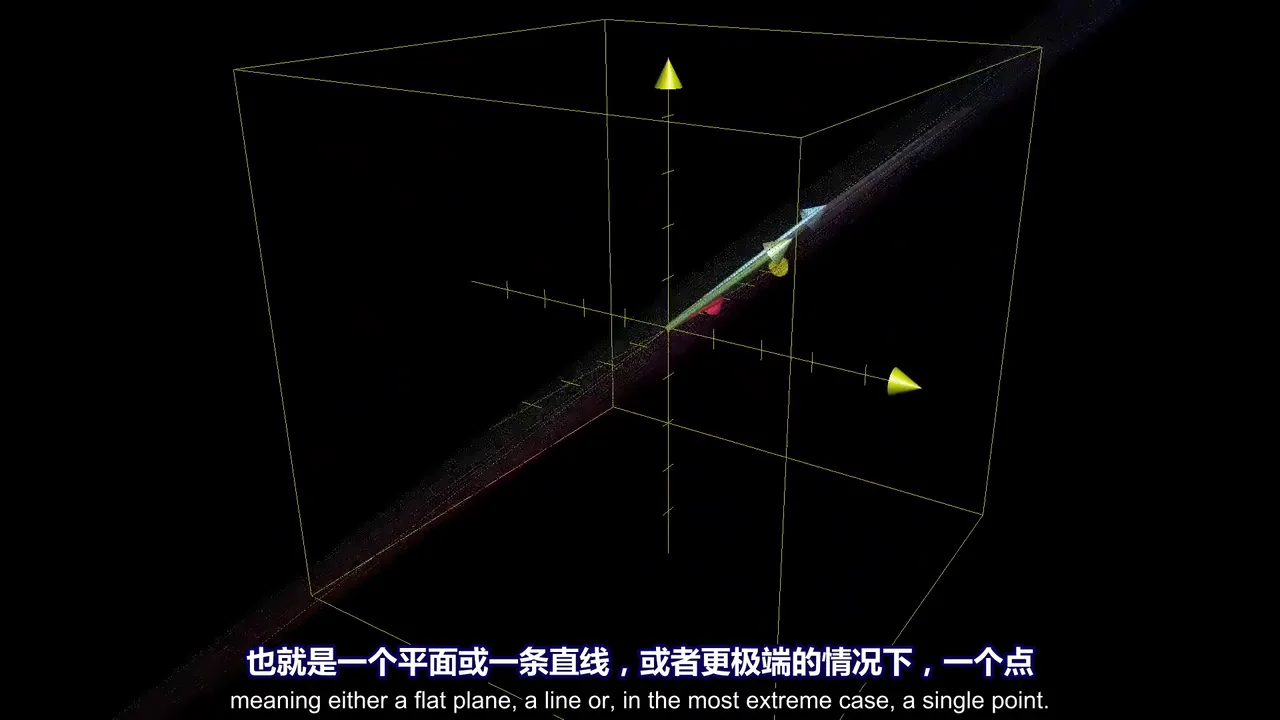
经三维线性变换后,这个单位立方体会斜扭成一个平行六面体(parallelepiped),行列式的绝对值就等于该平行六面体的体积。若 $\det=0$,则整个三维空间被压成体积为零的二维平面、一维直线或单个原点——对照第二章可知,这等价于矩阵的三列向量线性相关(其中至少一列落在其余列张成的空间内)。

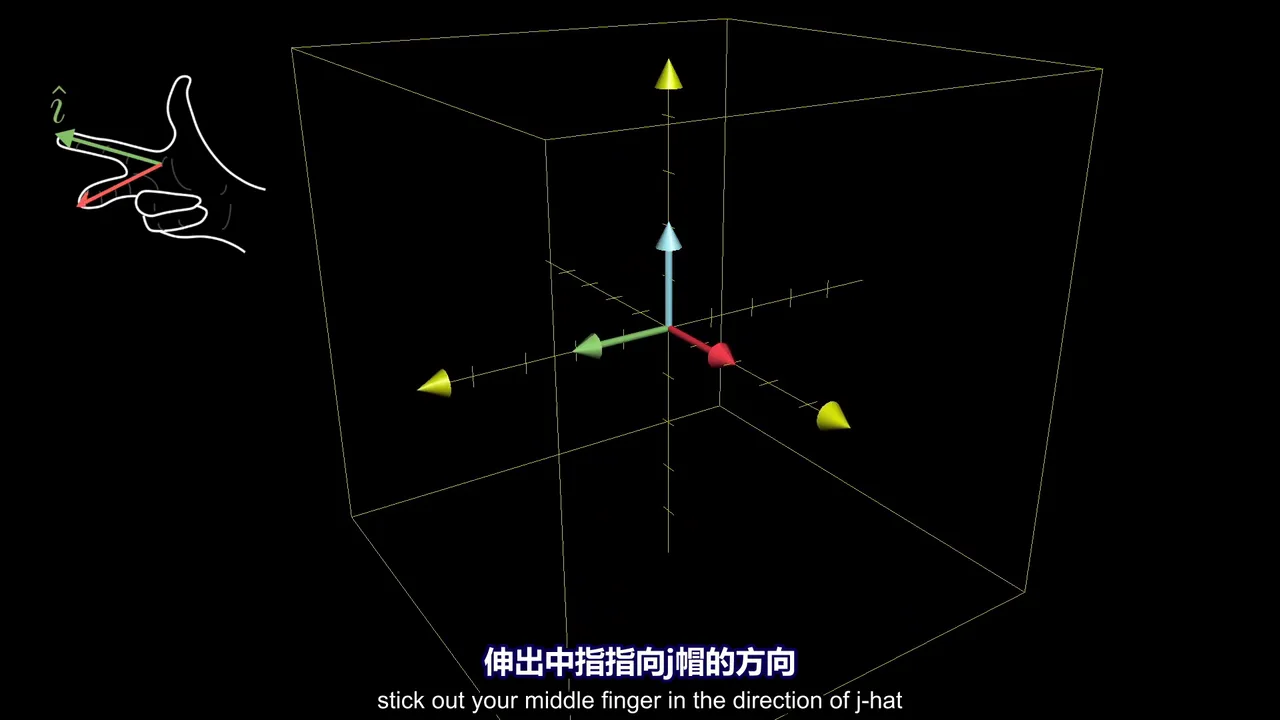
三维中的负行列式则由右手定则判定:伸出右手,令食指指向变换后的 $L(\hat{\imath})$,中指指向 $L(\hat{\jmath})$,竖起的大拇指指向 $L(\hat{k})$:

  • 若变换后仍能用右手自然比出上述三指方向,说明三维空间定向未改变,$\det > 0$。
  • 若变换后必须改用左手才能使食指、中指、大拇指分别对准 $L(\hat{\imath})$、$L(\hat{\jmath})$、$L(\hat{k})$,说明三维空间发生了手性翻转(镜像反转),$\det < 0$。
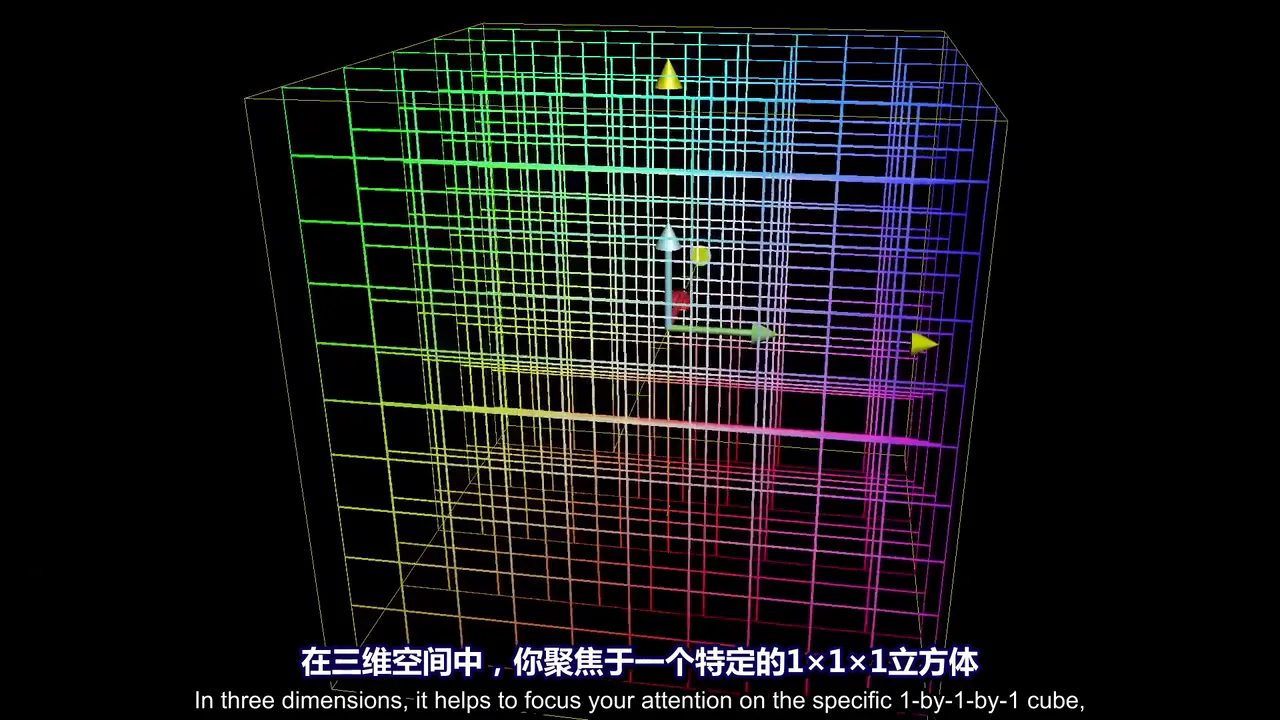
三维单位立方体:由 i-hat, j-hat, k-hat 张成 05:55
三维单位立方体:由 i-hat, j-hat, k-hat 张成画面重点:1×1×1 立方体初始体积为 1,网格呈三维彩线分布
立方体斜变为平行六面体(Parallelepiped) 06:16
立方体斜变为平行六面体(Parallelepiped)画面重点:灰色斜六面体的有向体积即为三维矩阵行列式
三维零行列式:空间坍缩成体积为零的平面 06:38
三维零行列式:空间坍缩成体积为零的平面画面重点:所有基向量共面,对应矩阵列向量线性相关
三维右手定则判别空间定向正负 07:08
三维右手定则判别空间定向正负画面重点:右手食指 i-hat、中指 j-hat、拇指 k-hat 与三轴一一对应
[05:31] ↗
以上就是在二维空间中对行列式的理解
So that's the understanding of determinants in two dimensions.
[05:34] ↗
你觉得行列式在三维空间中是什么意义?
What do you think it should mean for three dimensions?
[05:37] ↗
它告诉你的依然是变换前后的缩放比例 不过这次它说的是体积的缩放
It also tells you how much a transformation scales things, but this time, it tells you how much volumes get scaled.
[05:45] ↗
二维空间中 我们最容易考虑一个面积为1的特殊正方形 并观察变换对它的影响 在三维空间中,你聚焦于一个特定的1×1×1立方体 它的棱处于基向量i帽、j帽和k帽上
Just as in two dimensions, where this is easiest to think about by focusing on one particular square with an area 1 and watching only what happens to it, in three dimensions, it helps to focus your attention on the specific 1 by 1 by 1 cube whose edges are resting on the basis vectors, i-hat, j-hat and k-hat.
[06:04] ↗
在变换后,这个立方体可能就变成了一个斜不拉几的形状
After the transformation, that cube might get warped into some kind of slanty slanty cube.
[06:10] ↗
顺带一提,这个形状有个好听的名字——平行六面体 如果你的教授有着浓重的俄国口音,这个名字就会显得更滑稽
This shape, by the way, has the best name ever, parallelipiped, a name that's made even more delightful when your professor has a nice thick Russian accent.
[06:19] ↗
因为这个立方体的初始体积为1 而行列式给出的是体积缩放比例 所以你可以把行列式简单看作这个平行六面体的体积
Since this cube starts out with a volume of 1, and the determinant gives the factor by which any volume is scaled, you can think of the determinant simply as being the volume of that parallelipiped that the cube turns into.
[06:32] ↗
行列式为0则意味着整个空间被压缩为零体积的东西 也就是一个平面或一条直线,或者更极端的情况下,一个点
A determinant of 0 would mean that all of space is squished onto something with 0 volume, meaning either a flat plane, a line, or, in the most extreme case, onto a single point.
[06:44] ↗
看过第二章视频的朋友 可能会认得这是在说矩阵的列线性相关
Those of you who watched chapter 2 will recognize this as meaning that the columns of the matrix are linearly dependent.
[06:50] ↗
你明白为什么吗?
Can you see why?
[06:55] ↗
那么对于负值行列式呢?
What about negative determinants?
[06:57] ↗
它在三维空间中是什么意思?
What should that mean for three dimensions?
[06:59] ↗
有一种方法来描述三维空间的定向,那就是“右手定则”
One way to describe orientation in 3D is with the right hand rule.
[07:03] ↗
右手食指指向i帽的方向 伸出中指指向j帽的方向 当你把大拇指竖起来时,它就正好指向k帽的方向
Point the forefinger of your right hand in the direction of i-hat, stick out your middle finger in the direction of j-hat, and notice how when you point your thumb up, it's in the direction of k-hat.
[07:15] ↗
如果在变换后你仍然可以这么做 那么定向没有发生改变,行列式为正
If you can still do that after the transformation, orientation has not changed, and the determinant is positive.
[07:22] ↗
否则,如果在变换后你只能用左手这么做 说明定向发生了改变,行列式为负
Otherwise, if after the transformation it only makes sense to do that with your left hand, orientation has been flipped, and the determinant is negative.

二阶行列式公式 ad - bc 的几何面积推导

⏱ 07:32 – 08:43
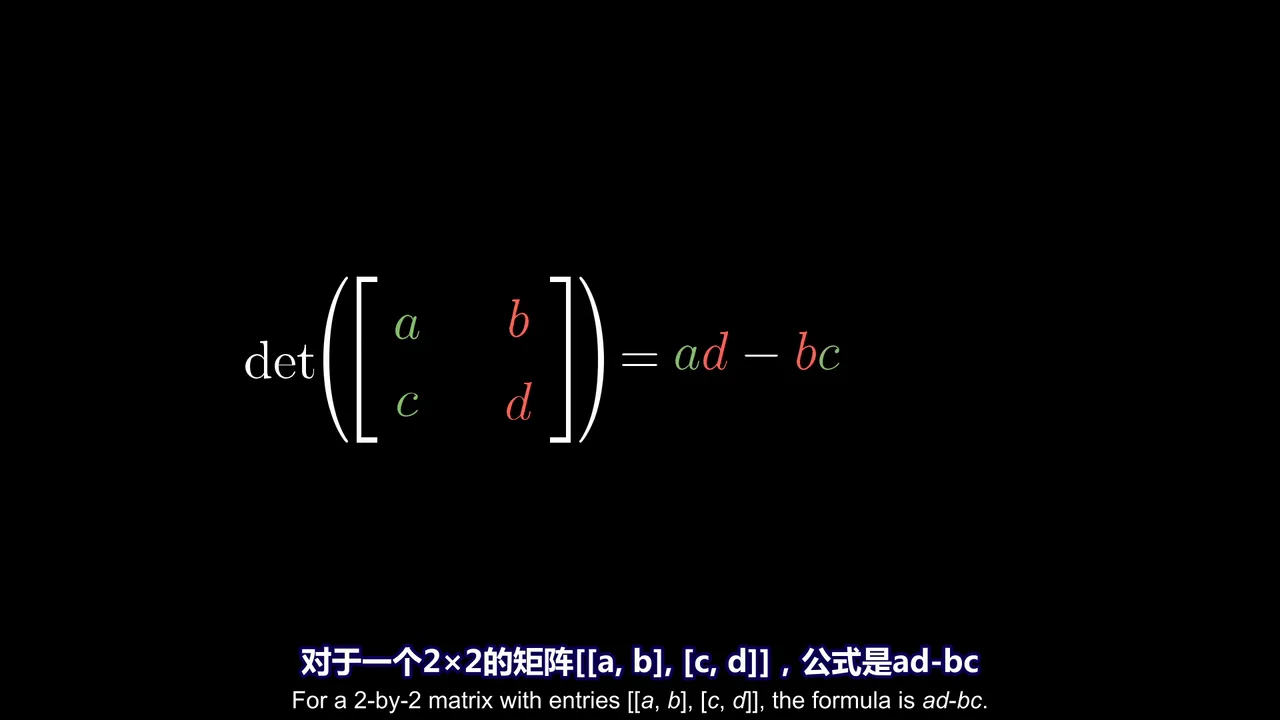
📐 二阶矩阵行列式计算公式
$$\det\begin{bmatrix} a & b \\ c & d \end{bmatrix} = ad - bc$$
第一列 (a, c) 为变换后 i-hat 的坐标,第二列 (b, d) 为变换后 j-hat 的坐标。

为什么恰好是 $ad - bc$?我们可以通过逐层放开非对角元来直观还原其面积来源:

  • 当 $b=0$ 且 $c=0$ 时:$a$ 表示 $\hat{\imath}$ 沿 $x$ 轴的拉伸比例,$d$ 表示 $\hat{\jmath}$ 沿 $y$ 轴的拉伸比例,单位正方形拉成 $a\times d$ 矩形,面积自然是 $ad$。
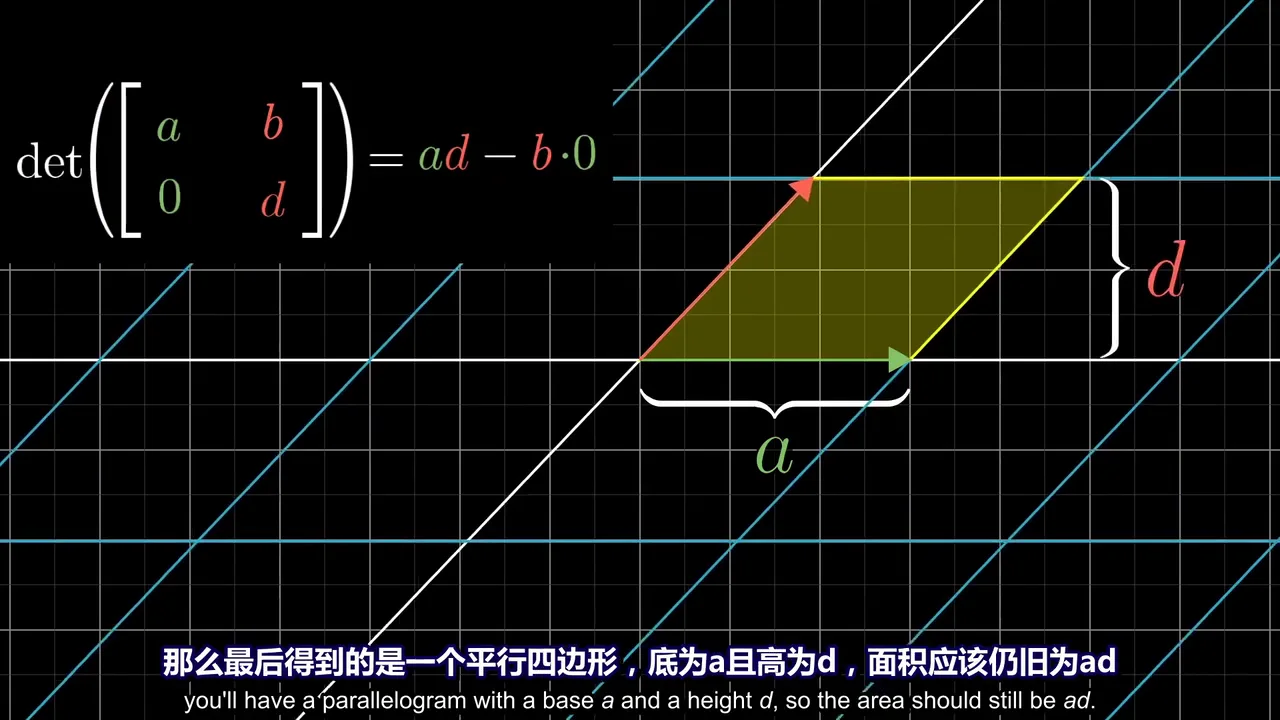
  • 当 $b$ 或 $c$ 中仅有一项为 $0$ 时(例如 $c=0$):$\hat{\imath}$ 落于 $(a,0)$,$\hat{\jmath}$ 落于 $(b,d)$,得到底为 $a$、高为 $d$ 的倾斜平行四边形,面积依然精确等于 $ad$。
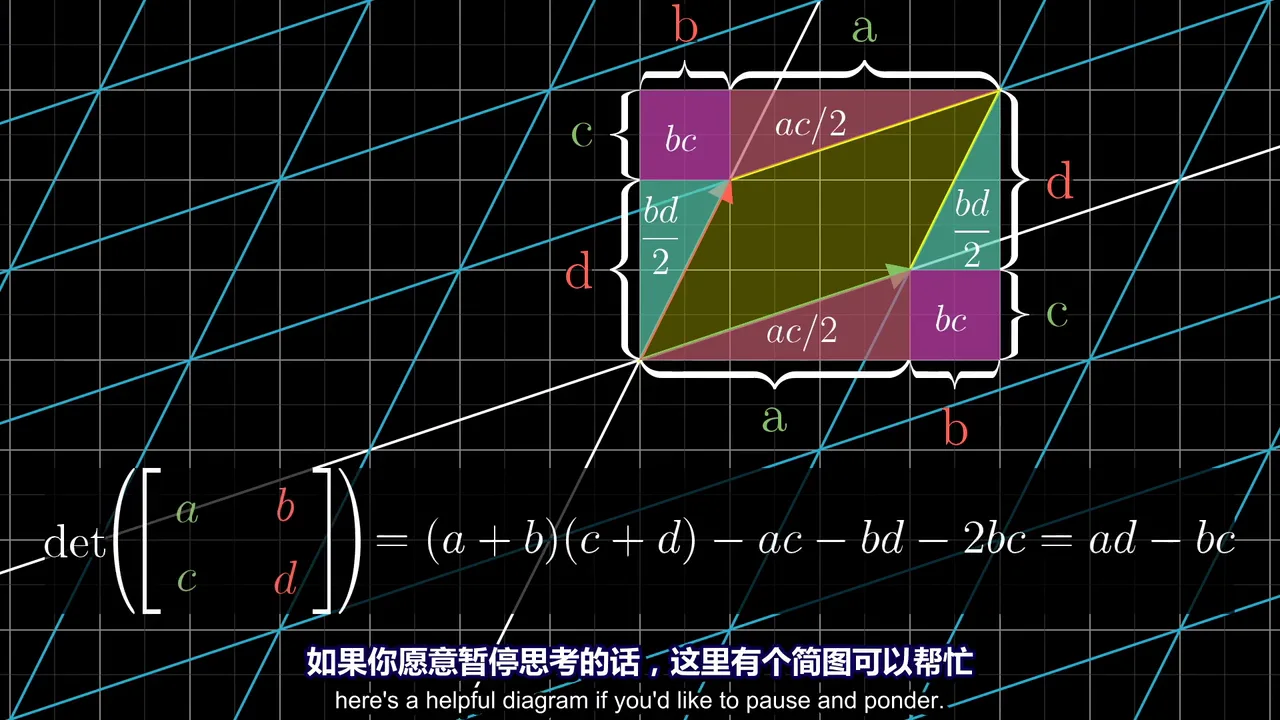
  • 当 $b$ 与 $c$ 均不为 $0$ 时:$bc$ 项刻画了平行四边形在对角线方向上被拉长或挤压的修正量。

视频第 8:42 给出的无字面积剖分图解极其优雅(取第一象限情形 $a,b,c,d>0$):把由 $(a,c)$ 与 $(b,d)$ 张成的黄色平行四边形框在一个宽为 $a+b$、高为 $c+d$ 的外接大矩形内。大矩形总面积减去四周多余部分即可得平行四边形面积:
📐 外接大矩形的面积剖分恒等式
$$(a+b)(c+d) - 2\cdot\frac{ac}{2} - 2\cdot\frac{bd}{2} - 2bc = (ac + ad + bc + bd) - ac - bd - 2bc = ad - bc$$
多余区域由两个面积为 ac/2 的直角三角形、两个面积为 bd/2 的直角三角形,以及两个面积为 bc 的角矩形组成。
2×2 行列式标准公式 det = ad - bc 07:41
2×2 行列式标准公式 det = ad - bc画面重点:公式展示:a, d 为绿色和红色主对角元素,b, c 为斜对角元素
单侧为零情况:c = 0 时面积仍为底 a 乘高 d 08:18
单侧为零情况:c = 0 时面积仍为底 a 乘高 d画面重点:倾斜平行四边形与等底等高矩形同积,bc 项贡献为 0
一般情形 ad - bc 的外接大矩形面积剖分图 08:42
一般情形 ad - bc 的外接大矩形面积剖分图画面重点:边长 (a+b)×(c+d) 矩形减去两对三角形与两块紫色 bc 矩形
[07:32] ↗
如果你以前没有学过行列式,那你现在大概就在想 到底怎么计算行列式呢?
So, if you haven't seen it before, you're probably wondering by now, how do you actually compute the determinant?
[07:38] ↗
对于一个2×2的矩阵[[a, b], [c, d]],公式是ad-bc
For a 2x2 matrix with entries a, b, c, d, the formula is a times d minus b times c.
[07:46] ↗
以下是对这个公式来源的直观理解
Here's part of an intuition for where this formula comes from.
[07:49] ↗
假如b和c均恰好为0
Let's say that the terms b and c both happened to be 0.
[07:52] ↗
那么a告诉你i帽在x轴方向的伸缩比例 d告诉你j帽在y轴方向的伸缩比例
Then, the term a tells you how much i-hat is stretched in the x direction, and the term d tells you how much j-hat is stretched in the y direction.
[08:03] ↗
因为其他项均为0,所以ad给出的是单位正方形伸缩后形成的矩形的面积 就像之前[[3, 0], [0, 2]]那个例子一样,这一点合情合理
So, since those other terms are 0, it should make sense that a times d gives the area of the rectangle that our favorite unit square turns into, kind of like the 3, 0, 0, 2 example from earlier.
[08:15] ↗
即便b和c中只有一项为0,你也会得到一个底为a、高为d的平行四边形。
Even if only one of b or c are 0, you'll have a parallelogram with a base a and a height d.
[08:22] ↗
所以它的面积应该仍旧为a乘以d。
So, the area should still be a times d.
[08:25] ↗
粗略地说,如果b和c均不为0 那么bc项就会告诉你平行四边形在对角方向上拉伸或压缩了多少
Loosely speaking, if both b and c are non-zero, then that b times c term tells you how much this parallelogram is stretched or squished in the diagonal direction.
[08:37] ↗
对于那些想迫切知道bc项精确含义的人 如果你愿意暂停思考的话,这里有个简图可以帮忙
For those of you hungry for a more precise description of this b times c term, here's a helpful diagram if you'd like to pause and ponder.

计算与本质之辨及乘积行列式思考题

⏱ 08:44 – 09:52

对于二阶乃至三阶行列式的手算(例如三阶行列式按第一行余子式展开:$\det\begin{bmatrix}a&b&c\\d&e&f\\g&h&i\end{bmatrix} = a\det\begin{bmatrix}e&f\\h&i\end{bmatrix} - b\det\begin{bmatrix}d&f\\g&i\end{bmatrix} + c\det\begin{bmatrix}d&e\\g&h\end{bmatrix}$),除了用具体数字刷几道题外,动画能展示的并不多。Grant 特别指出:机械的代数展开计算并不属于“线性代数的本质”,真正属于本质的是理解行列式代表面积或体积的有向缩放因子。
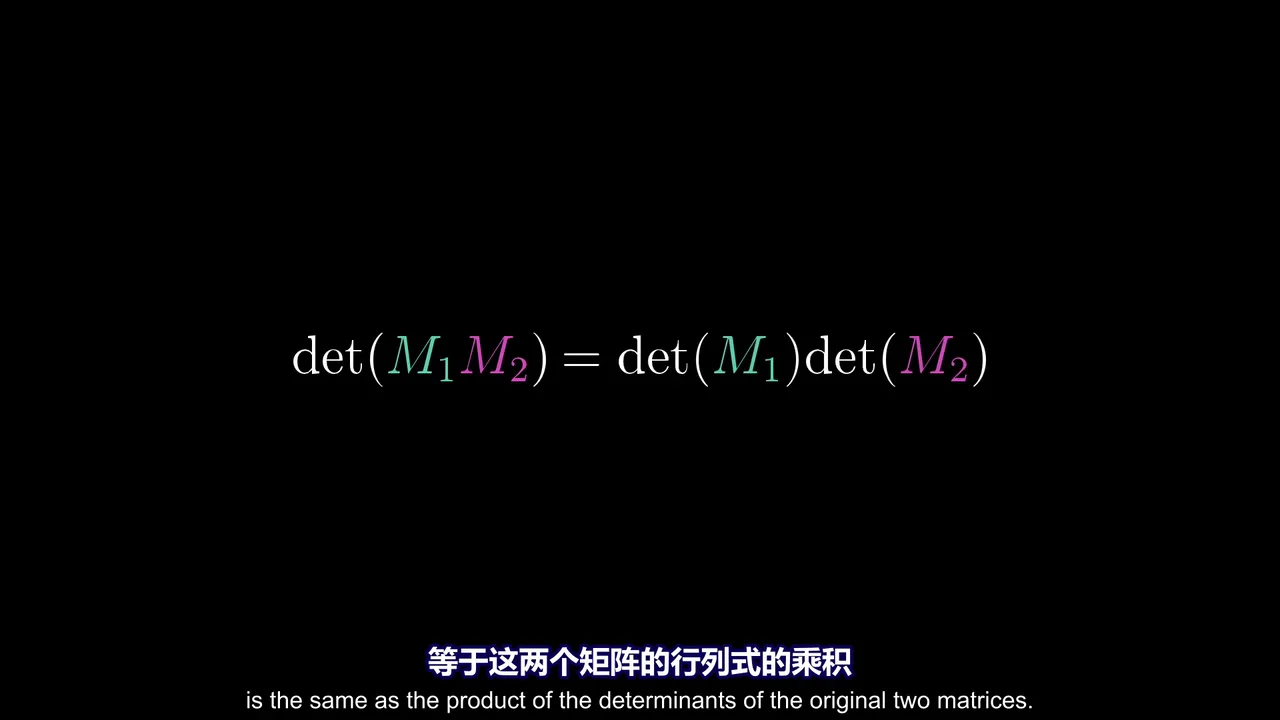
📐 矩阵乘积的行列式法则
$$\det(M_1 M_2) = \det(M_1)\det(M_2)$$
若用纯代数展开验证需要繁琐的多项式化简,但在几何视角下一句话即可秒证。
💡 思考题一句话几何证明
线性变换复合 $M_1 M_2$ 相当于先施加变换 $M_2$ 把任意区域的面积缩放 $\det(M_2)$ 倍,紧接着施加变换 $M_1$ 把一切区域的面积再统一缩放 $\det(M_1)$ 倍,因此两次变换下来总缩放比例自然就是 $\det(M_1)\det(M_2)$。
⚠️ 下一章预告与常见误区
切忌把 $\det(M_1+M_2)$ 误当作 $\det(M_1)+\det(M_2)$:矩阵加法并非变换复合,一般并不满足线性可加性;而矩阵乘法对应变换连续叠加,因此缩放倍率必然相乘。下一章我们将利用行列式是否为零,解开线性方程组的几何结构。
乘积的行列式等于行列式的乘积 09:30
乘积的行列式等于行列式的乘积画面重点:核心等式 det(M1 M2) = det(M1) det(M2) 思考题画面
[08:44] ↗
如果你觉得徒手计算行列式是你必须掌握的 那么唯一的方法就是用一些矩阵来练习
Now, if you feel like computing determinants by hand is something that you need to know, the only way to get it down is to just practice it with a few.
[08:51] ↗
训练计算的过程实在没有太多东西需要我讲解或是用动画演示的
There's really not that much I can say or animate that's going to drill in the computation.
[08:56] ↗
对三阶行列式来说,这个观点“三倍”正确
This is all triply true for three-dimensional determinants.
[08:59] ↗
这里有个计算公式,如果你觉得你必须掌握它 那就应该用一些矩阵来练习,或者去看看Sal Khan是怎么计算的
There is a formula, and if you feel like that's something you need to know, you should practice with a few matrices, or, you know, go watch Sal Khan work through a few.
[09:07] ↗
说实话,我不认为这些计算过程属于线性代数的本质 但是我确实认为理解行列式所代表的意义在它当中
Honestly, though, I don't think that those computations fall within the essence of linear algebra, but I definitely think that understanding what the determinant represents falls within that essence.
[09:18] ↗
下期视频开始前,你可以考虑这个有趣的问题
Here's kind of a fun question to think about before the next video.
[09:21] ↗
如果你将两个矩阵相乘 它们乘积的行列式 等于这两个矩阵的行列式的乘积
If you multiply two matrices together, the determinant of the resulting matrix is the same as the product of the determinants of the original two matrices.
[09:31] ↗
如果你想用数值方法证明,那要耗费你不少时间 不过,看看你能不能只用一句话就解释清楚它的道理
If you tried to justify this with numbers, it would take a really long time, but see if you can explain why this makes sense in just one sentence.
[09:42] ↗
下期视频中,我会将目前涉及的线性变换的思想 与线性代数中最有用的领域之一——线性方程组相结合 到时候再见!
Next up, I'll be relating the idea of linear transformations covered so far to one of the areas where linear algebra is most useful, linear systems of equations. See you then!

📝 几何直觉自测(点击题目展开解答)

Q1. 一个二维线性变换把直线 $y=0$ 上的单位向量映到 $(1,0)$,把 $\hat{\jmath}$ 映到 $(1,1)$,它对平面上任意半径为 $5$ 的圆的面积造成什么影响?▼
该矩阵为 $\begin{bmatrix}1 & 1 \\ 0 & 1\end{bmatrix}$,其行列式 $\det = 1\cdot 1 - 1\cdot 0 = 1$。因为行列式对所有区域取相同缩放比例,所以圆虽然被斜切为椭圆,面积依然保持 $25\pi$ 不变。
Q2. 如果矩阵 $A$ 的行列式 $\det(A) = -3$,在二维和三维中分别代表什么几何含义?▼
在二维中代表所有区域面积放大为原来的 $3$ 倍,同时空间定向反转(变换后 $\hat{\jmath}$ 跑到 $\hat{\imath}$ 的右侧,相当于纸面翻面);在三维中代表所有区域体积放大为原来的 $3$ 倍,同时空间手性反转(原本满足右手定则的基向量必须改用左手才能对应)。
Q3. 用几何直觉解释:为什么当三维矩阵的三个列向量线性相关时,其行列式必然为 $0$?▼
矩阵的三列分别是单位立方体三条棱 $\hat{\imath},\hat{\jmath},\hat{k}$ 变换后的向量。三列线性相关意味着它们落在同一个过原点的平面、直线甚至原点上,无法张成三维空间,因此变换后的平行六面体体积为 $0$,即 $\det = 0$。
Q4. 如何用一句话证明 $\det(M_1 M_2) = \det(M_1)\det(M_2)$?▼
复合变换 $M_1 M_2$ 先用 $M_2$ 将所有区域面积(或体积)缩放 $\det(M_2)$ 倍,再用 $M_1$ 在此基础上缩放 $\det(M_1)$ 倍,总缩放倍数自然是二者的乘积 $\det(M_1)\det(M_2)$。