线性代数的本质 · 精研复习站

第 08-1 集:叉积的标准介绍

Cross products
一句话直觉:三维叉积 $\vec{v}\times\vec{w}$ 产生一个新向量:它的长度等于两向量张成平行四边形的面积,方向垂直于该平面并由右手定则唯一确定。

本讲作为叉积两部曲的第一篇,聚焦于叉积的标准几何图像与代数计算方法。我们首先从“二维伪叉积”出发,用两向量张成平行四边形的有向面积和 $2\times 2$ 行列式建立方向与顺序的直觉;随后进入真正的三维向量叉积,阐明其长度(平行四边形面积)与方向(垂直平面且符合右手定则)的几何定义;最后引入带有基向量符号的三阶“伪行列式”计算口诀,为下一讲从线性变换与对偶性角度揭开这一神秘技巧的本质埋下伏笔。

▶ YouTube 原片 📺 B站官方双语 P11 🎙 B站中文配音 P11

前置依赖

← 第 04·附注 集 · 三维空间的线性变换:熟悉三维空间标准基向量 $\hat{\imath},\hat{\jmath},\hat{k}$ 的方向与三维坐标系。
← 第 05 集 · 行列式:掌握 $2\times 2$ 与 $3\times 3$ 行列式作为有向面积/体积缩放因子以及定向翻转(负行列式)的核心直觉。
← 第 07 集 · 点积与对偶性:初步了解“对偶性”思想,为下一讲彻底看懂叉积的行列式构造提供核心工具。

后续延伸

→ 第 08-2 集 · 以线性变换的眼光看叉积:从三维空间到数轴的线性变换与对偶向量出发,严格证明三阶伪行列式为何恰好算出具有上述几何性质的向量。
二维叉积(有向面积行列式)
$$\vec{v}\times_{2\mathrm{D}}\vec{w} = \det\begin{bmatrix} v_1 & w_1 \\ v_2 & w_2 \end{bmatrix} = v_1 w_2 - v_2 w_1$$
叉积的反交换律与双线性
$$\vec{w}\times\vec{v} = -(\vec{v}\times\vec{w}),\qquad (c\vec{v})\times\vec{w} = c(\vec{v}\times\vec{w})$$
三维叉积模长
$$\|\vec{v}\times\vec{w}\| = \text{Area}(\vec{v},\vec{w}) = \|\vec{v}\|\|\vec{w}\|\sin\theta$$
三维叉积的三阶伪行列式
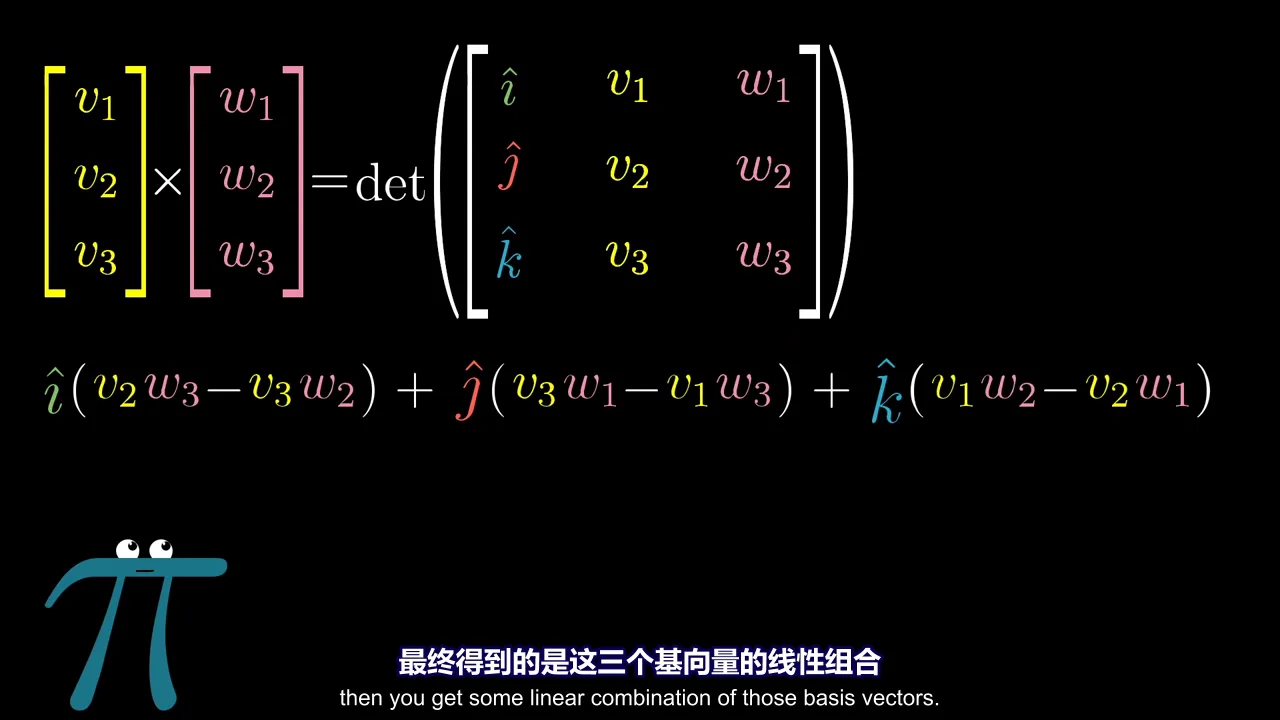
$$\vec{v}\times\vec{w} = \det\begin{bmatrix} \hat{\imath} & v_1 & w_1 \\ \hat{\jmath} & v_2 & w_2 \\ \hat{k} & v_3 & w_3 \end{bmatrix} = (v_2 w_3 - v_3 w_2)\hat{\imath} + (v_3 w_1 - v_1 w_3)\hat{\jmath} + (v_1 w_2 - v_2 w_1)\hat{k}$$

二维向量叉积:有向面积与定向

⏱ 00:09 – 02:14

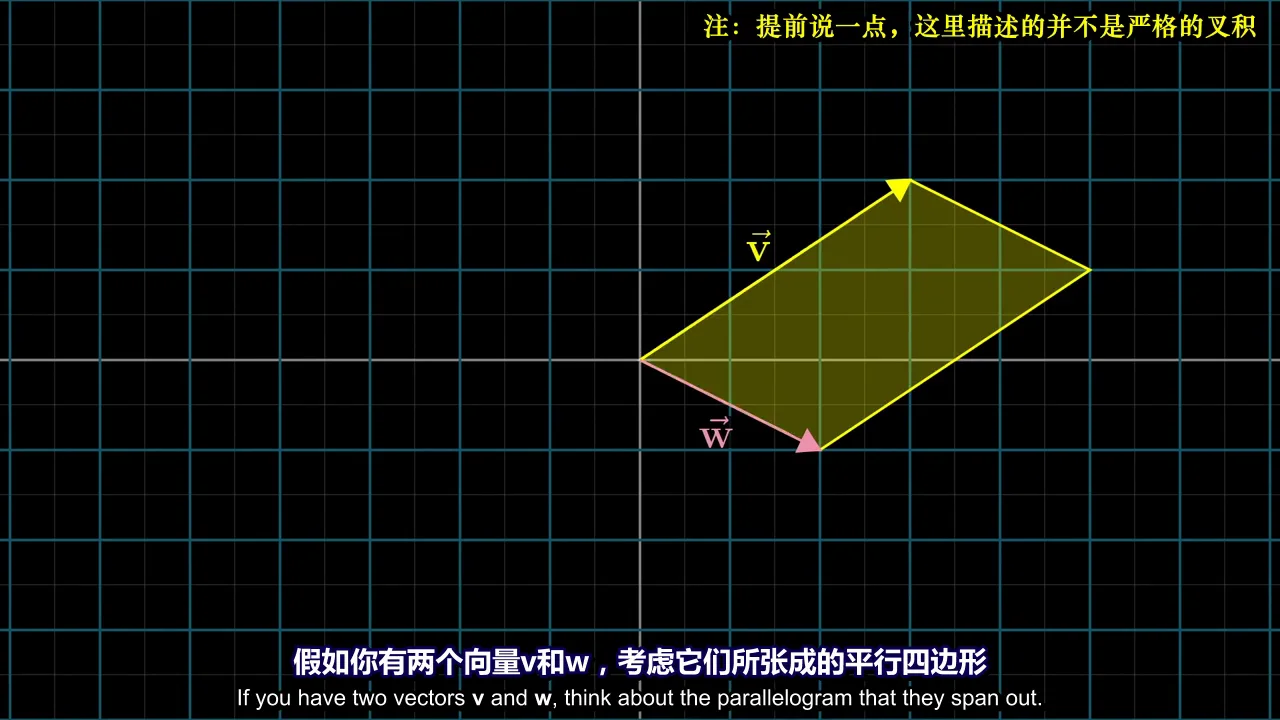
理解三维叉积之前,先从二维平面入手。设平面上有两个向量 $\vec{v}$ 与 $\vec{w}$,分别把它们的复制品平移到对方的终点,围成一个平行四边形。二维版本叉积 $\vec{v}\times\vec{w}$ 的绝对值,正是这个平行四边形的面积。

除了面积大小,还必须考虑定向(Orientation)带来的正负号:如果 $\vec{v}$ 在 $\vec{w}$ 的右侧,则 $\vec{v}\times\vec{w}$ 为正;如果 $\vec{v}$ 在 $\vec{w}$ 的左侧,则结果为负(面积的相反数)。这意味着叉积不满足交换律,交换次序会反号:$\vec{w}\times\vec{v} = -(\vec{v}\times\vec{w})$。
💡 用标准基向量记住正负定向
空间的标准定向由基向量顺序决定:默认 $\hat{\imath}$ 叉乘 $\hat{\jmath}$ 为正。在常规坐标系中,$\hat{\imath}$ 位于 $\hat{\jmath}$ 的右侧,因此只要第一个向量在第二个向量的右侧,二维叉积就取正值;反之取负。例如当平行四边形面积为 $7$ 且 $\vec{v}$ 在 $\vec{w}$ 左侧时,$\vec{v}\times\vec{w} = -7$。
二维向量 $\vec{v}$ 与 $\vec{w}$ 各自平移副本所张成的平行四边形区域 00:45
二维向量 $\vec{v}$ 与 $\vec{w}$ 各自平移副本所张成的平行四边形区域画面重点:黄色 $\vec{v}$、粉色 $\vec{w}$ 与半透明平行四边形
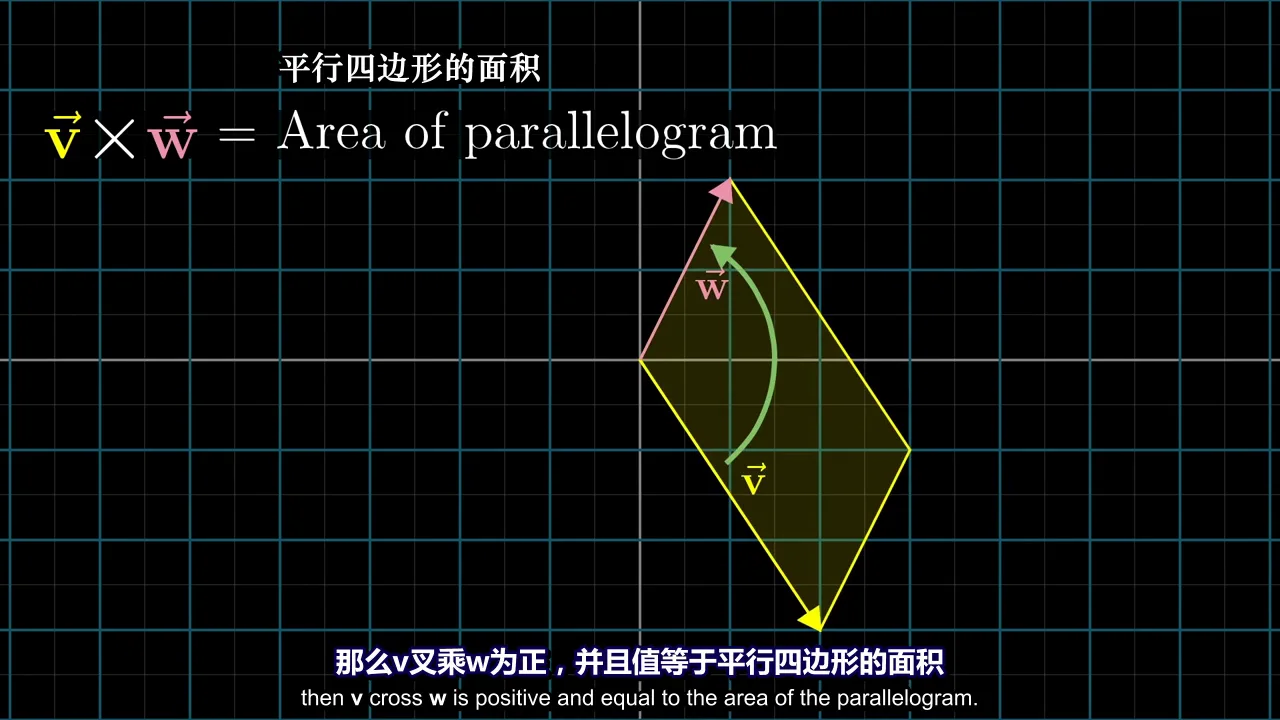
正定向情形:当 $\vec{v}$ 位于 $\vec{w}$ 右侧时,$\vec{v}\times\vec{w}$ 等于平行四边形正面积 01:17
正定向情形:当 $\vec{v}$ 位于 $\vec{w}$ 右侧时,$\vec{v}\times\vec{w}$ 等于平行四边形正面积画面重点:逆时针箭头与 $\vec{v}\times\vec{w} = \text{Area}$ 公式
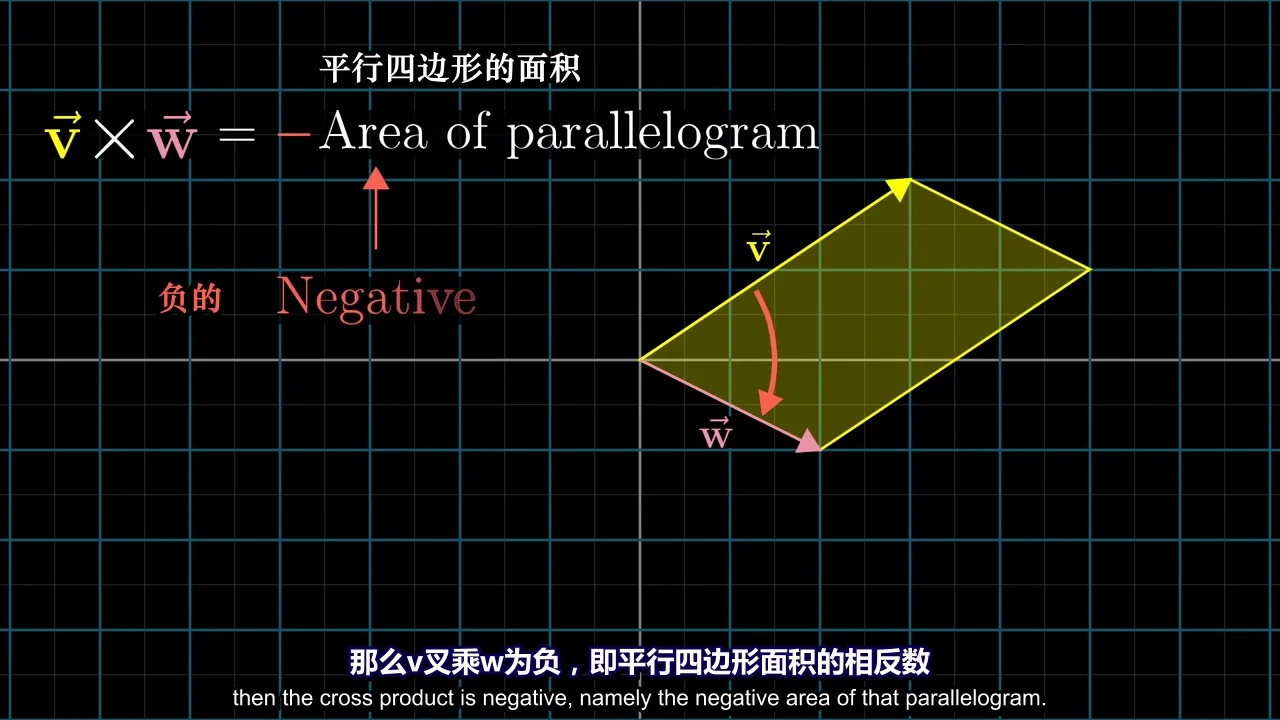
负定向情形:当 $\vec{v}$ 位于 $\vec{w}$ 左侧时,$\vec{v}\times\vec{w}$ 为负面积 01:26
负定向情形:当 $\vec{v}$ 位于 $\vec{w}$ 左侧时,$\vec{v}\times\vec{w}$ 为负面积画面重点:顺时针红色弧线与 Negative 符号标注
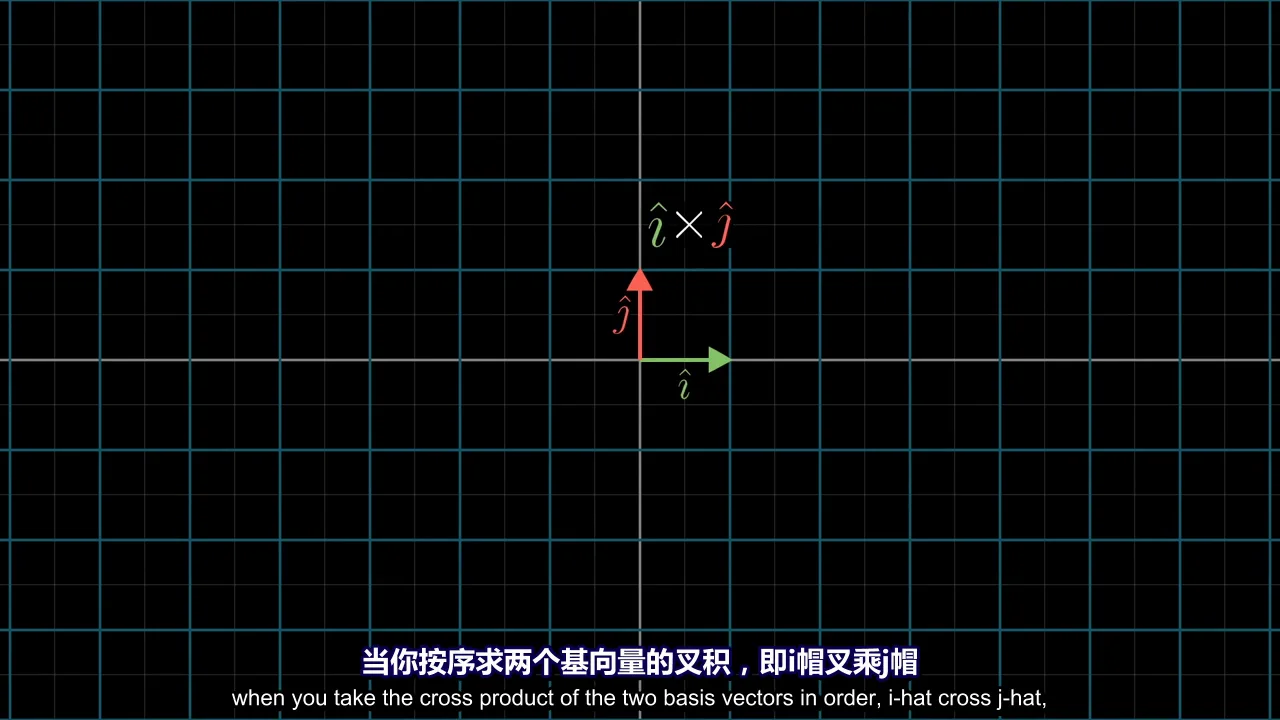
定向锚点:标准基向量顺序 $\hat{\imath}\times\hat{\jmath}$ 为正,因 $\hat{\imath}$ 在 $\hat{\jmath}$ 右侧 01:45
定向锚点:标准基向量顺序 $\hat{\imath}\times\hat{\jmath}$ 为正,因 $\hat{\imath}$ 在 $\hat{\jmath}$ 右侧画面重点:绿色 $\hat{\imath}$ 与红色 $\hat{\jmath}$ 构成的单位定向基准
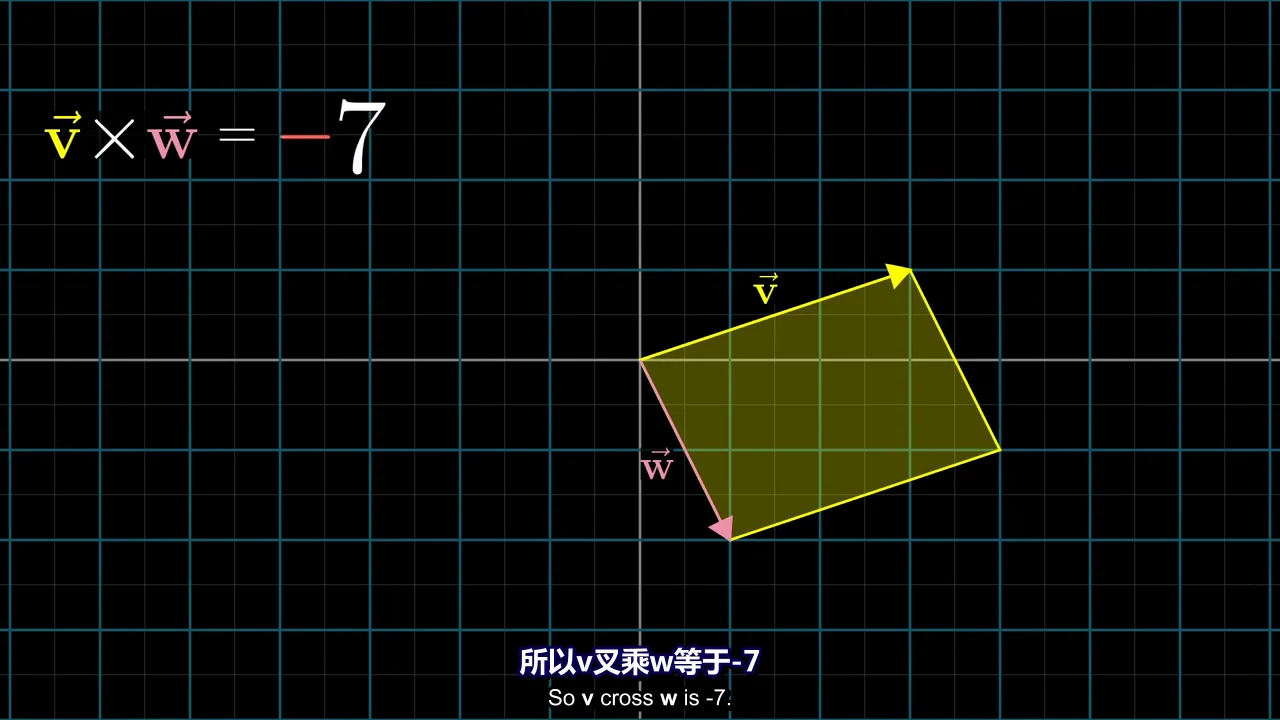
算例演示:平行四边形面积为 $7$,但 $\vec{v}$ 在 $\vec{w}$ 左侧,故 $\vec{v}\times\vec{w}=-7$ 02:12
算例演示:平行四边形面积为 $7$,但 $\vec{v}$ 在 $\vec{w}$ 左侧,故 $\vec{v}\times\vec{w}=-7$画面重点:$\vec{v}\times\vec{w}=-7$ 标注与对应平行四边形
[00:09] ↗
上期视频中,我讨论了点积 不仅展示了点积的标准介绍方法 还在更深层次说明了它与线性变换的关联
Last video I talked about the dot product, showing both the standard introduction to the topic, as well as a deeper view of how it relates to linear transformations.
[00:19] ↗
我想以相同的方式来讨论叉积 它既有着标准介绍方法 又可从线性变换的角度深刻理解 不过这一次我会分成两期视频
I'd like to do the same thing for cross products, which also have a standard introduction, along with a deeper understanding in the light of linear transformations, but this time I'm dividing it into two separate videos.
[00:30] ↗
在这期视频里,我会切中学生通常学习叉积时的要点 在下期视频里,我会展示一种教学中不常见的 但是学习起来又让人很满足的观点
Here, I'll try to hit the main points that students are usually shown about the cross product, and in the next video I'll be showing a view which is less commonly taught, but really satisfying when you learn it.
[00:41] ↗
我们从二维空间开始说起
We'll start in two dimensions.
[00:42] ↗
假如你有两个向量v和w,考虑它们所张成的平行四边形
If you have two vectors, v and w, think about the parallelogram that they span out.
[00:48] ↗
这句话的意思是,你取一份v的副本,将它的起点移到w的终点 再取一份w的副本,将它的起点移到v的终点 屏幕上显示的这四个向量围成了一个平行四边形
What I mean by that is that if you take a copy of v and move its tail to the tip of w, and you take a copy of w and move its tail to the tip of v, the four vectors now on the screen enclose a certain parallelogram.
[01:02] ↗
v和w的叉积(写作X形乘积符号) 就是这个平行四边形的面积
The cross product of v and w, written with the x-shaped multiplication symbol, is the area of this parallelogram.
[01:11] ↗
嗯...差不多是这样,我们还要考虑定向问题
Well, almost.
[01:12] ↗
嗯...差不多是这样,我们还要考虑定向问题
We also need to consider orientation.
[01:14] ↗
大致来讲,如果v在w的右侧 那么v叉乘w为正,并且值等于平行四边形的面积
Basically, if v is on the right of w, then v cross w is positive and equal to the area of the parallelogram.
[01:22] ↗
但是如果v在w的左侧 那么v叉乘w为负,即平行四边形面积的相反数
But if v is on the left of w, then the cross product is negative, namely the negative area of that parallelogram.
[01:29] ↗
注意,这就是说顺序会对叉积有影响
Notice this means that order matters.
[01:31] ↗
如果你不计算w叉乘v,而是交换二者位置计算 那么叉积就是之前计算结果的相反数
If you swapped v and w, instead taking w cross v, the cross product would become the negative of whatever it was before.
[01:39] ↗
我用来记住顺序的方法是 当你按序求两个基向量的叉积,即i帽叉乘j帽 结果应该是正的
The way I always remember the ordering here is that when you take the cross product of the two basis vectors in order, i-hat cross j-hat, the result should be positive.
[01:48] ↗
实际上,基向量的顺序就是定向的基础
In fact, the order of your basis vectors is what defines orientation.
[01:52] ↗
因为i帽在j帽的右侧 所以我记得v在w的右侧时,v叉乘w为正
So since i-hat is on the right of j-hat, I remember that v cross w has to be positive whenever v is on the right of w.
[02:02] ↗
以现在所示的向量为例 我直接告诉你这个平行四边形的面积为7
So for example, with the vectors shown here, I'll just tell you that the area of that parallelogram is seven.
[02:08] ↗
又因为v在w的左侧,它们的叉积应该是负的
And since v is on the left of w, the cross product should be negative.
[02:12] ↗
所以v叉乘w等于-7
So v cross w is negative seven.

利用二维行列式计算与代数直觉

⏱ 02:16 – 04:57

如何不靠目测直接算出二维有向面积?答案正是《行列式》(06-determinant):把 $\vec{v}$ 的坐标写为 $2\times 2$ 矩阵的第一列,把 $\vec{w}$ 的坐标写为第二列,求行列式即可。几何上,该矩阵对应把 $\hat{\imath}$、$\hat{\jmath}$ 映到 $\vec{v}$、$\vec{w}$ 的线性变换,面积为 $1$ 的单位正方形恰好被变成这个平行四边形,而行列式度量面积缩放比例并在定向翻转时取负。

📐 二维叉积的行列式算例
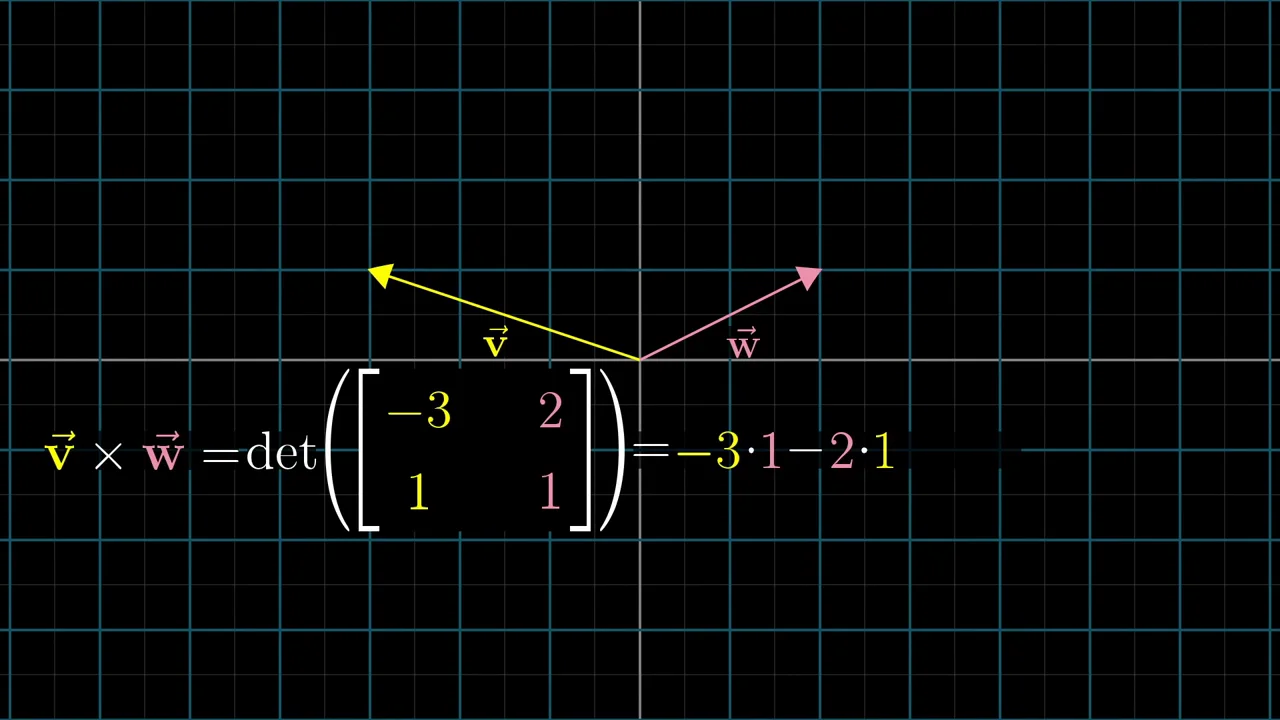
$$\vec{v}=\begin{bmatrix}-3\\1\end{bmatrix},\;\vec{w}=\begin{bmatrix}2\\1\end{bmatrix}\;\Longrightarrow\; \det\begin{bmatrix}-3 & 2 \\ 1 & 1\end{bmatrix} = (-3)(1) - 2(1) = -5$$
面积为 $5$,因 $\vec{v}$ 在 $\vec{w}$ 左侧(定向翻转)而得负值 $-5$。
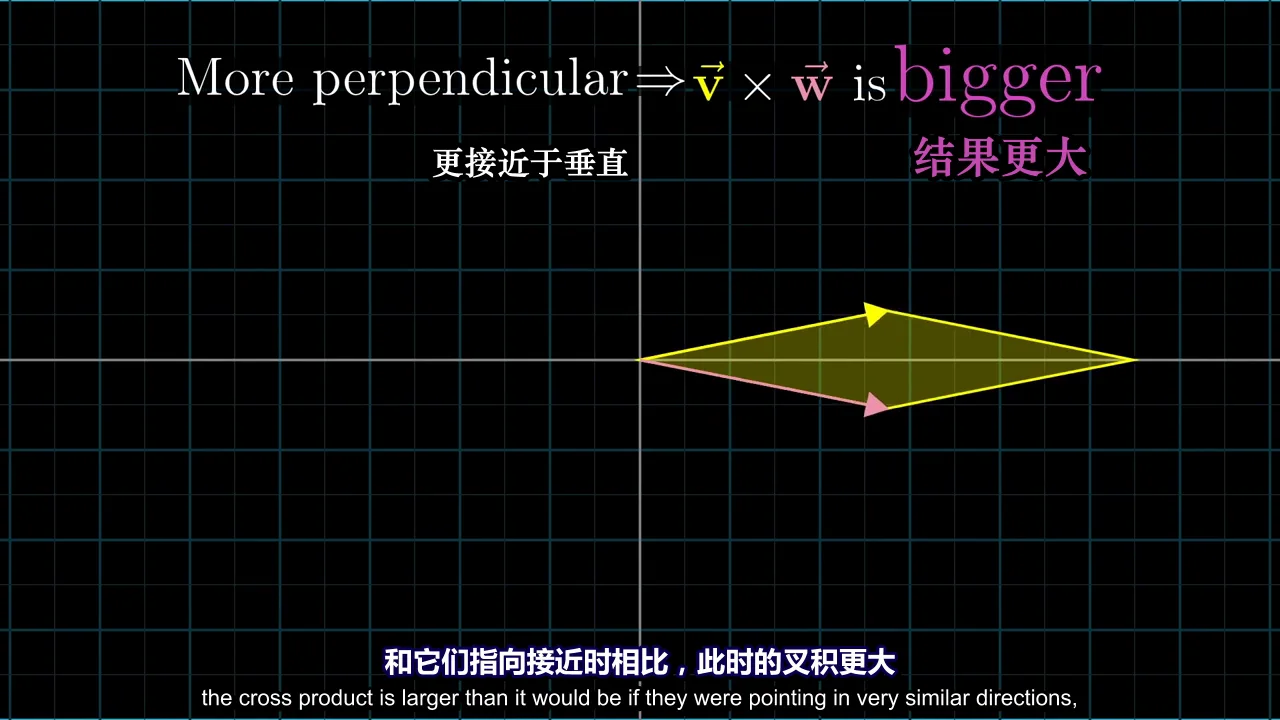
  • 垂直最大化:两向量越接近相互垂直,平行四边形越接近矩形,面积(叉积绝对值)越大;若两向量共线,平行四边形退化为线段,叉积为 $0$。
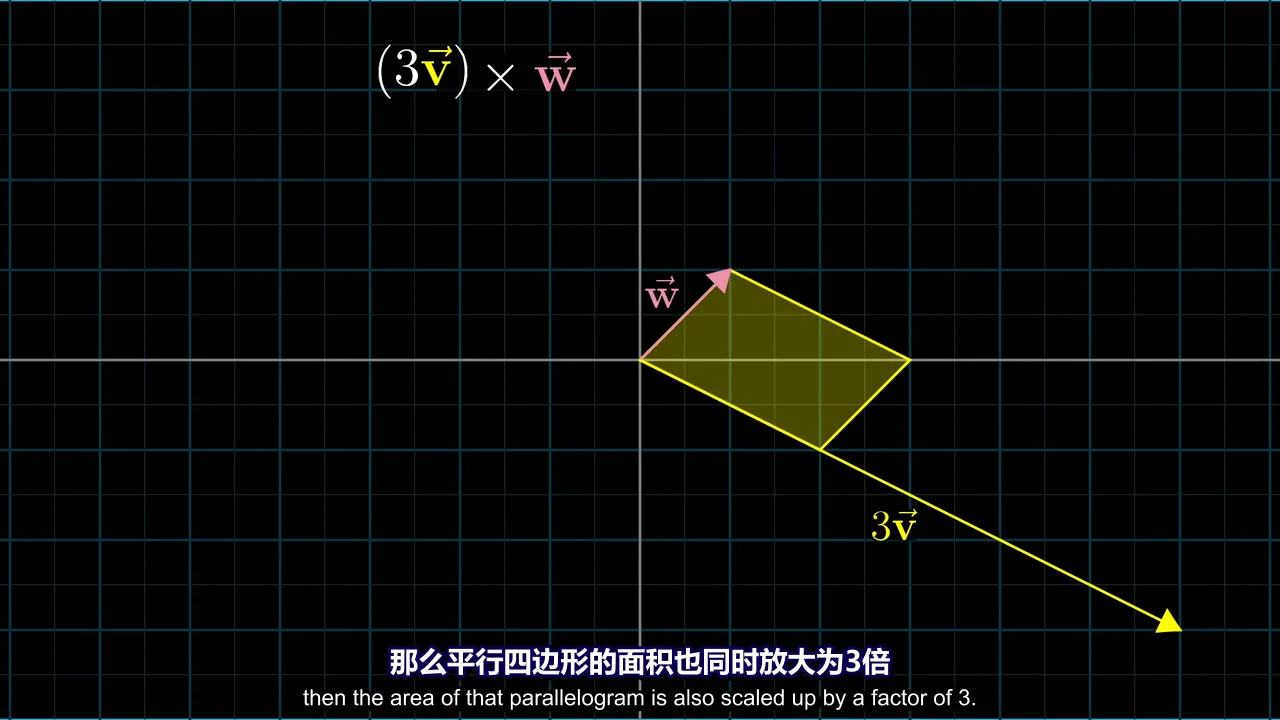
  • 线性缩放律:将其中一个向量放大 $3$ 倍(如 $3\vec{v}$),平行四边形的边长按比例伸长 $3$ 倍而高不变,面积同样放大 $3$ 倍,即 $(3\vec{v})\times\vec{w} = 3(\vec{v}\times\vec{w})$。
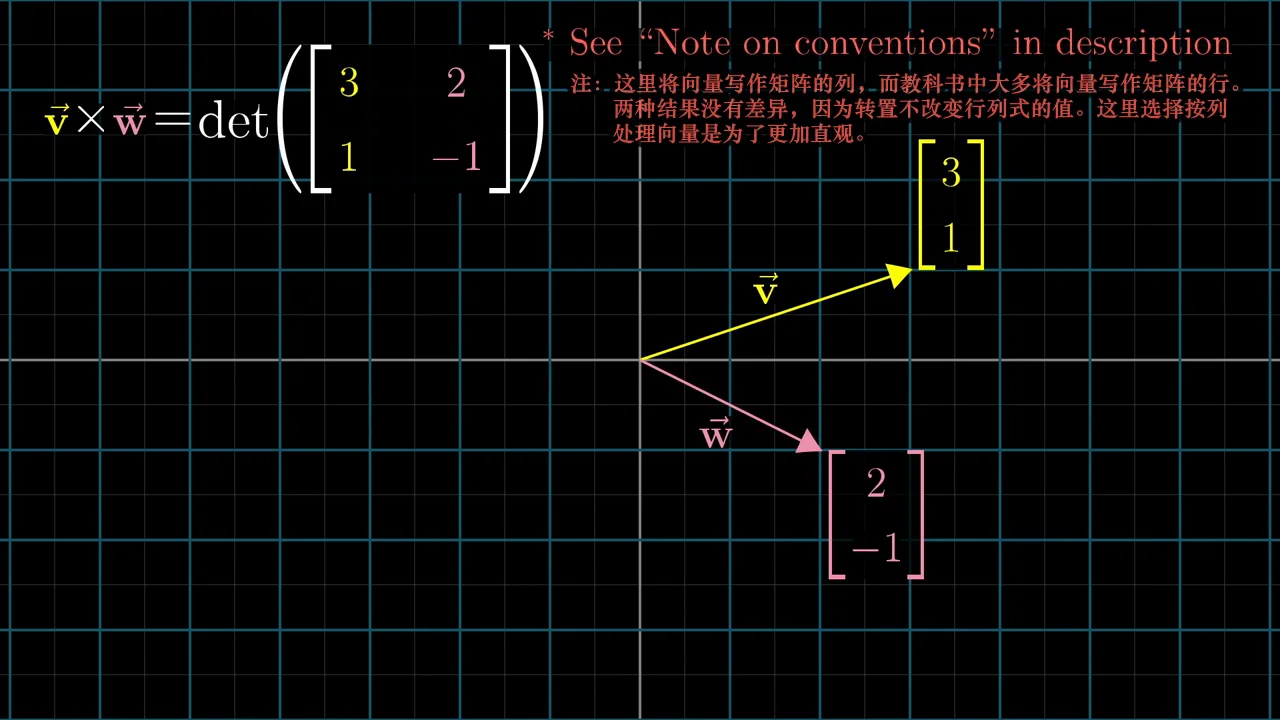
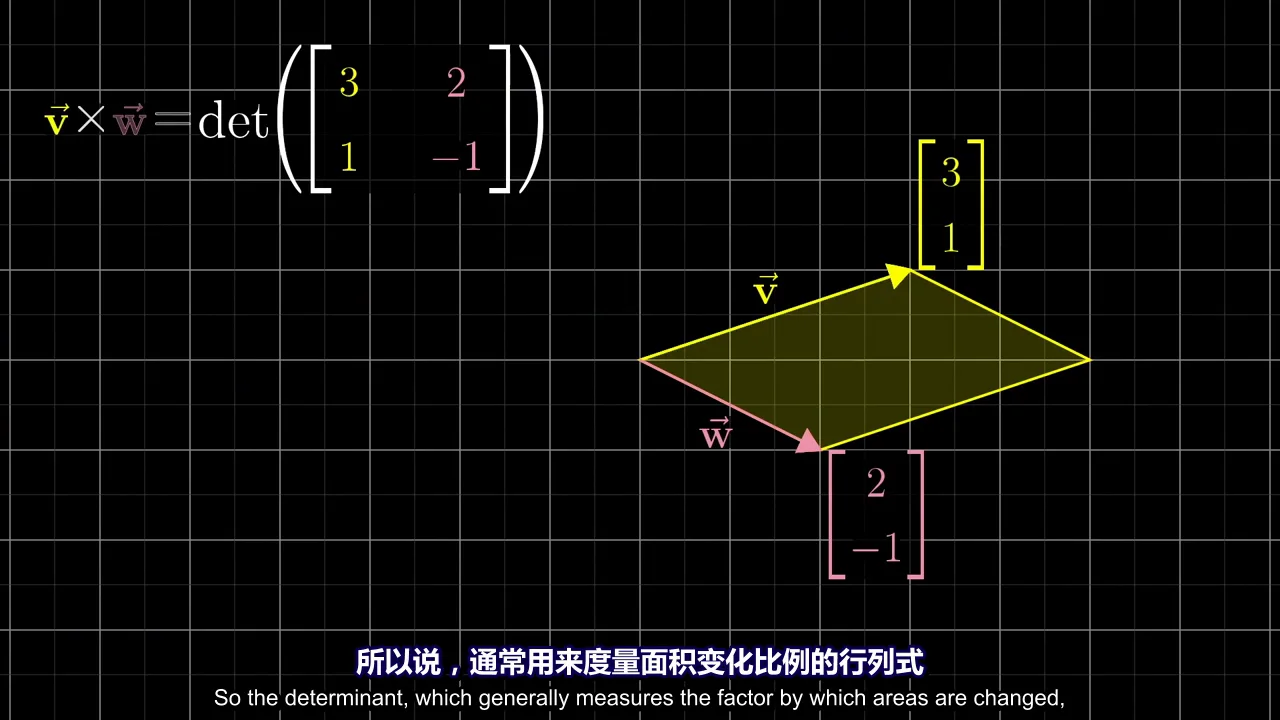
矩阵构造:将 $\vec{v}$ 和 $\vec{w}$ 的坐标依次排作 $2\times 2$ 矩阵的两列 02:51
矩阵构造:将 $\vec{v}$ 和 $\vec{w}$ 的坐标依次排作 $2\times 2$ 矩阵的两列画面重点:列向量 $[3,1]^T$ 与 $[2,-1]^T$ 填入 $2\times 2$ 矩阵
行列式解释:以 $\hat{\imath},\hat{\jmath}$ 为边的单位正方形(面积 $1$)被变换成 $\vec{v},\vec{w}$ 的平行四边形 03:25
行列式解释:以 $\hat{\imath},\hat{\jmath}$ 为边的单位正方形(面积 $1$)被变换成 $\vec{v},\vec{w}$ 的平行四边形画面重点:$\vec{v}\times\vec{w}=\det([3,2;1,-1])$ 与变换后平行四边形
数值算例:$\det([-3,2;1,1]) = (-3)\cdot 1 - 2\cdot 1 = -5$ 03:58
数值算例:$\det([-3,2;1,1]) = (-3)\cdot 1 - 2\cdot 1 = -5$画面重点:负行列式计算过程与左侧定向图形
夹角对面积的影响:两向量越接近垂直,平行四边形越饱满、叉积绝对值越大 04:28
夹角对面积的影响:两向量越接近垂直,平行四边形越饱满、叉积绝对值越大画面重点:More perpendicular $\Rightarrow \vec{v}\times\vec{w}$ is bigger
缩放律演示:将 $\vec{v}$ 拉伸为 $3\vec{v}$,平行四边形面积同步放大 $3$ 倍 04:45
缩放律演示:将 $\vec{v}$ 拉伸为 $3\vec{v}$,平行四边形面积同步放大 $3$ 倍画面重点:$(3\vec{v})\times\vec{w}$ 延伸后的三倍平行四边形面积
[02:16] ↗
不过,你当然想不依赖别人给出的答案,直接计算出它的面积
But of course, you want to be able to compute this without someone telling you the area.
[02:20] ↗
行列式就在这里起作用了
This is where the determinant comes in.
[02:23] ↗
如果你还没看过第五章中讨论行列式的部分 现在是个好机会去看一看
So if you didn't see chapter five of this series, where I talk about the determinant, now would be a really good time to go take a look.
[02:30] ↗
即便你已经看过了,不过时间有点久远 我还是推荐你再去复习一下,保证这些概念记忆犹新
Even if you did see it, but it was a while ago, I'd recommend taking another look just to make sure those ideas are fresh in your mind.
[02:37] ↗
对于二维向量的叉积 - v叉乘w 你需要将v的坐标作为矩阵的第一列 w的坐标作为矩阵的第二列 然后直接计算行列式
For the 2D cross product, v cross w, what you do is you write the coordinates of v as the first column of a matrix, and you take the coordinates of w and make them the second column, then you just compute the determinant.
[02:51] ↗
这是因为,由v和w的坐标为列所构成的矩阵 与一个将i帽和j帽分别移至v和w的线性变换相对应
This is because a matrix whose columns represent v and w corresponds with a linear transformation that moves the basis vectors i-hat and j-hat to v and w.
[03:06] ↗
行列式就是变换前后面积变化比例的度量 而我们关注的,就是以i帽和j帽为边的单位正方形
The determinant is all about measuring how areas change due to a transformation, and the prototypical area that we look at is the unit square resting on i-hat and j-hat.
[03:17] ↗
在变换之后,这个单位正方形变成我们关心的平行四边形
After the transformation, that square gets turned into the parallelogram that we care about.
[03:22] ↗
所以说,通常用来度量面积变化比例的行列式 在这里给出了平行四边形的面积 因为这个平行四边形来源于面积为1的正方形
So the determinant, which generally measures the factor by which areas are changed, gives the area of this parallelogram, since it evolved from a square that started with area one.
[03:33] ↗
更重要的是,如果v在w的左侧,也就是说变换后定向发生了改变 那么行列式就为负
What's more, if v is on the left of w, it means that orientation was flipped during that transformation, which is what it means for the determinant to be negative.
[03:44] ↗
举一个例子,比如说v的坐标为(-3, 1),w的坐标为(2, 1)
As an example, let's say v has coordinates negative 3, 1, and w has coordinates 2, 1.
[03:51] ↗
以它们的坐标为列构成的矩阵的行列式为(-3)×1-2×1 也就是-5
The determinant of the matrix with those coordinates as columns is negative 3 times 1 minus 2 times 1, which is negative 5.
[04:02] ↗
所以很显然,它们构成的平行四边形的面积为5 而且因为v在w的左侧,结果自然为负
So evidently, the area of the parallelogram they define is 5, and since v is on the left of w, it should make sense that this value is negative.
[04:11] ↗
对于你所学到的任何新的运算 我建议你在脑海里好好想象 只是为了能让你对它有一些直观感受(像是这里的叉积)
As with any new operation you learn, I'd recommend playing around with this notion a bit in your head, just to get kind of an intuitive feel for what the cross product is all about.
[04:20] ↗
比如说,你可能注意到一点,当两个向量垂直 或至少是接近垂直时 和它们指向接近时相比,此时的叉积更大 因为当两条边接近垂直时,平行四边形的面积会更大
For example, you might notice that when two vectors are perpendicular, or at least close to being perpendicular, their cross product is larger than it would be if they were pointing in very similar directions, because the area of that parallelogram is larger when the sides are closer to being perpendicular.
[04:37] ↗
你可能还注意到了其他的东西 如果你放大其中一个向量,比如将v放大为3倍 那么平行四边形的面积也同时放大为3倍
Something else you might notice is that if you were to scale up one of those vectors, perhaps multiplying v by 3, then the area of that parallelogram is also scaled up by a factor of 3.
[04:49] ↗
这也就是说,3v叉乘w正好是v叉乘w的3倍
So what this means for the operation is that 3v cross w will be exactly 3 times the value of v cross w.

真正的三维叉积:面积、法向与右手定则

⏱ 04:58 – 06:40
⚠️ 二维只是“伪叉积”,真正的叉积输出三维向量
严格来说,上述返回单个实数的二维运算并不是真正的叉积。真正的叉积输入两个三维向量 $\vec{v},\vec{w}\in\mathbb{R}^3$,输出的不是一个标量,而是一个新的三维向量 $\vec{p}=\vec{v}\times\vec{w}$。
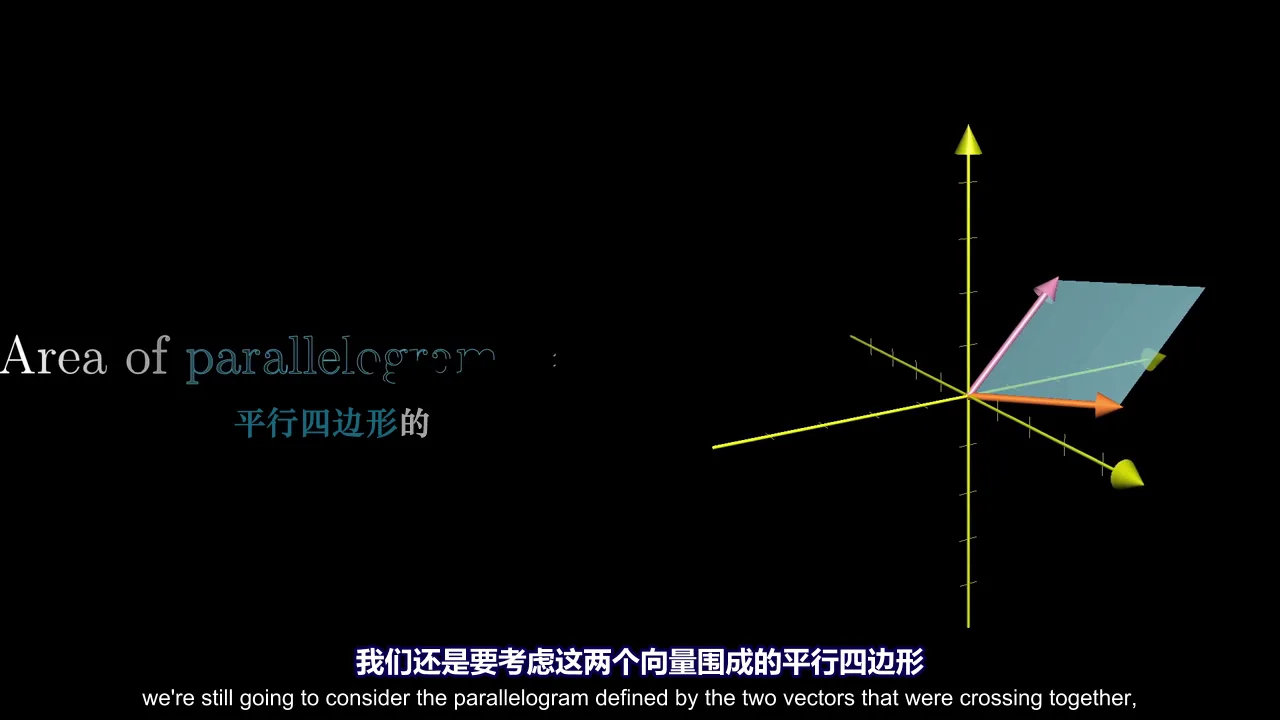
  • 长度:新向量 $\vec{v}\times\vec{w}$ 的模长等于 $\vec{v}$ 与 $\vec{w}$ 在三维空间中所张成平行四边形的面积。
  • 方向直线:该向量同时垂直于 $\vec{v}$ 和 $\vec{w}$(即垂直于平行四边形所在的平面)。
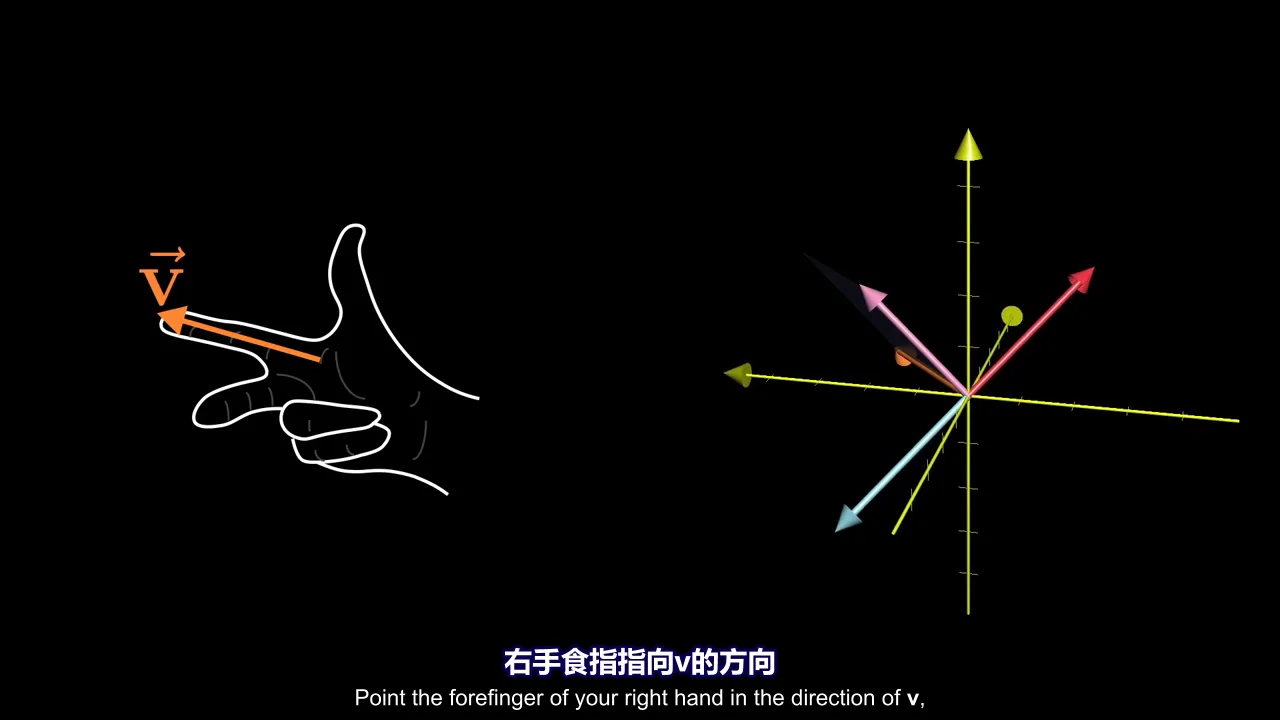
  • 正反抉择(右手定则):垂直于平面的两个相反方向中,伸出右手让食指指向 $\vec{v}$、中指指向 $\vec{w}$,此时竖起的大拇指所指方向即为 $\vec{v}\times\vec{w}$ 的方向。
📐 三维正交算例验证
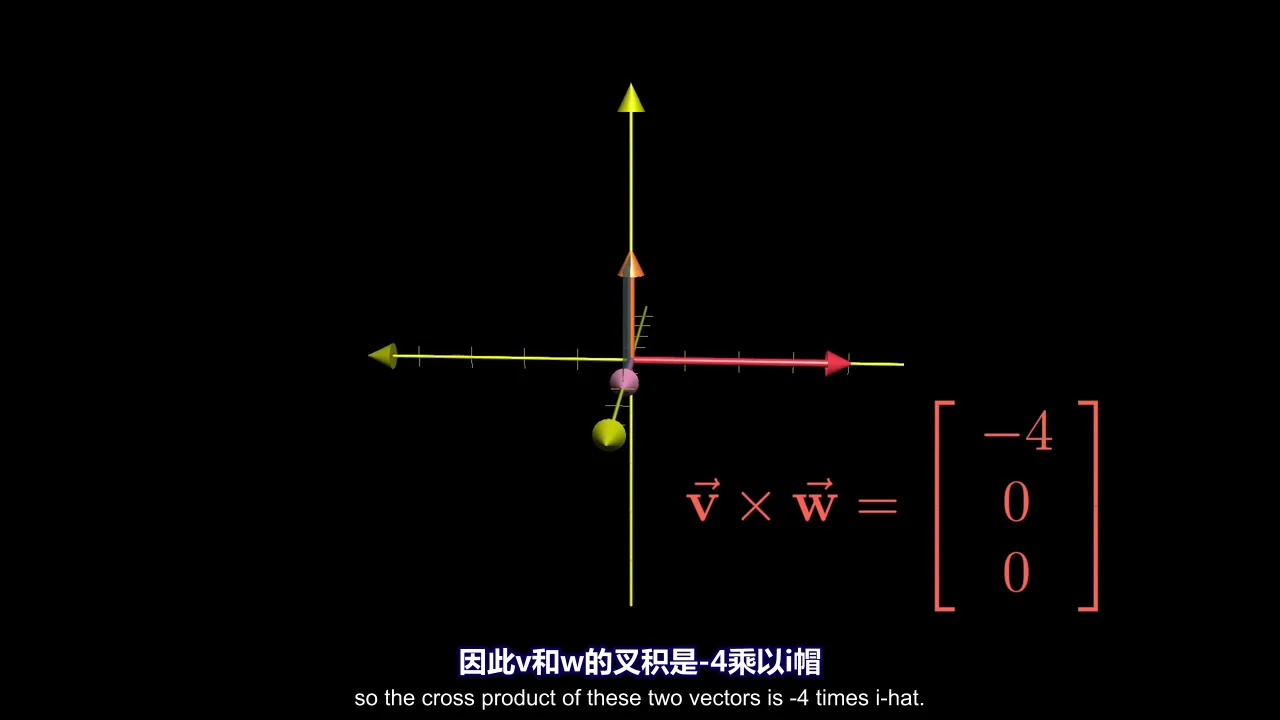
$$\vec{v}=\begin{bmatrix}0\\0\\2\end{bmatrix}=2\hat{k},\quad \vec{w}=\begin{bmatrix}0\\2\\0\end{bmatrix}=2\hat{\jmath}\;\Longrightarrow\; \vec{v}\times\vec{w} = \begin{bmatrix}-4\\0\\0\end{bmatrix} = -4\hat{\imath}$$
两向量正交且长均为 $2$,围成面积为 $4$ 的正方形;右手食指朝 $+z$、中指朝 $+y$,大拇指指向 $-x$ 方向。
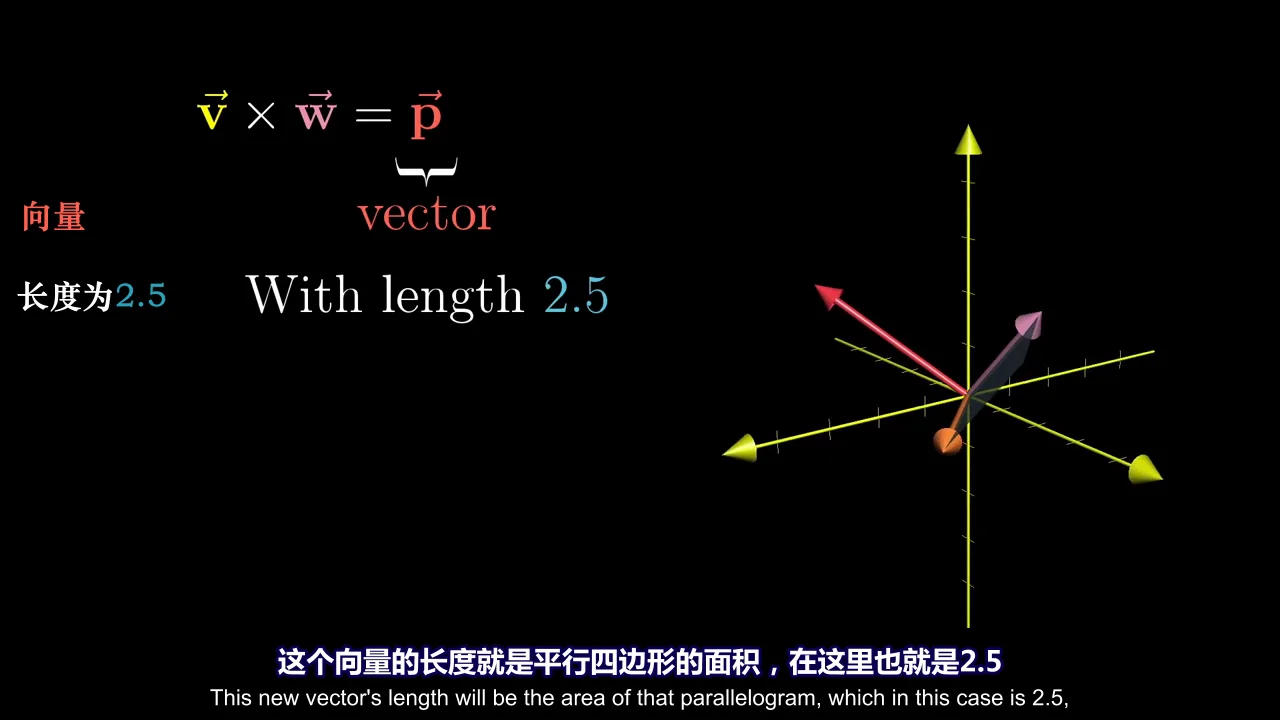
进入三维空间:两个三维向量张成一个倾斜于空间中的平行四边形(设面积为 $2.5$) 05:18
进入三维空间:两个三维向量张成一个倾斜于空间中的平行四边形(设面积为 $2.5$)画面重点:三维坐标系中的彩色矢量与蓝色平行四边形面
三维叉积定义:结果是一个长度为 $2.5$ 且垂直于该平行四边形的新向量 $\vec{p}$ 05:36
三维叉积定义:结果是一个长度为 $2.5$ 且垂直于该平行四边形的新向量 $\vec{p}$画面重点:$\vec{v}\times\vec{w}=\vec{p}$、With length 2.5 与垂线方向
右手定则图示:食指指向 $\vec{v}$、中指指向 $\vec{w}$,大拇指指向叉积向量方向 05:56
右手定则图示:食指指向 $\vec{v}$、中指指向 $\vec{w}$,大拇指指向叉积向量方向画面重点:左手侧右手手势示意图与三维坐标向量对照
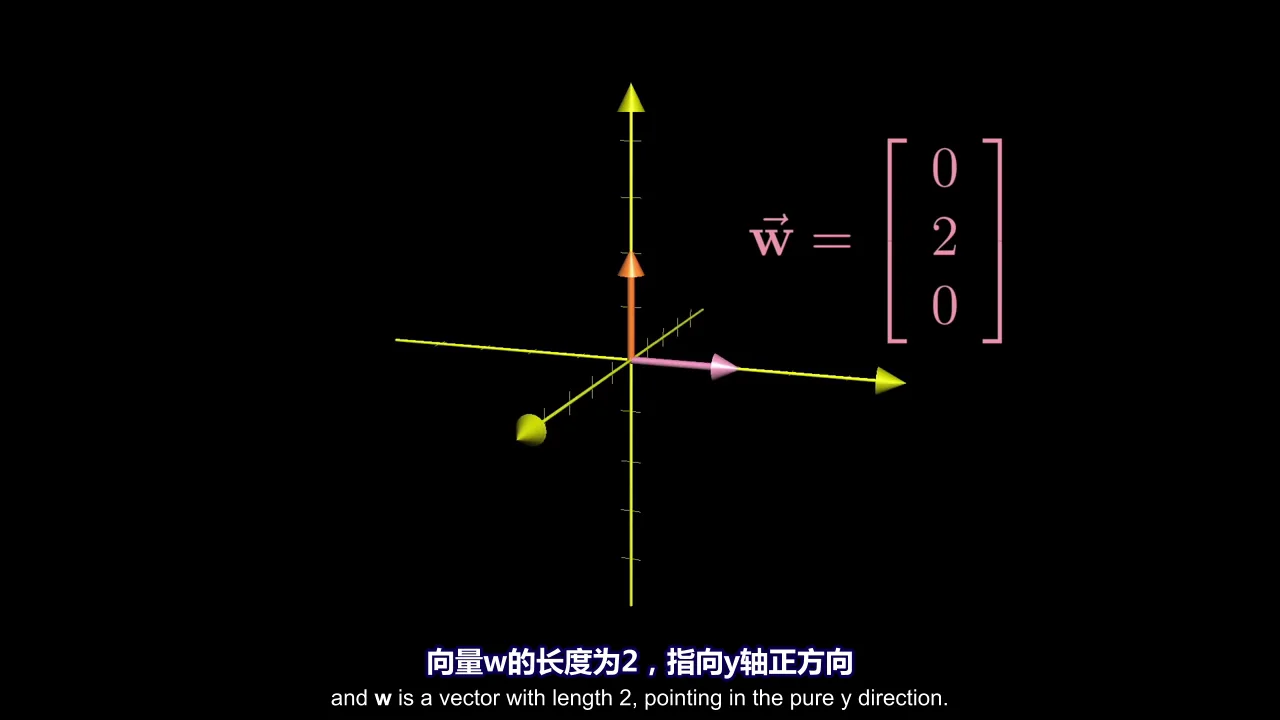
三维算例设置:$\vec{v}$ 沿 $+z$ 轴长为 $2$,$\vec{w}=[0,2,0]^T$ 沿 $+y$ 轴长为 $2$ 06:15
三维算例设置:$\vec{v}$ 沿 $+z$ 轴长为 $2$,$\vec{w}=[0,2,0]^T$ 沿 $+y$ 轴长为 $2$画面重点:垂直正交的 $\vec{v}$ 与 $\vec{w}$ 及面积为 $4$ 的正方形
由面积 $4$ 与右手定则判定指向 $-x$ 方向,得叉积向量 $[-4,0,0]^T=-4\hat{\imath}$ 06:38
由面积 $4$ 与右手定则判定指向 $-x$ 方向,得叉积向量 $[-4,0,0]^T=-4\hat{\imath}$画面重点:沿负 $x$ 轴伸出的结果向量 $\vec{v}\times\vec{w}=[-4,0,0]^T$
[04:58] ↗
即便上面这种数学运算看上去非常好 但是严格地讲,我刚才描述的东西并不是叉积
Now, even though all of this is a perfectly fine mathematical operation, what I just described is technically not the cross product.
[05:06] ↗
真正的叉积是通过两个三维向量生成一个新的三维向量
The true cross product is something that combines two different 3d vectors to get a new 3d vector.
[05:13] ↗
和之前一样 我们还是要考虑这两个向量围成的平行四边形 而这个平行四边形的面积依然会发挥重要的作用
Just as before, we're still going to consider the parallelogram defined by the two vectors that we're crossing together, and the area of this parallelogram is still going to play a big role.
[05:23] ↗
说得具体一些,比如这两个向量围成的平行四边形的面积为2.5
To be concrete, let's say that the area is 2.5 for the vectors shown here.
[05:27] ↗
但是我之前提到,叉积的结果不是一个数,而是一个向量
But as I said, the cross product is not a number, it's a vector.
[05:31] ↗
这个向量的长度就是平行四边形的面积,在这里也就是2.5 而这个向量的方向与平行四边形(所在的面)垂直
This new vector's length will be the area of that parallelogram, which in this case is 2.5, and the direction of that new vector is going to be perpendicular to the parallelogram.
[05:43] ↗
不过是哪边呢?
But which way, right?
[05:44] ↗
因为长度为2.5并且垂直于给定面的向量有两个
I mean, there are two possible vectors with length 2.5 that are perpendicular to a given plane.
[05:51] ↗
这里就需要用到右手定则
This is where the right hand rule comes in.
[05:53] ↗
右手食指指向v的方向 伸出中指指向w的方向
Point the forefinger of your right hand in the direction of v, then stick out your middle finger in the direction of w.
[06:00] ↗
当你把大拇指竖起来时,它所指的方向就是叉积的方向
Then, when you point up your thumb, that's the direction of the cross product.
[06:08] ↗
比如说,假设向量v的长度为2,指向z轴正方向 向量w的长度为2,指向y轴正方向
For example, let's say that v was a vector with length 2 pointing straight up in the z direction, and w is a vector with length 2 pointing in the pure y direction.
[06:18] ↗
在这个简单的例子里,它们围成的图形实际上是正方形 因为它们相互垂直且长度相同 又因为正方形的面积为4
The parallelogram that they define in this simple example is actually a square, since they're perpendicular and have the same length, and the area of that square is 4.
[06:26] ↗
所以它们的叉积是一个长度为4的向量
So their cross product should be a vector with length 4.
[06:30] ↗
根据右手定则,它们的叉积应该指向x轴负方向
Using the right hand rule, their cross product should point in the negative x direction.
[06:36] ↗
因此v和w的叉积是-4乘以i帽
So the cross product of these two vectors is negative 4 times i-hat.

三阶“伪行列式”计算技巧与伏笔

⏱ 06:46 – 08:41

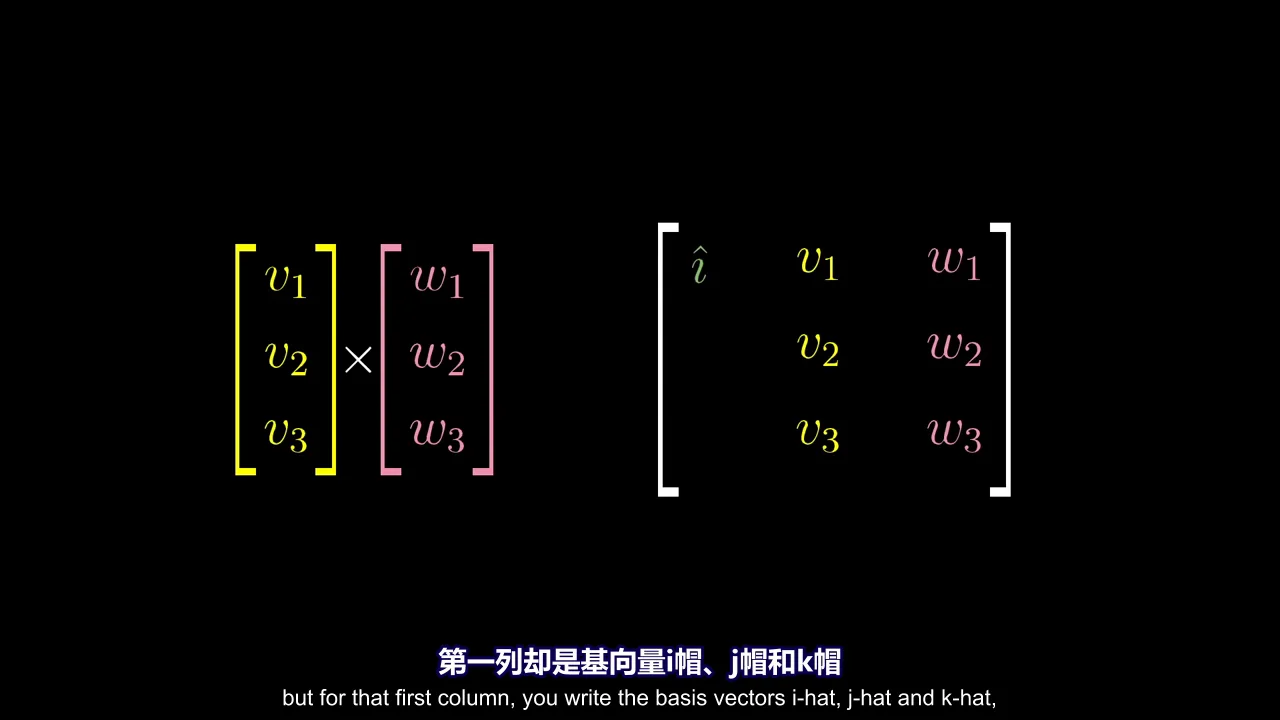
面对任意两个三维向量的坐标,教科书通常给出一个看似荒诞却极其好用的“符号技巧”:构造一个 $3\times 3$ 矩阵,第二、三列分别填入 $\vec{v}$ 和 $\vec{w}$ 的坐标,但第一列却放入三个标准基向量符号 $\hat{\imath}$、$\hat{\jmath}$、$\hat{k}$。
📐 三阶伪行列式展开
$$\det\begin{bmatrix} \hat{\imath} & v_1 & w_1 \\ \hat{\jmath} & v_2 & w_2 \\ \hat{k} & v_3 & w_3 \end{bmatrix} = (v_2 w_3 - v_3 w_2)\hat{\imath} + (v_3 w_1 - v_1 w_3)\hat{\jmath} + (v_1 w_2 - v_2 w_1)\hat{k}$$
暂时把 $\hat{\imath},\hat{\jmath},\hat{k}$ 当作普通数来展开行列式,收集到的三个系数恰好构成满足垂直、面积长度与右手定则的唯一向量。
💡 这绝不只是“符号魔术”
把向量塞进矩阵第一列看起来像胡闹,但它背后其实隐藏着深刻的几何原因:为何行列式会再度现身?为何恰好是基向量占据了第一列?答案正要动用上一讲学到的对偶性(Duality)——我们将在下一集用无比优雅的几何论证揭晓全部谜底。
三阶伪行列式构造:第一列填入基向量 $\hat{\imath},\hat{\jmath},\hat{k}$,第二、三列填入 $\vec{v},\vec{w}$ 坐标 07:08
三阶伪行列式构造:第一列填入基向量 $\hat{\imath},\hat{\jmath},\hat{k}$,第二、三列填入 $\vec{v},\vec{w}$ 坐标画面重点:第一列含 $\hat{\imath},\hat{\jmath},\hat{k}$ 的 $3\times 3$ 矩阵
按第一列展开该伪行列式,得到以 $\hat{\imath},\hat{\jmath},\hat{k}$ 为基底的线性组合坐标公式 07:31
按第一列展开该伪行列式,得到以 $\hat{\imath},\hat{\jmath},\hat{k}$ 为基底的线性组合坐标公式画面重点:$\hat{\imath}(v_2w_3-v_3w_2)+\hat{\jmath}(v_3w_1-v_1w_3)+\hat{k}(v_1w_2-v_2w_1)$ 展开式
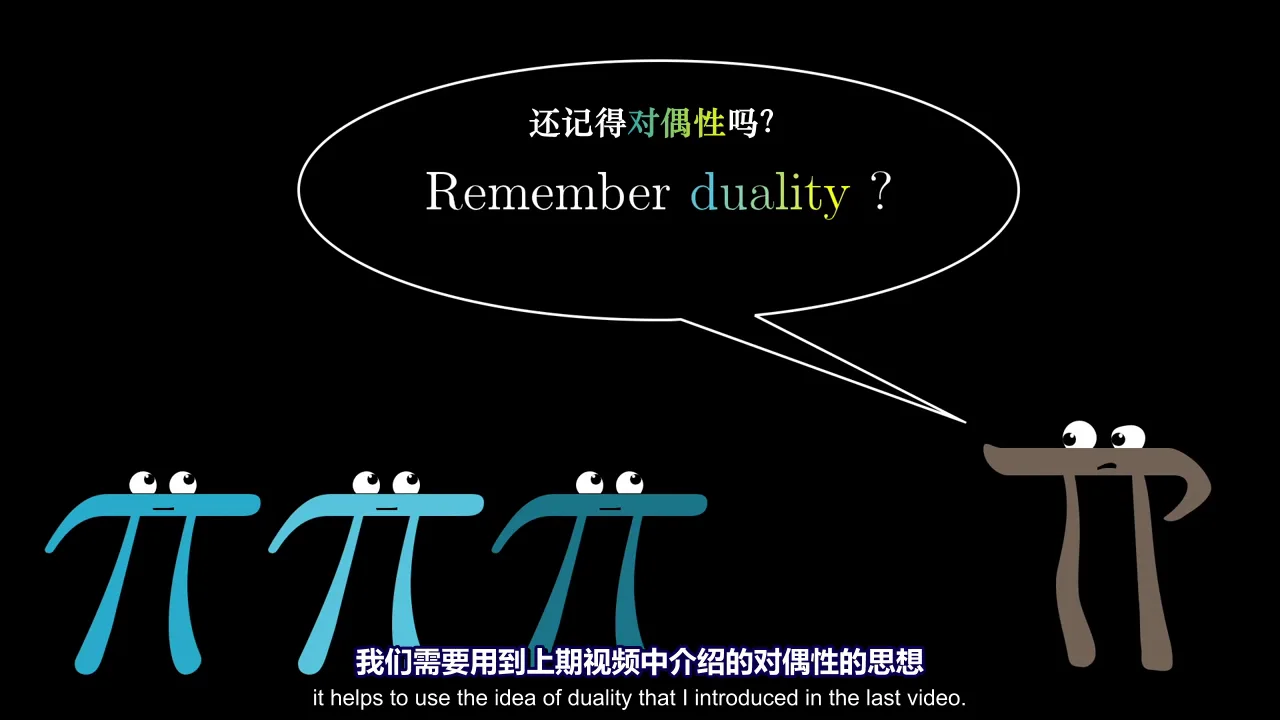
埋下伏笔:理解这一行列式技巧几何来源的关键,在于上一讲引入的对偶性思想 08:10
埋下伏笔:理解这一行列式技巧几何来源的关键,在于上一讲引入的对偶性思想画面重点:Pi 角色思考“Remember duality?”气泡画面
[06:46] ↗
对于更一般的情况,如果你愿意的话,这里有个公式可以让你记忆 但是它可以由一个三阶行列式代替,使这种运算记忆起来更加简便
For more general computations, there is a formula that you could memorize if you wanted, but it's common and easier to instead remember a certain process involving the 3D determinant.
[06:55] ↗
这个过程乍一看非常奇怪
Now, this process looks truly strange at first.
[06:59] ↗
你写下一个三阶矩阵 第二列和第三列分别为v和w的坐标
You write down a 3D matrix where the second and third columns contain the coordinates of v and w.
[07:06] ↗
第一列却是基向量i帽、j帽和k帽
But for that first column, you write the basis vectors i-hat, j-hat, and k-hat.
[07:11] ↗
然后计算这个矩阵的行列式
Then you compute the determinant of this matrix.
[07:15] ↗
很明显,令人糊涂的地方在这里
The silliness is probably clear here.
[07:17] ↗
让向量作为一个矩阵元究竟是什么意思?
What on earth does it mean to put in a vector as the entry of a matrix?
[07:21] ↗
老师经常告诉学生,这只是符号上的技巧
Students are often told that this is just a notational trick.
[07:26] ↗
假装i帽、j帽和k帽都是数,当你进行计算时 最终得到的是这三个基向量的线性组合
When you carry out the computations as if i-hat, j-hat, and k-hat were numbers, then you get some linear combination of those basis vectors.
[07:36] ↗
学生也只是相信,这个线性组合所决定的向量 是唯一一个与v和w垂直 长度为v和w围成的平行四边形的面积 并且遵循右手定则的向量
And the vector defined by that linear combination, students are told to just believe, is the unique vector perpendicular to v and w, whose magnitude is the area of the appropriate parallelogram, and whose direction obeys the right hand rule.
[07:51] ↗
当然从某种意义上说,这就是符号上的技巧,但是这么做是有原因的
And sure, in some sense this is just a notational trick, but there is a reason for doing it.
[07:58] ↗
行列式重要性的体现并非完全巧合
It's not just a coincidence that the determinant is once again important.
[08:02] ↗
基向量作为矩阵元也不是信手而为
And putting the basis vectors in those slots is not just a random thing to do.
[08:06] ↗
要想理解这一切的源头 我们需要用到上期视频中介绍的对偶性的思想
To understand where all of this comes from, it helps to use the idea of duality that I introduced in the last video.
[08:13] ↗
这一概念的介绍略显繁重 所以我将它单独放在后续视频当中,以便有兴趣的朋友继续学习
This concept is a little bit heavy though, so I'm putting it in a separate follow-on video for any of you who are curious to learn more.
[08:20] ↗
可以说,这一部分不在线性代数的本质当中
Arguably, it falls outside the essence of linear algebra.
[08:23] ↗
它的重要性在于让你了解叉积所得向量的几何意义
The important part here is to know what that cross product vector geometrically represents.
[08:28] ↗
所以如果你想跳过下期视频,请自便
So if you want to skip that next video, feel free.
[08:31] ↗
但是如果你愿意更深入地了解 或者对叉积运算和潜在几何直观的联系感到好奇 下期视频的内容是数学中的一个精妙思想
But for those of you who are willing to go a bit deeper, and who are curious about the connection between this computation and the underlying geometry, the ideas that I'll talk about in the next video are just a really elegant piece of math.

📝 几何直觉自测(点击题目展开解答)

Q1. 在二维向量叉积 $\vec{v}\times_{2\mathrm{D}}\vec{w}$ 中,如何根据 $\vec{v}$ 与 $\vec{w}$ 的相对方位快速判断正负号?▼
以标准基向量的正序 $\hat{\imath}\times\hat{\jmath}=+1$ 为锚点:$\hat{\imath}$ 位于 $\hat{\jmath}$ 的右侧,因此只要 $\vec{v}$ 位于 $\vec{w}$ 的右侧(从 $\vec{v}$ 逆时针转最小角到 $\vec{w}$),结果就是正的平行四边形面积;若 $\vec{v}$ 在 $\vec{w}$ 左侧,则结果为负面积。
Q2. 为什么可以用以 $\vec{v}$、$\vec{w}$ 为列的 $2\times 2$ 矩阵行列式来计算二维有向面积?▼
该矩阵对应的线性变换会把由 $\hat{\imath}$、$\hat{\jmath}$ 张成的单位正方形(面积 $1$)变换成由 $\vec{v}$、$\vec{w}$ 张成的平行四边形;而行列式度量线性变换的面积缩放比例并在空间定向翻转时取负号,因此行列式数值恰好等于有向面积。
Q3. 已知 $\vec{v}=2\hat{k}$、$\vec{w}=2\hat{\jmath}$,不套用坐标公式,如何直接用几何性质求出 $\vec{v}\times\vec{w}$?▼
两向量正交且长度皆为 $2$,张成边长为 $2$、面积为 $4$ 的正方形,故叉积长度为 $4$;同时垂直于 $z$ 轴与 $y$ 轴的直线是 $x$ 轴;用右手定则(食指 $+z$、中指 $+y$),大拇指指向 $-x$,因此 $\vec{v}\times\vec{w}=-4\hat{\imath}$。
Q4. 三维叉积在什么情况下会等于零向量 $\vec{0}$?几何意义是什么?▼
当 $\vec{v}$ 与 $\vec{w}$ 共线(夹角为 $0^\circ$ 或 $180^\circ$)或其中至少有一个为零向量时,它们张成的平行四边形退化为一条线段或一个点,面积为 $0$,因此叉积长度为 $0$,即等于零向量。